
I used to draw support and resistance like I was decorating a crime scene. Swing high here. Trendline there. Round number because it looked important. Then NQ would slice through my beautiful little art project like it owed me money. The lesson was humiliating and useful: price does not care where I drew a line. Price cares where size actually traded.
Volume Profile is the first indicator in the Sage Trading System — the WHERE. It does not tell you direction. It does not give you entry signals. What it does is show you the prices where institutions parked their capital. Those prices become the levels that matter — not because you drew a line there, but because real money is anchored there.
Bad support and resistance is a horoscope with candles. Volume Profile is a receipt.
If these terms are new, keep this sequence open while reading: STS overview for the system map, this post for the auction levels, QPulse for timing, and POC Bounce Long for the first practical playbook.
Beginner Auction Glossary
Why Traditional Support/Resistance Fails
Traditional S/R is drawn from price action — swing highs, swing lows, round numbers. The problem? Price action alone doesn't tell you why a level should hold. A swing low could be random noise. A round number could be psychologically meaningless in the current context.
Volume Profile solves this by showing you volume at each price — not over time (like a standard volume bar), but distributed vertically across the price axis. A price level with massive volume means thousands of contracts were exchanged there. Institutions built positions. They have skin in the game at that price. When price returns, they defend it.
A price level with almost no volume? Price slices through it like it doesn't exist. Because, in volume terms, it doesn't. Nobody traded there. Nobody cares about defending it.
The Key Levels
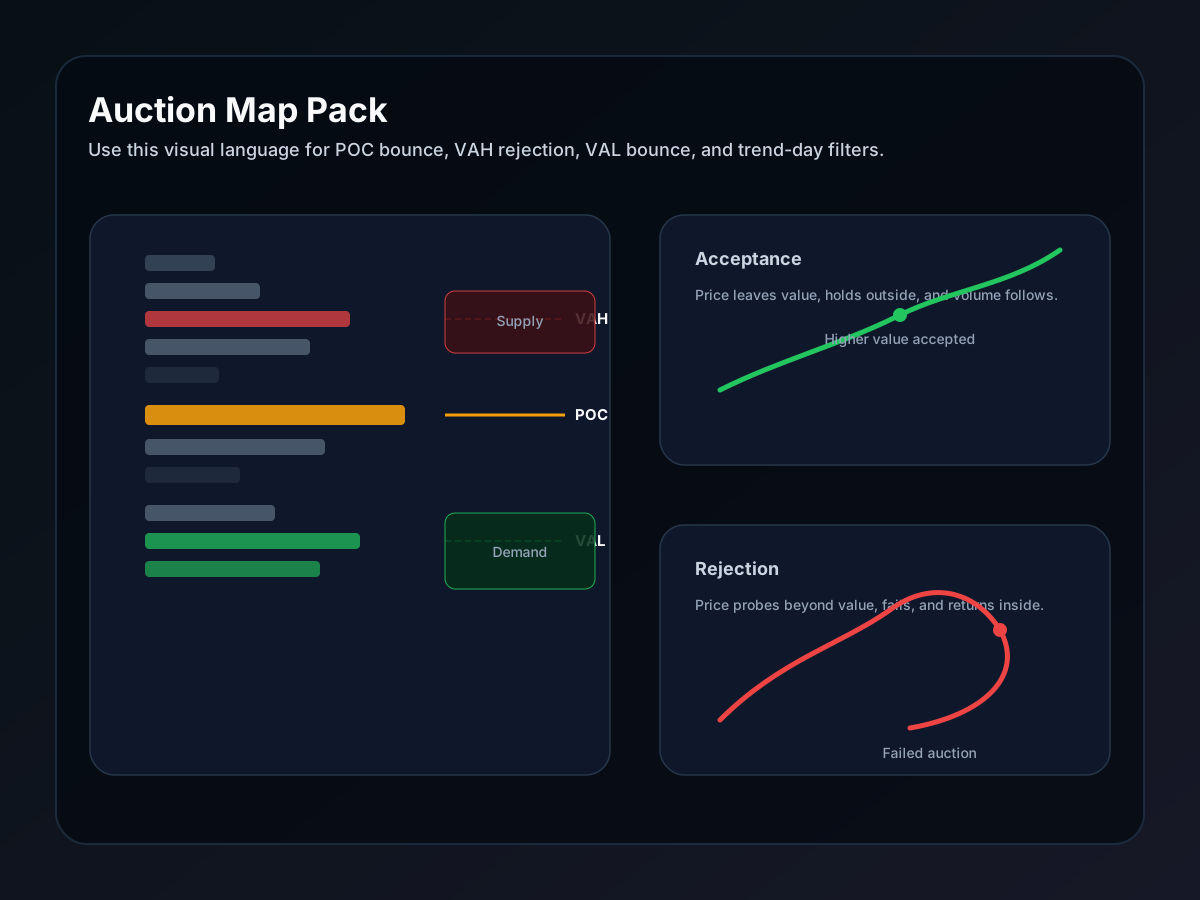
Volume Profile produces six levels that form the backbone of every STS trade. Here's what each one means and how it behaves:
The single price with the most volume in the session. This is where the market agreed on fair value. Think of it as the price where the most negotiation happened — the most buying AND selling occurred at this exact level.
The upper boundary of the range where 70% of all volume traded. This is statistical resistance — not a line you drew, but a mathematically derived boundary where the majority of business was conducted.
The lower boundary of the 70% value area. Statistical support. The price where the market said "below this, we're undervalued."
Prices with significantly above-average volume. Clusters of HVNs form the Supply and Demand zones that institutions defend. Price tends to slow down and consolidate at HVNs.
Prices with minimal volume — gaps in the profile. Price moves fast through LVNs because nobody has positions to defend there. These are the acceleration zones between levels.
Supply and Demand Zones
When three or more consecutive HVN rows cluster together, they form a zone — a price range where institutions built significant positions. These zones are the highest-probability levels in STS.
- Demand Zones (below POC) — where buyers previously accumulated. When price returns to a Demand Zone, those buyers tend to defend their positions. This is where long setups develop.
- Supply Zones (above POC) — where sellers previously distributed. When price rises into a Supply Zone, selling pressure returns. This is where short setups develop.
The key insight: these zones are not arbitrary lines. They're derived from actual traded volume. When you see a Demand Zone with 65%+ buy-dominant delta, you're seeing a price range where institutions committed capital on the long side. They have a vested interest in defending that level. That's why it holds.
The 5 Layers of Nexural Volume Profile
The VP I built for the Sage Trading System isn't a basic profile with POC and value area. It's a 5-layer system, and understanding each layer gives you progressively deeper insight into what the market is actually doing.
Value Area Overlap: Reading the Day Type
One of the most powerful features of VP is the Value Area overlap classifier. By comparing today's developing value area to yesterday's, you can identify the type of day you're trading — before the day unfolds. This changes which setups you take.
What Each Day Type Looks Like on a Chart
This is critical because it changes which setups work. The POC Bounce — one of STS's core playbooks — works beautifully on Inside and Partial overlap days. On No Overlap days? POC gets steamrolled. Knowing the day type prevents you from taking a setup that has no chance of working.
That last sentence is where money gets saved. The level can be real and still be the wrong level to trade today. A prior POC on a no-overlap trend day is not support. It is a speed bump.
Naked POCs: The Magnetic Levels
A Naked POC is a prior session's Point of Control that price never revisited. These are some of the most reliable levels in all of trading.
Why? Because the POC represents where the market agreed on fair value during that session. If price moved away and never came back, there's unfinished business at that level. The auction is incomplete. Markets are auction processes — they tend to complete their auctions. Price is drawn back to Naked POCs like a magnet.
When two or more Naked POCs cluster within a tight range, the pull compounds. I've seen price travel 100+ points on NQ to fill a Naked POC cluster. It's one of the highest-probability setups in STS — Playbook 5: Naked POC Magnet.
How VP Fits Into STS
Volume Profile answers one question: WHERE. It gives you the levels. But it doesn't tell you when to enter or whether there's enough flow to support a move. That's why STS uses three indicators, not one.
- VP identifies the level — price pulls back to a Demand Zone, POC, or VAL
- QPulse triggers the entry — zero-line cross at the VP level
- Flow Pro confirms the activity — actual buying/selling volume present
Without VP, QPulse crosses are meaningless — you're entering at random prices. Without QPulse, VP levels are just interesting lines — you have no timing mechanism. Without Flow Pro, the first two might align but there's no volume to support the move. All three must agree.
That's the elegance of the system. Each indicator has one job. No overlap. No redundancy. No ambiguity.
When Volume Profile Lies to You
Volume Profile is not holy scripture. It fails when the auction changes. CPI, FOMC, trend days, thin holiday sessions, and overnight headline shocks can make yesterday's carefully built profile irrelevant by 9:35 AM. If value is migrating and you keep fading old levels, you are not trading structure. You are arguing with the tape.
My rule is simple: if today's value area has no overlap with yesterday's, I stop treating prior POC as a bounce level. I treat it as information. Big difference. A level worth watching is not automatically a level worth trading.
Source and Risk Notes
Volume Profile is an auction-context tool. It can help identify where prior trading activity concentrated, but current price behavior still has to confirm whether that history matters today.
- NinjaTrader documents Order Flow Volume Profile as a way to display volume at price and identify value-area and profile references.
- CME and CFTC glossary materials are useful references for futures terminology, contract structure, and risk language used in this guide.
- POC, VAH, VAL, HVN, and LVN are context levels, not automatic buy or sell signals.
- This article is educational. Futures markets are leveraged, fast moves can slip stops, and profile levels can fail during news, trend days, and liquidity shocks.
Reference links: NinjaTrader Order Flow Volume Profile guide, NinjaTrader volume profile education, CME glossary, and CFTC futures glossary.
"The VP doesn't tell you direction — it just gives you areas to pay attention to. That's all you need. When price reaches a level where real money traded, pay attention. When it reaches a level where nobody traded, price will slice through it. The VP makes the invisible visible."
Getting Started with VP
If you're new to Volume Profile, here's where to start:
- Add VP to a 3-minute NQ or ES chart. Set 360-bar lookback, RTH filter on (0930-1600), 100 price rows.
- Mark three levels: POC, VAH, VAL. Just these three. Get comfortable identifying them before adding anything else.
- Watch how price behaves at these levels. Don't trade yet. Just observe. You'll see price slow down at HVNs, accelerate through LVNs, bounce off VAL, and get rejected at VAH.
- After one week of observation, start identifying Supply and Demand zones. Look for clusters of 3+ HVN rows. Mark them.
- After two weeks, start noting Naked POCs from prior sessions. Watch how price is drawn to them.
Don't rush this. VP is the foundation of everything in STS. If your VP reads are wrong, your entries will be at the wrong levels, your stops will be in the wrong places, and your R:R will be garbage. Layer it with the GEX regime before the open so you know whether today favors mean reversion or continuation. Final rule: never trade a line you cannot defend with volume. If the level has no auction evidence behind it, it is not structure. It is decoration.
Read QPulse and the Zero-Line Cross next if you want the timing layer. VP tells you where the trade can happen. QPulse tells you when the crowd starts moving.
Turn auction levels into a tradable sequence
A level is not a trade. Pair the level with timing, flow, and a defined playbook.


