

You're watching NQ on the 3-minute chart. Price pulls back to a Demand Zone at 21,320. QPulse crosses zero from negative to positive. Flow Pro lights up with green stacks and a 3:1 buy imbalance glow. The 15-minute structure is bullish. Every single box is checked. This is the setup. And I still managed to turn it into garbage because I wanted to feel safer before doing the thing my own system told me to do.
But you hesitate. "Let me see one more candle to confirm." Price moves to 21,335. "Okay, one more." 21,350. Now you're nervous — the move is happening without you. FOMO kicks in. You enter at 21,365, four candles after the cross.
Your stop is still at 21,270 — that's where the thesis is invalidated, and that hasn't changed. But your entry has. And that changes everything. This is why the timing layer from QPulse only works when the execution is immediate enough to preserve the original R:R.
The bad belief this post is killing: confirmation is free. It is not. Confirmation has a price, and on fast futures tape that price is usually worse entry, wider risk, smaller reward, and a beautiful little story you tell yourself after you just bought the top of your own setup.
Use this with the R-multiple calculator open. The rule is not about being fast for the sake of being fast. It is about knowing when the trade you planned has mathematically become a different trade.
The Math That Proves It
Let's run the exact numbers for the same setup at four different entry points. The stop doesn't move. The target doesn't move. The only variable is when you entered.
| Entry Candle | Entry Price | Stop (fixed) | Target (fixed) | Risk (pts) | Reward (pts) | R:R | Verdict |
|---|---|---|---|---|---|---|---|
| 1st candle | 21,320 | 21,270 | 21,480 | 50 | 160 | 3.2:1 | TAKE IT |
| 2nd candle | 21,335 | 21,270 | 21,480 | 65 | 145 | 2.2:1 | BORDERLINE |
| 3rd candle | 21,350 | 21,270 | 21,480 | 80 | 130 | 1.6:1 | PASS |
| 4th+ candle | 21,365 | 21,270 | 21,480 | 95 | 115 | 1.2:1 | CHASING |
Read that slowly. The same setup. The same thesis. The same stop and target. The only difference is 45 points of entry slippage — about 13 minutes on a 3-minute chart. And the R:R collapsed from 3.2:1 to 1.2:1.
At 3.2:1, you need to win 24% of the time to break even. At 1.2:1, you need to win 45%. That's not a slight downgrade — that's a completely different trade with completely different math. The 1st candle entry is an asymmetric bet. The 4th candle entry is a coin flip with worse odds.
R:R Degradation Per Candle
The Double Penalty of Late Entries
Entering late doesn't just shrink your reward. It expands your risk. That's the double penalty most traders don't see until it's too late.
When you enter at 21,320 (1st candle), your risk to the stop at 21,270 is 50 points. When you enter at 21,365 (4th candle), your risk to the same stop is 95 points. Your risk nearly doubled. Your reward shrank by 28%. And your position size — if you're sizing correctly based on risk — dropped from 2 contracts to 1.
That's a $410 difference in profit potential — on a single trade — from 12 minutes of hesitation. Over 20 trades a month where this pattern repeats, that's $8,200 in lost potential. Per month. That's not a rounding error. That's the difference between a growing account and a stagnant one.
Why Traders Chase: The FOMO Anatomy
If the math is so clear, why does anyone enter late? Because FOMO isn't a logical process — it's an emotional hijack. Here's exactly how it works:
Every step in that spiral feels reasonable in the moment. That's what makes it dangerous. The "confirmation" you waited for was actually the move you were supposed to be on. The "entry" you took was actually a chase. And the "trade" you're managing is actually a gamble with terrible R:R.
The book I wrote — The Asymmetric Investor — has an entire chapter on this: FOMO is the R:R killer. Not because it makes you enter bad trades (though it does), but because it destroys the math on trades that might otherwise have been good. The same instrument, entered with discipline at the signal, offers 3.2:1. Entered after chasing, it's 1.2:1. Same chart. Same day. Completely different R:R.
Hesitation Autopsy
| What I Said | What It Meant | Cost |
|---|---|---|
| "One more candle." | I did not trust the prep. | -1.0R quality |
| "It still looks good." | I was comparing the chart, not the math. | wider stop |
| "I can't miss this." | The trade had already become emotional. | bad execution |
The Antidote: Making the Rule Mechanical
The 1-3 candle rule isn't a guideline. It's a hard rule. Here's how to make it impossible to break:
- Set a visual timer. When QPulse crosses zero, you have the duration of 3 candles to act. On a 3-minute chart, that's 9 minutes. After 9 minutes, the trade is dead. Move on.
- Pre-calculate R:R at each candle. Before the session, know your stop and target. As price moves away from the VP level, mentally update the R:R. The moment it drops below 3:1, the trade is invalid — regardless of how "good" it looks.
- Keep a "missed trade" journal. Every time you let a valid 1st-candle entry pass, write it down. Note the R:R you would have had. After 20 entries, review: how many of those missed setups would have been winners? This data will cure your hesitation faster than any motivational quote.
- Use the phrase. When you miss a setup, say it out loud: "If I missed it, I missed it. The next setup will come." It sounds trivial. It works. It breaks the FOMO loop by acknowledging the miss and redirecting to the future.
What the Data Actually Shows
I've tracked over 500 STS trades. Here's what the entry timing data reveals:
The 1st candle entry has a 47% win rate with an average 3.4:1 R:R. That's an expectancy of +$1.10 per dollar risked. The 4th+ candle entry has a 29% win rate with 1.1:1 R:R. That's an expectancy of -$0.39 per dollar risked. The same setup, entered late, has negative expectancy. You're literally paying the market to take your money.
The win rate drops because late entries have wider stops relative to the move remaining. The R:R drops because the reward has already been partially consumed by the move you missed. Both factors compound to turn a positive-expectancy system into a negative-expectancy one — simply by being 4 candles late.
The Deeper Lesson: Speed Is Part of the Edge
Most trading education treats entry timing as a secondary concern. "Get the direction right and the timing will work itself out." That's wrong. In day trading futures, timing IS the edge.
A 15-point difference in entry price on NQ doesn't sound like much. But at 50 points of stop distance, 15 points is a 30% increase in risk. At 160 points of target distance, 15 points is a 9% decrease in reward. Combined, a 15-point entry delay degrades your R:R by roughly 40%. Forty percent — from one candle of hesitation.
This is why STS says to enter on the QPulse cross itself, not on the candle close. This is why the 1-3 candle window is hard, not soft. This is why "I'll wait for one more candle to confirm" is one of the most expensive sentences in trading.
Speed of entry isn't about being reckless. It's about being prepared. When you've marked your VP levels before the session, when you've identified which direction the 15m supports, when you're watching QPulse approach zero — the entry should feel almost automatic. The preparation was the analysis. The entry is just execution.
When the 1-3 Candle Rule Does Not Apply
The rule is for STS trigger entries, not every possible trade on earth. If you are trading a new setup after a fresh base forms, a retest creates a second valid structure, or the market gives you a new Volume Profile level with fresh Flow Pro participation, that is a new trade. Fine. Take the new trade if the math works.
What you do not get to do is rename a chase as a new setup because you are annoyed you missed the first one. If the stop is still tied to the original level and the target is still the original target, you are late. No amount of candle poetry changes the R:R.
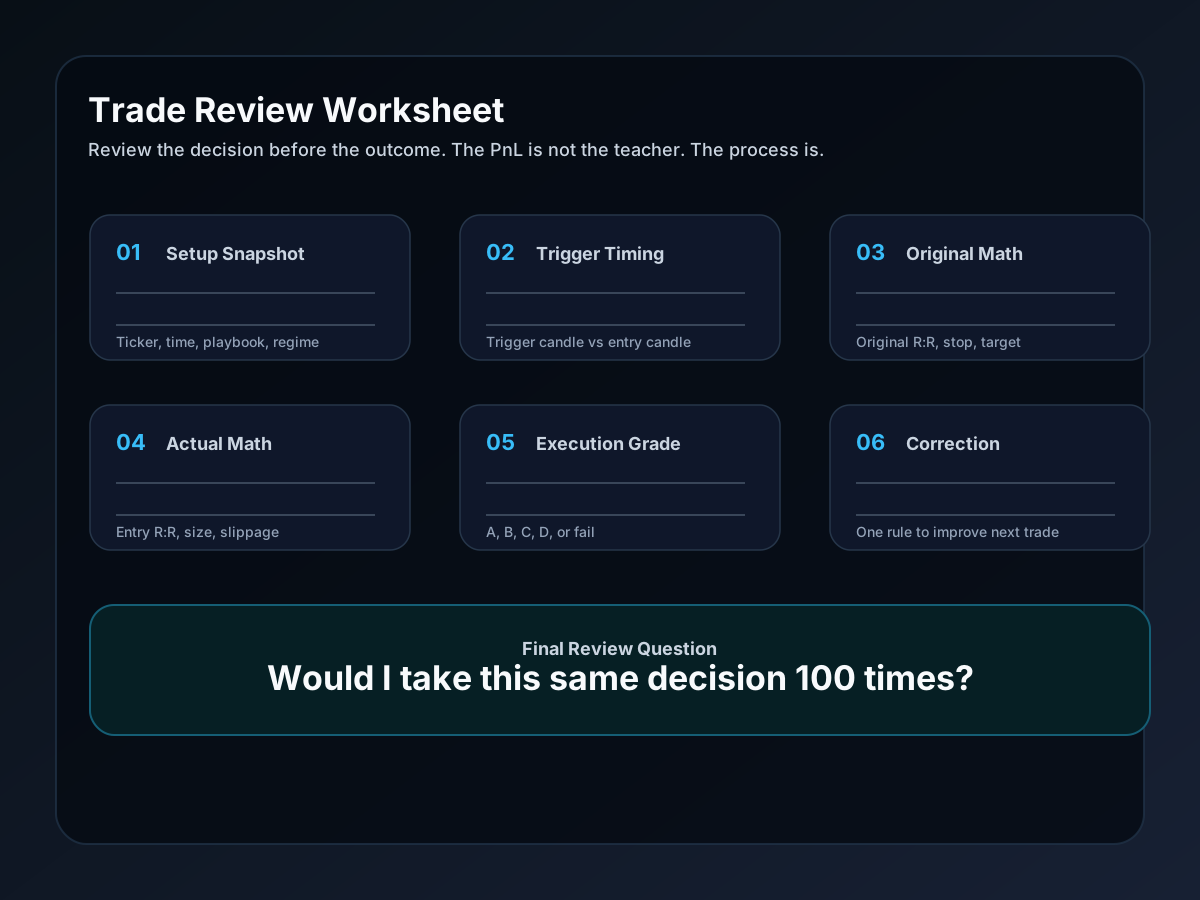
Late Entry Autopsy Card
When you chase, do not just mark the trade as "bad discipline." That is too vague to teach you anything. Break the mistake into evidence.
Source and Risk Notes
The 1-3 Candle Rule is a Nexural timing rule for this STS intraday workflow. The core idea is reward-to-risk decay: as entry moves away from the original level, the trade changes.
- The timing stats above are an internal Nexural trade-journal sample, not an independently audited performance record.
- NinjaTrader's ATR documentation is relevant because volatility affects how quickly a trigger can move away from the original entry zone.
- NinjaTrader's Order Flow+ materials are relevant because timing only matters when order-flow participation supports the trigger.
- This article is educational. Fast futures markets can gap, slip, reverse, or invalidate a setup before a trader can act.
Reference links: NinjaTrader ATR guide, NinjaTrader Order Flow+ overview, CME glossary, and CFTC futures glossary.
"The move you see is usually the move you missed. If QPulse crossed zero four candles ago, the asymmetric entry is gone. Let it go. The next setup will come. There are 252 trading days per year. You only need to be on time for the ones that matter."
Final rule: the setup is not yours because you saw it. It is yours only if you execute while the math is still alive. Next, apply the timing rule to the most common STS setup: the POC Bounce Long.
Review timing like a professional
Late entries improve only when the review names the trigger, entry, original math, and actual math.


