

I've spent years building indicators, testing systems, and blowing up accounts. My worst phase was not when I had no system. It was when I had too many. Every indicator gave me another excuse to hesitate, override, or explain away the trade I was already emotionally married to. The system I trade today uses three indicators on two timeframes. That's it. Every additional indicator I've ever added made me worse, not better. Here's why — and here's the system.
The bad belief this post is killing: more information creates more edge. In trading, more information usually creates more negotiation. You do not need a prettier chart. You need fewer places to hide.
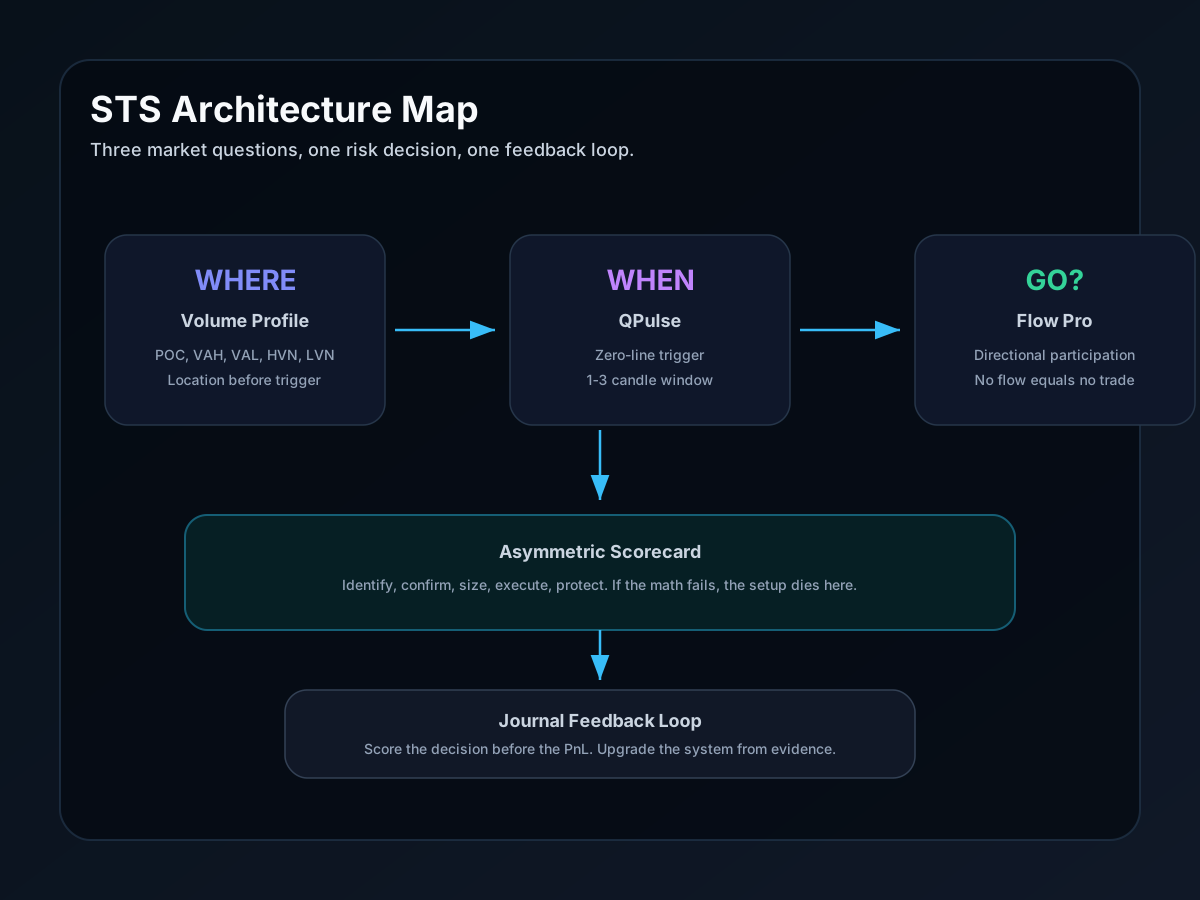
The best way to read this guide is as the hub: learn Volume Profile first, add QPulse timing second, use Flow Pro as the final participation check, and record the outcome in the journal so the system improves from evidence instead of memory.
The Problem With More Indicators
Most traders' charts look like a Jackson Pollock painting. Six moving averages, three oscillators, Bollinger Bands, MACD, Ichimoku, and something they found on a forum at 2 AM. Each indicator says something slightly different. The result isn't clarity — it's paralysis.
More indicators create more conflicting signals. And when signals conflict, traders do what humans always do under uncertainty: they follow their emotions. The indicators become decoration. The decisions become gut feelings.
The Sage Trading System takes the opposite approach. Three indicators. Each answers exactly one question. No overlap. No redundancy. No room for ambiguity.
That's the entire system. Volume Profile tells you WHERE to trade. QPulse tells you WHEN to enter. Flow Pro tells you whether to GO or stay out. If all three agree, you have a trade. If any one is missing, you sit.
Indicator 1: Volume Profile — The WHERE
Volume Profile is the backbone of STS. While most indicators tell you what price did, VP tells you where institutions traded. It shows volume at each price level — not over time, but at specific prices. This reveals the levels that actually matter.
The key levels VP produces:
- POC (Point of Control) — the price with the most volume. Where the market agreed on "fair value." Acts as a magnet.
- VAH / VAL (Value Area High/Low) — the upper and lower boundaries where 70% of volume traded. Statistical support and resistance.
- Supply & Demand Zones — clusters of high-volume nodes where institutions previously accumulated or distributed. They tend to defend these on retest.
- Naked POCs — prior session POCs that price never revisited. They act as magnets — price almost always returns to fill them.
These aren't arbitrary lines drawn by a pattern-recognition trader. They're levels where real money actually traded. That's why they work.
Indicator 2: QPulse — The WHEN
Volume Profile shows you where to trade. QPulse tells you when to pull the trigger.
QPulse is a volume-normalized momentum indicator. It oscillates around a zero line. The signal is simple: when QPulse crosses zero, that's your entry trigger.
- Crosses zero from negative to positive = momentum shifting to buyers = long entry
- Crosses zero from positive to negative = momentum shifting to sellers = short entry
Critical rule: you do NOT wait for the candle to close. Enter on the cross itself. Speed matters. By the time the candle closes, price may have already moved 10-15 points away from your ideal entry, destroying your R:R.
QPulse also has extension zones. Above +69, the move is already extended — don't initiate new longs. Below -69, selling is extended — don't initiate new shorts. The best entries come when QPulse crosses zero from -69 or deeper back to positive. That's exhausted selling turning into fresh buying. High conviction.
Indicator 3: Flow Pro — The GO / NO-GO
This is the filter that prevents the #1 account killer: trading when there's no flow.
Flow Pro shows real order flow — stacked buy/sell volume columns with imbalance detection. When one side is dominant and volume is active, you have tradeable flow. When it's flat, balanced, or dead — you sit out.
- Green stacks building + buy imbalance (3:1+ ratio) = buyers in control. GO for longs.
- Red stacks building + sell imbalance = sellers in control. GO for shorts.
- Flat, choppy, no clear dominance = NO-GO. No trade. Period.
This is the indicator most traders don't have — and its absence is why they get chopped up in sideways markets. They see QPulse cross zero, they see price at a VP level, and they enter. But there's no actual volume behind the move. It fizzles. They take a small loss. Then another. Then another. Five small losses later, they've given back their week.
Flow Pro prevents that. If there's no flow, there's no trade. The market owes you nothing.
The Two Timeframes
STS uses exactly two timeframes:
That's it. Two timeframes. The 15m gives you the "should I be trading?" answer. The 3m gives you the "where exactly do I enter?" answer.
If you're looking at 1-minute charts, you're overtrading. If you're on 1-hour charts, you're swing trading, not day trading. The 3m/15m combination gives you precision without noise.
How a Trade Comes Together
Here's the complete STS flow, from market open to trade execution:
What Makes STS Different
I've used dozens of systems over the years. Here's why this one stuck:
- Only 3 indicators. Most traders use 10+ and get analysis paralysis. STS uses 3, each with one job. No ambiguity.
- No candle close wait. QPulse zero-cross is the trigger. Speed of entry matters — waiting for close destroys R:R.
- VP gives institutional context. You're not guessing support/resistance. You're seeing where actual volume traded.
- Flow Pro prevents chop trades. The #1 account killer — trading when there's no directional flow — is eliminated.
- Never add to winners. Counter-intuitive but protects R:R. Start with your position, scale out.
- Process over results. A loss that followed STS rules is celebrated. A win that broke rules is flagged.
- 3-5 loss daily limit. Prevents emotional spirals. The market will be there tomorrow.
The system isn't about being right. It's about the math being right. At a 40% win rate with 3:1 R:R, every trade I take has positive expectancy. I don't need to predict the market. I need to follow the process and let the math compound.
The Decision Debt STS Removed
| Old Chart Habit | What It Really Did | STS Replacement |
|---|---|---|
| Six confirmations | permission to hesitate | three binary questions |
| Candle-close safety | paid late-entry tax | QPulse cross timing |
| Random support lines | chart astrology | Volume Profile levels |
| Taking every setup | death by chop | Flow Pro no-trade filter |
"Three indicators. Two timeframes. One principle: if the R:R is there and the indicators confirm, the trade makes sense. If not, you sit. That's the entire system."
Instruments
STS works on any liquid futures market. Here's what I trade:
- Primary: ES, NQ, RTY, YM (equity index futures) — the most liquid, best VP data
- Secondary: GC (Gold), CL (Crude Oil) — different character, event-driven
- Overnight: BTC, ETH — when equity markets are closed and crypto is active
All on micro contracts for position sizing flexibility. Start with one micro on NQ or ES. Learn the levels. Learn the process. Size up only after 20+ trades with consistent process.
When STS Fails
STS fails when traders turn it into a prediction machine. It is not. It is a decision filter. News can overpower the setup. A negative-GEX trend day can steamroll a mean-reversion level. Thin liquidity can make Flow Pro flash without follow-through. A perfect checklist can still lose because the market is allowed to be rude.
The edge is not that every trade works. The edge is that the losers are defined before entry, the winners are large enough to matter, and the rules prevent the stupid losses that used to eat the week. That is the adult version of a trading system. Less magic. More accountability.
Source and Risk Notes
STS combines proprietary Nexural rules with common market-analysis building blocks: Volume Profile, momentum, volatility context, order flow, and futures risk management. The system is a decision framework, not a forecast engine.
- NinjaTrader's Volume Profile documentation describes profile levels such as point of control and value area concepts used in the WHERE layer.
- NinjaTrader's RSI and ATR documentation are useful references for the momentum and volatility families that inform QPulse-style trigger logic.
- NinjaTrader's Order Flow+ materials describe volume, delta, imbalance, absorption, and exhaustion tools that relate to Flow Pro's GO/NO-GO role.
- This article is educational. Futures trading is leveraged, losses can exceed expectations during fast markets, and no indicator stack guarantees profitability.
Reference links: NinjaTrader Volume Profile guide, NinjaTrader RSI guide, NinjaTrader ATR guide, and NinjaTrader Order Flow+ overview.
Final rule: if an indicator does not answer WHERE, WHEN, or GO/NO-GO, it does not get chart space. Start with Volume Profile next. That is the first layer because bad location ruins everything downstream.
Build the STS stack in order
Learn the three questions one at a time, then connect them to a playbook.


