

A trader sees NQ pull back into a clean level. The account says 2% risk allows $1,000. The chart says the real invalidation is 42 points away. One E-mini NQ contract makes that an $840 stop before slippage. So the trader does something that feels responsible and is actually dangerous: keeps the contract, tightens the stop, and calls it discipline.
That is the real problem with the 2% rule. It is not wrong in spirit. Risk limits matter. But applying a flat percentage to every trade regardless of edge quality turns position sizing into a permission slip. The stop gets bent to fit the size instead of the size being reduced to fit the stop.
Use this article as the risk model behind the futures position size calculator. The job is simple: define invalidation, score the setup, adjust for volatility, and only then choose contract count.
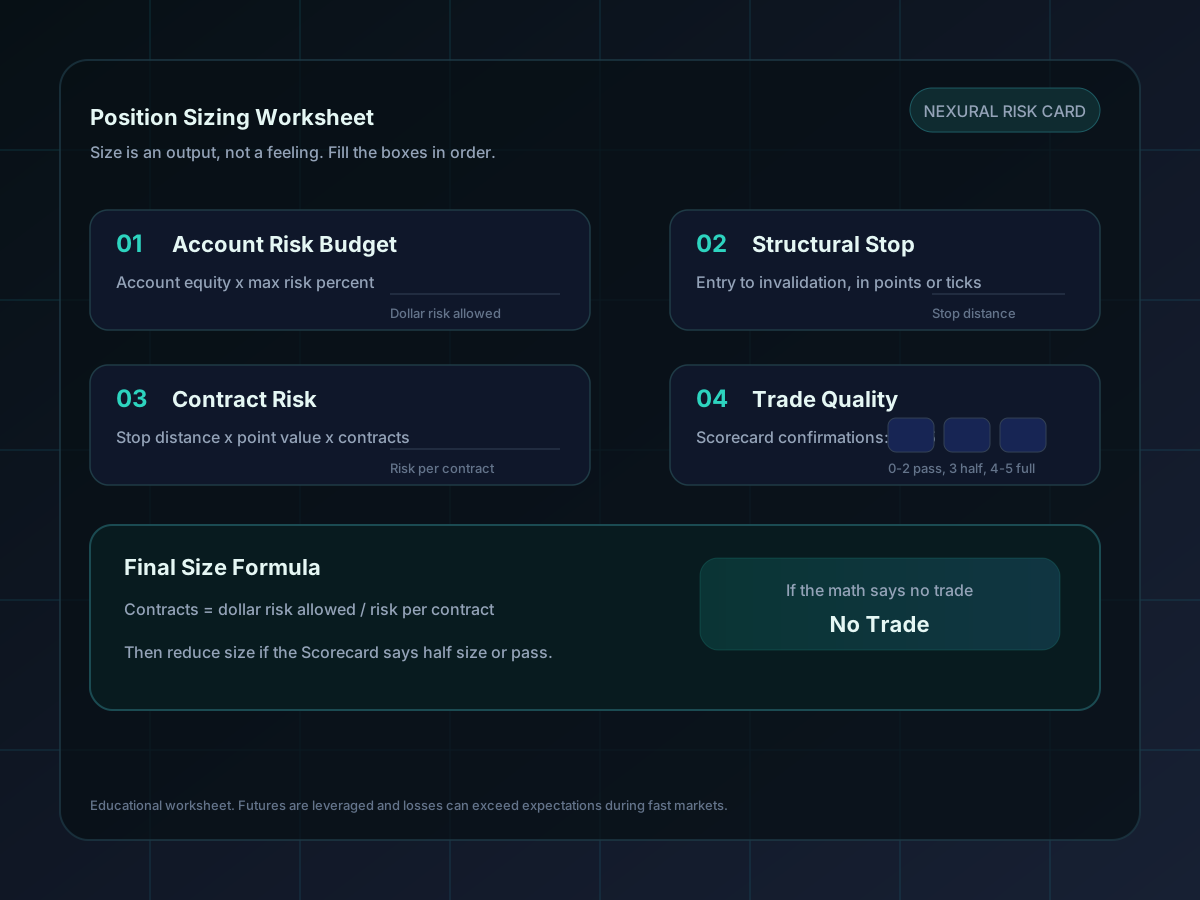
The bad belief this post is killing: fixed risk equals disciplined risk. Fixed risk is better than chaos, but it is not the finish line. A flat percentage ignores setup quality, volatility, stop location, correlation, and drawdown state. That is not institutional risk management. That is a bumper sticker.
The Four Problems With a Flat 2%
Problem 1: It Ignores R:R
Risking 2% on a 1:1 trade and risking 2% on a 5:1 trade are fundamentally different propositions. The first has a breakeven win rate of 50%. The second has a breakeven win rate of 17%. They're not the same risk — but the 2% rule treats them identically.
| Metric | 1:1 Trade @ 2% | 3:1 Trade @ 2% | 5:1 Trade @ 2% |
|---|---|---|---|
| Risk per trade ($50K acct) | $1,000 | $1,000 | $1,000 |
| Potential reward | $1,000 | $3,000 | $5,000 |
| Breakeven win rate | 50% | 25% | 17% |
| Should you size these the same? | ABSOLUTELY NOT | ||
The 5:1 trade has 3x more expected value per dollar risked. It deserves more capital. The 1:1 trade has razor-thin margins — it deserves less. A flat 2% misses this entirely.
Problem 2: No Conviction Scaling
Not all setups are created equal. An A+ setup — full STS confirmation, positive GEX, confluence of three VP levels, perfect QPulse timing — is a fundamentally better bet than a B setup with two of three confirmations. The 2% rule says risk the same on both. That's leaving money on the table.
The best poker players don't bet the same amount on every hand. They bet based on the strength of their hand relative to the situation. Trading is the same game.
This is where the Asymmetric Scorecard earns its keep. If the trade only has two or three confirmations, it does not deserve the same size as a clean five-confirmation setup. A sizing rule that cannot tell the difference between those two trades is too blunt for live markets.
What Flat 2% Misses
| Input | Why It Matters | Sizing Effect |
|---|---|---|
| Scorecard strength | not all edges deserve equal capital | scale up/down |
| Volatility regime | same stop behaves differently in fast tape | compress size |
| Structural stop | the market defines invalidation, not your calculator | contracts adjust |
| Daily/weekly drawdown | risk tolerance changes after damage | cut or stop |
Problem 3: Volatility Blindness
Risking 2% when VIX is 12 and the expected daily range is 35 points is very different from risking 2% when VIX is 30 and the expected daily range is 100 points. In the high-vol environment, your stop is more likely to get hit, gaps are larger, and the speed of adverse moves is faster. For futures traders, this matters even more because contract leverage is structural; start with the futures beginner guide if the tick math is not automatic yet.
Problem 4: It Puts Size Before Stop
The worst application of the 2% rule is when traders work backwards from the dollar amount to determine their stop placement. "I want to risk $1,000, and I'm trading 2 NQ contracts, so my stop needs to be at 25 points." But what if the correct structural stop — below the demand zone, below the POC, wherever your invalidation is — sits at 35 points?
Now you have two bad options: place the stop at 25 points (wrong location, likely gets hit by noise) or risk more than 2% (breaks the "rule"). The right answer is neither — the right answer is to trade fewer contracts so your proper structural stop fits within your risk budget. The stop dictates the size. Never the reverse.
If the math produces a fractional futures contract or a size that feels emotionally loud, step down to micros or skip. The micro futures guide is useful here because MES and MNQ let traders express the same idea with smaller increments instead of forcing oversized E-mini risk.
The Asymmetric Sizing Framework
Here's what I actually use. It's not a single number — it's a system with four inputs that produce a dynamic position size for every trade.
The Formula
For futures, translate the stop into dollars before you touch the order ticket. ES, NQ, MES, and MNQ do not have the same dollar value per point, so "25 points" is not a universal risk number. If you want the calculator to do the conversion, use the futures position size calculator and sanity-check the result against your structural stop.
Worked Example
| Input | A+ Setup, Low Vol | B Setup, Normal Vol | B Setup, High Vol |
|---|---|---|---|
| Account | $50,000 | $50,000 | $50,000 |
| Base risk | 1% = $500 | 1% = $500 | 1% = $500 |
| Scorecard multiplier | 1.5x (A+ = 5/5) | 1.0x (B = 4/5) | 1.0x (B = 4/5) |
| Vol adjustment (VIX) | 1.0x (VIX 14) | 1.0x (VIX 18) | 0.5x (VIX 28) |
| Dollar risk | $750 | $500 | $250 |
| Stop distance (MNQ) | 25 pts ($500) | 30 pts ($600) | 45 pts ($900) |
| Contracts | 1 MNQ + partials | 1 MNQ | Skip — too thin |
Look at the third column. A B-grade setup in VIX 28 with a 45-point stop only allows $250 of risk — which doesn't even cover one MNQ contract. The system is telling you to skip the trade. And it's right. That's a low-conviction setup in dangerous conditions with a wide stop. The 2% rule would say "sure, risk $1,000" — and that $1,000 loss would sting far more than the math suggests because the environment amplifies adverse outcomes.
The Drawdown Perspective
Position sizing isn't about individual trades — it's about surviving strings of losses. The real question is: how many consecutive losses can you absorb before your account is damaged beyond practical recovery?
With the 2% rule and a run of 10 consecutive losses (which happens more often than you think — it's statistically expected every 1,024 trades at a 50% win rate), you'd be down 20%. With the asymmetric framework using 1% base risk and volatility adjustment, the same losing streak costs 7-10%. One is recoverable in a few weeks. The other takes months and devastating psychological damage.
The cleaner way to review this is in R-multiples, not dollars. A $400 loss and a $900 loss can both be -1R if they were sized correctly for their stop. The R-multiple calculator helps normalize that review so contract size does not hide execution quality.
When This Framework Fails
This framework fails if your edge is fictional. Dynamic sizing does not rescue a bad strategy. It also fails if you inflate the Scorecard because you want size, ignore correlation because the symbols look different, or keep trading after the daily cap because you are "seeing it well." That last phrase has funded many brokers.
The sizing model is not there to make you brave. It is there to make bravery unnecessary. The right size should feel slightly boring. If the position size makes your pulse change, the size is already giving you information.
Daily and Weekly Risk Caps
Individual trade sizing is only half the equation. You also need aggregate risk limits that prevent a bad day from becoming a bad month.
Risk caps also make the next trade easier to take correctly. If you are within 1R of the daily stop, the right answer is usually no trade. This connects directly to the psychology of taking the stop: the exit is easier to honor when the size was correct before entry.
The Complete Sizing Checklist
Here's the pre-trade sizing checklist I run before every entry. It takes 30 seconds and prevents sizing mistakes that cost thousands.
Source and Risk Notes
Position sizing has to respect contract mechanics. Exchange multipliers, tick values, margin rules, and leverage are not interchangeable with "safe risk." Broker margin tells you what may be required to hold a position; it does not tell you what a trader can prudently lose.
- CME describes the E-mini S&P 500 contract as tied to a $50 multiplier and the E-mini Nasdaq-100 contract as tied to a $20 multiplier. That is why the same point stop can create different dollar risk across ES and NQ.
- CME's Micro E-mini contracts use smaller multipliers, which is why MES and MNQ are often better tools when the correct structural stop is too wide for a full-size contract.
- The CFTC glossary is a useful reference for futures terminology, leverage, margin, and related market structure language.
- This framework is educational. It is not individualized financial advice, and it does not remove the risk of loss in futures trading.
Reference links: CME ES futures, CME NQ futures, CME MES specs, CME MNQ specs, and CFTC glossary.
"The 2% rule is training wheels. It's better than no rule — but it treats every trade and every market condition identically, which is the opposite of thinking asymmetrically. Real position sizing is dynamic: it scales with your edge, adjusts to the environment, and always starts with the stop — never the other way around. Size is an output of the system, not an input."
Final rule: size is an output, not a vibe. Define the structural stop, score the trade, adjust for volatility, then let the contract count fall out of the math. If the math says no trade, that is not a missed opportunity. That is risk management doing its job. Next, run the position size calculator, review the result in your trading journal, and pair this with The Psychology of Taking the Stop so the size and the exit reinforce each other.
Turn sizing into a repeatable risk workflow
Define invalidation first, then let the calculator and Scorecard decide whether the trade can exist.


