

Let me describe a moment every trader has lived. You entered the trade with a plan. Stop at -1R. Target at +3R. Clean setup, confirmed by STS. You felt good about it.
Then price starts moving against you. It's not at your stop yet, but the P&L is turning red. -$150. -$280. The candle that just closed was ugly. The next one opens worse.
Your stop is at -$500. Price is at -$380. Twenty more ticks and you're out. And then — in that exact moment — something shifts in your chest. A tightening. A resistance. An animal instinct that says: if I close this trade, the loss becomes real.
So you do the thing you swore you'd never do. You move the stop. "Just a little more room." You tell yourself it's a rational adjustment — the market might bounce, the volume is picking up, there's support nearby. But you know. Deep down, you know. You're not adjusting. You're hoping.
And that moment — not the entry, not the analysis, not the indicators — is where trading careers go to die.
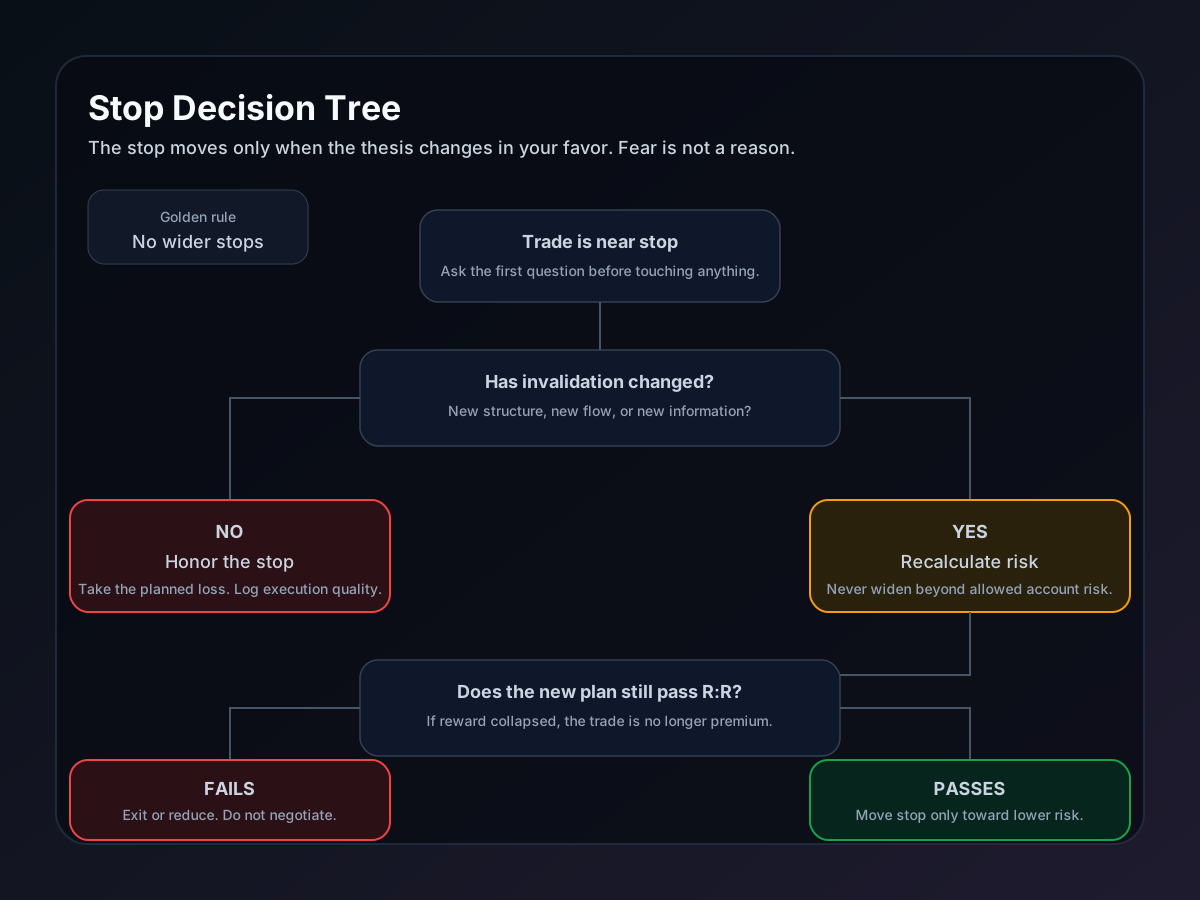
The bad belief this post is killing: moving a stop is "active management." Usually it is just fear wearing a blazer. If the thesis changed, exit. If the thesis did not change, the original stop still stands. What you do not get to do is keep the upside plan and renegotiate the downside after the market starts billing you.
Why Your Brain Betrays You
This isn't weakness. It's behavioral wiring. Daniel Kahneman and Amos Tversky's work on decision-making under uncertainty helped formalize loss aversion: people tend to react more strongly to losses than to equivalent gains. A $500 loss does not feel like the clean opposite of a $500 win. For many traders, it feels bigger, louder, and harder to accept.
Your brain evolved to avoid loss. When money, status, or identity feels threatened, the fast emotional system gets loud and the slow planning system gets quiet. That is a brutal setup for live trading, because stops require you to do the rational thing at the exact moment the emotional system wants control.
This is why knowledge isn't enough. You've read Chapter 13 on risk management. You understand the Asymmetric Filter. You know that a 1R loss is the cost of doing business. Intellectually, you're prepared.
But when the amygdala fires, intellectual knowledge evaporates. The rational brain goes offline. You're operating on pure survival instinct — and survival instinct says avoid loss at all costs.
The Cascade: What Happens When You Don't Take the Stop
Moving the stop is never a one-time event. It's the first domino in a cascade that follows the same pattern almost every time:
I've lived this cascade. Multiple times. Every experienced trader has. The traders who survive are the ones who build systems that prevent Stage 1 from ever happening — because once Stage 1 triggers, the rest is almost inevitable.
The prevention starts before entry. If the correct stop creates too much dollar risk, the fix is not emotional toughness. The fix is smaller size. Use the futures position size calculator before the trade exists so the stop is financially acceptable when it gets hit.
The Stop Negotiation Ledger
| Thought | Translation | Professional Response |
|---|---|---|
| "It just needs room." | I sized too big for the real stop. | take the stop |
| "Support is right below." | I found new evidence after entry. | exit, reassess |
| "I can't lose today." | my ego is managing risk. | shut it down |
| "It will come back." | hope has replaced process. | honor the order |
The Stop Decision Tree
When the stop starts to feel negotiable, do not debate with yourself. Run the tree.
The Cost of Moving the Stop: Real Math
Let's quantify what "just a little more room" actually costs over time.
| Scenario | Avg Loss | Win Rate | Avg Win | Expectancy | 100 Trades |
|---|---|---|---|---|---|
| Disciplined (always take the 1R stop) | -$500 | 40% | +$1,500 | +$300 | +$30,000 |
| Moves stop 20% of the time (to -3R) | -$700 | 42% | +$1,500 | +$224 | +$22,400 |
| Moves stop 40% of the time (to -3R avg) | -$900 | 44% | +$1,500 | +$156 | +$15,600 |
Notice something subtle: moving the stop does slightly increase win rate (sometimes the trade does come back). That's the trap. You get rewarded just often enough to reinforce the bad behavior. But the math is devastating: a trader who moves their stop 40% of the time makes half the money of the disciplined trader. Over a year, that's the difference between +$30,000 and +$15,600 — and that's the good scenario. In reality, the cascade effect means some of those moved stops result in -5R or -8R blowups that can turn positive expectancy negative.
This is why every review should include R-multiple, not just dollars. If a planned -1R loss turns into -2.8R, the trade did not merely lose. The process leaked. Use the R-multiple calculator to make that leak visible.
Seven Techniques That Actually Work
I've tried every psychological trick in the book. Affirmations. Visualization. Meditation. Some help at the margins. But the techniques that actually move the needle are structural — they remove the decision from the emotional moment entirely.
The Identity Shift
The deepest change isn't a technique — it's an identity shift. Most traders see a stop-loss as a failure. "I was wrong. I lost money. I failed."
Professional traders see a stop-loss as proof that the system is working. The stop protected capital. It prevented the cascade. It kept the loss at 1R instead of 5R. Taking the stop is not failure — it's the most disciplined, professional thing a trader can do.
"I got stopped out" is passive. Something happened to you. "I honored my stop" is active. You made a decision. The reframe isn't semantic — it rewires how your brain processes the event. Active language activates the prefrontal cortex. Passive language activates the amygdala.
When Taking the Stop Is Not Enough
Taking the stop is mandatory, but it is not a complete risk process. If your stop is in a stupid place, honoring it just means you executed a bad plan cleanly. A professional stop sits at structural invalidation: below the level, outside normal noise, and sized so the loss is acceptable before the trade starts.
That is why stop discipline and position sizing are the same conversation. If you cannot afford the correct stop, the answer is not a tighter stop. The answer is fewer contracts or no trade. Tight stops used to force size are just hidden leverage.
Source and Risk Notes
Stop discipline sits at the intersection of psychology and order mechanics. Behavioral finance explains why losses feel urgent; market structure explains why stop orders still need thoughtful placement, sizing, and review.
- Kahneman and Tversky's prospect theory work describes reference-dependent decisions and the tendency for losses to weigh more heavily than comparable gains.
- The Nobel Prize's 2002 economics materials describe Kahneman's contribution to decision-making under uncertainty and the role of loss aversion.
- SEC Investor.gov explains that stop orders and stop-limit orders have different execution tradeoffs; a stop can help manage risk, but execution price and liquidity still matter.
- FINRA warns that stop orders deserve extra care in volatile markets because triggered orders can execute under fast-moving conditions.
- This article is educational. It is not individualized trading advice, and a stop-loss order does not guarantee a specific fill or eliminate trading risk.
Reference links: Kahneman and Tversky prospect theory, Nobel Prize 2002 explanation, SEC Investor.gov stop-order bulletin, and FINRA stop-order guidance.
"Taking the stop is not the failure. Not taking it is. Every stop honored is proof that your risk management works. Every stop moved is a deposit into the account of future regret. The best traders I know don't celebrate their winners — they celebrate their discipline on the losers. Because that's where the edge actually lives."
Final rule: taking the stop is not punishment. It is rent. You pay it to stay in business. Log the next stopped trade in the trading journal, score the execution before the P&L, then read Position Sizing: Why the 2% Rule Is Wrong because the easiest stop to honor is the one you sized correctly before the trade existed.
Make the stop financially easy to obey
The easiest stop to honor is the one you sized correctly before the trade existed.


