

At 10:12 AM, I had the exact trade I wanted. ES was sitting on a clean Volume Profile level, QPulse had crossed zero, Flow Pro was green, and the entry looked like something you would screenshot for a course page. I went long, took the stop, re-entered because the setup still looked "right," and took another stop. Minus 2R before lunch. The chart did not betray me. I ignored the options regime.
The next day, the same setup fired from a nearly identical level. This time ES ran 80 points without looking back. Plus 4R before lunch. Same trader. Same tools. Same playbook. Different market plumbing.
What changed? Not your system. Not the indicators. Not the chart pattern. The difference was something you couldn't see on your chart: Gamma Exposure (GEX) — the invisible force that determines whether the market trends or chops on any given day.
Here is the ugly truth: a setup can be technically valid and still be the wrong trade for the day. That is where traders get rinsed. They keep applying yesterday's playbook to today's dealer positioning, then call it bad luck when the market behaves like a different market entirely.
What Is GEX?
GEX — Gamma Exposure — estimates the aggregate gamma positioning around an index, ETF, or stock. In plain English: it helps you infer whether options dealer hedging may buy dips and sell rips (dampening moves) or sell dips and buy rips (amplifying moves).
This is not a crystal ball. It is plumbing. Options have delta, and gamma describes how that delta changes as the underlying moves. If a dealer is hedging an options book, price movement can force hedge adjustments in the underlying or related futures. Enough of that flow clustered around the same strikes can change how the day trades.
How GEX Changes Your Trading
This is where it gets practical. GEX should change what you trade, how much you trade, how wide your stop is, and how patient you are with targets. If it does not change anything in your plan, you are not using regime data. You are collecting trivia.
The GEX Flip Level
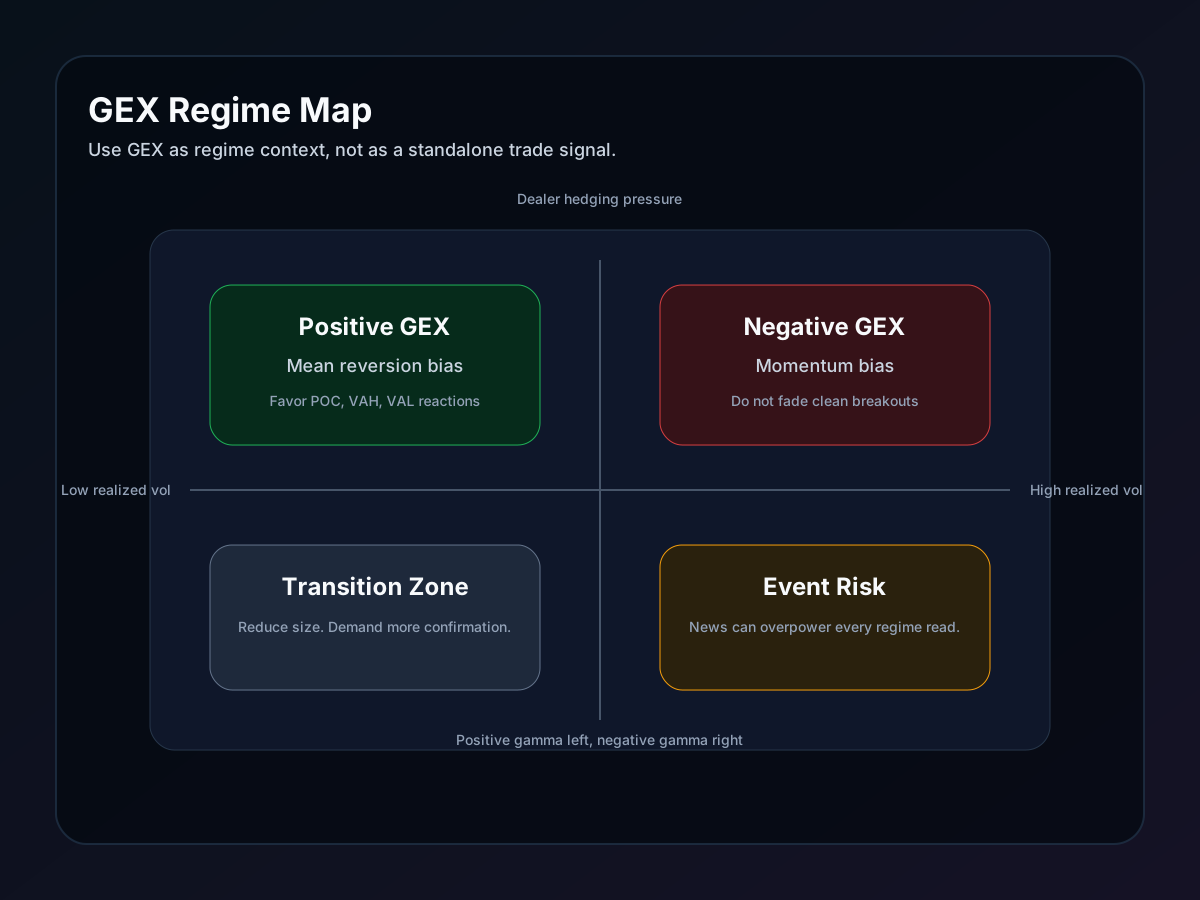
There's a specific price level where dealer positioning flips from positive to negative gamma. Above this level, dealers dampen moves. Below it, they amplify them. This is the GEX flip level — and it's one of the most important numbers in the market on any given day.
Dealer Regime Map
The level is not magic. It is a behavior switch. Above it, dealer hedging often cushions price. Below it, hedging can chase price and turn a selloff into a hallway with no exits.
How to Check GEX Before the Open
You don't need a Bloomberg terminal to access GEX data. Here's a practical pre-market routine:
| Step | Action | What You're Looking For |
|---|---|---|
| 1 | Check aggregate GEX (SpotGamma, Menthor Q, or similar service) | Positive GEX = today will likely be range-bound. Negative GEX = today could trend hard. |
| 2 | Identify the GEX flip level (also called "put wall" or "zero gamma" level) | This is your "line in the sand." Above it = calm. Below it = volatile. Mark it on your chart. |
| 3 | Note the "call wall" (highest positive gamma strike) | This is the ceiling. Price tends to pin here or reject from here. Think of it as synthetic resistance created by dealer hedging. |
| 4 | Choose your strategy and size based on the regime | Positive GEX → full size, mean reversion. Negative GEX → half size, momentum only. |
The Nexural GEX Level Overlay indicator does steps 2 and 3 automatically on your NinjaTrader chart — plotting the flip level, call wall, and put wall so you can see the gamma landscape in real time.
The 90-Second GEX Checklist
Do this before the opening bell. Do it again after a major macro event. The point is not to predict the day. The point is to stop trading the wrong playbook.
GEX and Your STS Playbooks
Here's the practical connection between GEX and the Sage Trading System:
| STS Playbook | Positive GEX | Negative GEX |
|---|---|---|
| POC Bounce Long | HIGH PROBABILITY | Reduced — POC may not hold |
| VAH Rejection Short | HIGH PROBABILITY | Dangerous — VAH may break |
| ORB Breakout | Lower R:R — breakouts fade | HIGH PROBABILITY |
| Momentum Continuation | Low probability — mean reverts | HIGH PROBABILITY |
The insight: Your STS playbooks don't change. The three-question process (WHERE, WHEN, GO/NO-GO) stays the same. But GEX tells you which playbooks to prioritize today. On positive GEX days, your mean-reversion playbooks are the A-setups. On negative GEX days, your breakout playbooks take priority.
This is what institutional traders do that retail traders don't — they select their strategy based on the regime, not based on what they feel like trading that day.
When GEX Lies to You
GEX is not a crystal ball. It is a pressure map. News can overpower it. CPI, FOMC, NFP, surprise Treasury headlines, large single-name shocks, and ugly geopolitical tape can turn a calm positive-GEX morning into a mess. If you treat GEX like permission to ignore stops, congratulations, you have built a more sophisticated way to do something dumb.
My rule: GEX selects the playbook. Price action still has to confirm the trade. If the order flow disagrees, I stand down. The order flow read, Volume Profile level, and Scorecard still have to line up. GEX is the weather report. You still look out the window before you drive.
Source and Risk Notes
GEX is an estimate built from options positioning assumptions, not an official exchange signal. Use it as context for regime selection, then let price, volume, order flow, and risk limits decide whether a trade is valid.
- Cboe describes gamma as the change in option delta as the underlying moves, and discusses market-maker delta hedging in the context of SPX 0DTE options.
- The Options Clearing Corporation's Options Disclosure Document explains standardized option characteristics and risks; options are complex and not suitable for every investor.
- Cboe's GAMMA index materials show that gamma can be studied through delta-hedged option behavior, but that does not make any single GEX estimate a guaranteed trading signal.
- This article is educational. Dealer hedging estimates can be wrong, stale, or overwhelmed by news, liquidity, and aggressive directional flow.
Reference links: Cboe on SPX 0DTE market impact and gamma hedging, OCC Options Disclosure Document, and Cboe GAMMA index dashboard.
"GEX is the operating system of the market. Your strategies are the apps. You wouldn't run iOS apps on Android. Don't run mean-reversion strategies in a negative GEX environment. Match the app to the operating system, and the results take care of themselves."
The final rule is simple: do not trade a mean-reversion playbook on a day built to punish mean reversion. Check the GEX regime before the open, mark the flip level, then validate the idea with order flow and the Asymmetric Scorecard. The expensive mistake is not being wrong. The expensive mistake is playing yesterday's game after the rules changed.
Match the playbook to the regime
GEX selects the game. Price, flow, and risk controls decide whether you actually trade.


