
The VIX Playbook
"The VIX is the market's fear gauge — but it's really more like the market's uncertainty gauge. Fear is just uncertainty that's already been confirmed."
— Unknown
Understanding Fear as a Trading Asset
Most traders use the VIX as background noise — "VIX is up, be careful." That's leaving enormous money on the table. The VIX is a precision instrument that tells you not just how scared the market is, but how scared it was, how scared it expects to be, and whether that fear is accurately priced.
Once you understand VIX at the structural level — what it actually measures, how it's constructed, and how institutional players use it — you gain a second market clock running parallel to price. Price tells you what happened. VIX tells you what the market thinks will happen next.
This chapter is your operating manual for that second clock.
What VIX Actually Measures
The CBOE Volatility Index (VIX) measures the implied volatility of S&P 500 options over the next 30 calendar days, annualized. It's not a sentiment poll. It's the market's literal pricing of risk — derived from real options transactions where real money changed hands.
The construction: VIX aggregates the prices of out-of-the-money S&P 500 options across multiple strikes and two expiration dates, then extracts the implied volatility that explains those prices. When options are expensive (high demand for protection), VIX rises. When options are cheap (complacency), VIX falls.
The VIX Regime Map
VIX doesn't move randomly. It oscillates between four distinct regimes, each with its own trading implications. Understanding which regime you're in changes every trading decision you make.
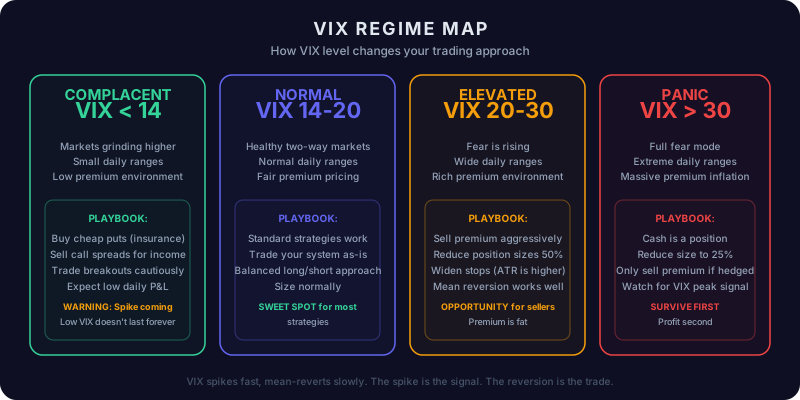
Regime 1: Complacency (VIX below 15)
Low VIX doesn't mean low risk. It means low perceived risk. These are often the most dangerous periods for directional traders — markets are priced for perfection, and any negative surprise creates outsized moves. Options are cheap, making long volatility strategies (buying calls or puts) attractive relative to their cost.
Complacency regime playbook:
- Be cautious with large directional bets — risk is underpriced, not absent
- Use cheap options to hedge existing positions (the "insurance" is on sale)
- Reduce position sizes — upside is limited, tail risk is underpriced
- Watch for VIX divergences: price making new highs while VIX refuses to drop is a warning
Regime 2: Normal (VIX 15–20)
This is the market's natural equilibrium. Options are fairly priced, directional strategies work as expected, and volatility strategies have normal risk-reward profiles. Most of your bread-and-butter setups function best here.
Regime 3: Elevated (VIX 20–30)
Elevated VIX signals institutional hedging demand. Funds are buying protection, which means the options skew is steep and premium selling becomes highly attractive. Credit spreads, iron condors, and cash-secured puts have exceptional risk-reward when VIX is in this range.
Elevated regime playbook:
- Increase premium-selling activity — this is the sweet spot for options income
- Widen spread widths to capture more premium while managing risk
- Expect mean-reverting price behavior — good for range-bound strategies
- Look for confirmed support levels as entry points for bullish positions
Regime 4: Crisis (VIX above 30)
Crisis VIX means the market is in genuine distress. Realized volatility is high, options are extremely expensive, and the VRP may flip negative (meaning options buyers are actually getting a fair deal). This is not the time to be a mechanical premium seller.
But crisis VIX also creates the best buying opportunities. When VIX spikes to 40+, it almost always overshoots fair value. The eventual mean reversion in VIX corresponds directly with equity recovery. The traders who buy quality assets when VIX is at 40 and sell when VIX returns to 18 generate outsized returns.
VIX Futures: The Term Structure Edge
The spot VIX is just the beginning. The real insight comes from the VIX futures curve — the market's forecast of VIX at different points in the future.
In normal conditions, the VIX futures curve is in contango: VIX futures for later months are priced higher than spot VIX. This reflects the market's expectation that uncertainty increases over time. Contango is the natural state of volatility markets — it's why short-vol ETFs like SVXY have historically drifted higher over time (collecting the roll yield as futures converge to spot).
VIX Contrarian Signals
The most valuable VIX signals are often the contrarian ones — when sentiment reaches an extreme that historically precedes reversals.
| Signal | Condition | Historical Implication | Trade Idea |
|---|---|---|---|
| VIX Spike >40% | VIX rises more than 40% in a single session | Panic selling; 80% chance of equity recovery within 5 days | Buy SPY/ES on close; sell VIX calls |
| VIX Below 12 | Spot VIX under 12 for 5+ consecutive days | Extreme complacency; elevated drawdown risk in next 60 days | Buy cheap OTM puts as tail hedge; reduce net long exposure |
| VIX-SPX Divergence | SPX making new highs but VIX failing to make new lows | Smart money hedging while prices rise; distribution phase | Tighten stops on long positions; begin reducing exposure |
| VIX Mean Reversion | VIX at 40+ with equity prices at extreme lows | Historically best risk-reward entry point for 3-6 month holds | Scale into quality long positions; sell premium to lower cost basis |
VIX Case Study: March 2020
Integrating VIX Into Your Process
Here's how to embed VIX analysis into your daily workflow without turning it into a full-time job:
Morning Regime Check
Before placing any trade, note the current VIX level and regime. Check whether VIX futures are in contango or backwardation (compare M1 and M2 VIX futures prices). This takes 60 seconds and fundamentally shapes your strategy selection for the day.
Strategy Selection Matrix
Map your intended strategies to the current VIX regime. VIX below 15: long vol strategies, hedges, reduced size. VIX 15–20: full suite of strategies. VIX 20–30: premium selling, income strategies. VIX above 30: stop selling, look for recovery setups, cut risk.
VIX-Position Size Link
Scale position sizes inversely with VIX. When VIX is at 30, daily moves are twice as large as when VIX is at 15 — which means your dollar risk per contract is twice as high. Halve your position sizes when VIX doubles, and you maintain consistent risk exposure across regimes.
Weekly VIX Review
Every weekend, review the week's VIX action. Did VIX confirm or contradict price action? Did the term structure shift? Were there any divergences? This 15-minute review builds your pattern recognition for VIX behavior over time — which is where the real edge develops.
What's Next
You now have a complete operating manual for VIX as a trading tool. In Chapter 21, Institutional Volatility, we go deeper into how the largest market participants — pension funds, hedge funds, and market makers — use volatility derivatives to manage risk. Understanding their flow gives you a structural edge that most retail traders never access.