
Options Income Strategies
"In investing, what is comfortable is rarely profitable."
— Robert Arnott
The Income Mindset
Every strategy we've discussed so far has been directional — you're betting that price goes up or down. Options income strategies flip the script. Instead of paying for the right to profit from a move, you collect payment from others who want that right.
You become the house. The casino. The insurance company.
The math is compelling: implied volatility overstates realized volatility roughly 85% of the time (the VRP we covered in Chapter 21). That means options buyers are systematically overpaying, and options sellers are systematically collecting that excess premium. Over enough trades, the edge compounds.
But here's what every options income course conveniently omits: the other 15% of the time, you can give back months of profits in a single day. Managing that tail risk is what separates professional premium sellers from retail traders who blow up.
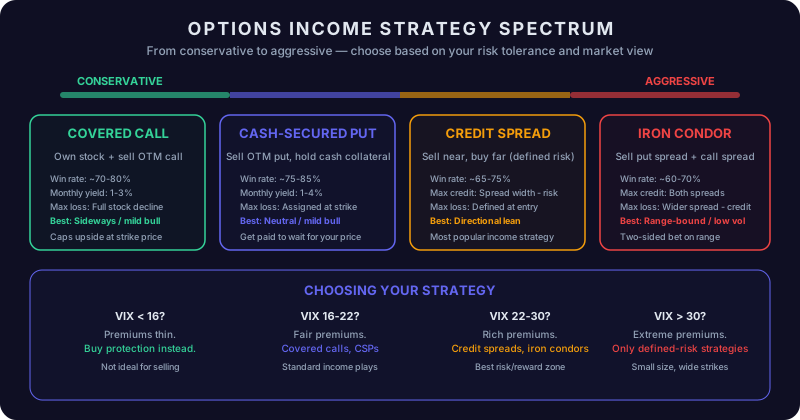
Strategy 1: The Cash-Secured Put
The cash-secured put is the foundation of options income. You sell a put option at a price where you'd be happy to buy the stock or futures contract. You hold enough cash to cover the assignment. You collect premium.
Three outcomes, all acceptable:
Price stays above strike (most common)
The put expires worthless. You keep the full premium. You never had to buy anything. This is pure income — money for committing to buy at a price you liked anyway. Rinse and repeat.
Price drops to strike — you get assigned
You buy at the strike price, but your effective cost basis is strike minus premium collected. You wanted to buy at this price anyway — now you got paid to wait. Begin selling covered calls against the position.
Price drops well below strike — you're underwater
This is the risk. You're assigned at a price that's now significantly above market. The premium provides a small cushion, but if the underlying drops 15%, you've lost far more than you collected. This is why position sizing and strike selection matter enormously.
Strike selection rules for CSPs:
- Sell at a price where you genuinely want to own the underlying — not just wherever the premium looks juicy
- Target the 0.20-0.30 delta range (roughly 70-80% probability of expiring worthless)
- Select 30-45 DTE for optimal theta decay rate
- Never risk more than 5% of your account on a single CSP
Strategy 2: The Credit Spread
The credit spread is the workhorse of options income. You sell one option and buy another further out-of-the-money at the same expiration. The sold option generates premium; the bought option caps your risk.
The credit spread advantage over naked puts: defined risk. You know your maximum loss at entry. No surprises. No margin calls. No overnight gaps that wipe you out. This peace of mind is worth the reduced premium.
Credit Spread Management Rules
Take profit at 50% of max credit
If you collected $125, close the spread when you can buy it back for $62 or less. Don't hold to expiration for the last $62. The risk-reward of the final 50% is terrible — you're risking $2,375 to make $62. Take the money and redeploy.
Cut at 2x the credit received
If your $125 spread is now costing $250 to close, exit. The thesis is failing. Don't let a $125 winner turn into a $2,375 max loss. Professional traders have hard stops on spreads — you should too.
Roll before it's too late
If price is approaching your short strike with 10+ DTE remaining, consider rolling the spread down and out — moving to a lower strike and later expiration. This gives you more time and a better breakeven. But only roll if the original thesis is still intact.
Strategy 3: The Iron Condor
The iron condor is a credit spread on both sides — a bull put spread below the market AND a bear call spread above. You're betting that price stays within a defined range.
When iron condors work best:
- Elevated VIX (22-30). Premiums are fat enough to make the risk-reward worthwhile.
- Positive GEX. Dealers are stabilizing the market, reducing the chance of a breakout.
- Post-event. After FOMC or CPI, when the uncertainty premium has been resolved and IV is crushing.
- No major events in the next 30 days. You don't want an earnings bomb or a surprise FOMC statement blowing through your wing.
When iron condors fail: trending markets, negative GEX environments, and VIX spikes. If the market is trending, one side of your condor will be tested relentlessly. If GEX is negative, moves are amplified. If VIX spikes, your wings are suddenly too narrow. Know when NOT to trade the condor — that's more important than knowing how to set one up.
Strategy 4: The Covered Call
The covered call is the most conservative income strategy. You own shares (or a futures contract) and sell a call above the current price. If price stays below the call strike, you keep the premium plus your position. If price exceeds the strike, your shares get called away at the strike — but you keep the premium.
This strategy is ideal when:
- You hold a long-term position and want to generate income while waiting
- You have a price target and would sell at that level anyway
- VIX is elevated enough to make the premium worthwhile (16+ for indices)
- You're comfortable capping your upside in exchange for current income
Covered calls are psychologically comfortable but mathematically mediocre in strong bull markets — you cap your upside at the exact time you should be letting winners run. Use them in sideways or mildly bullish environments. In a confirmed uptrend, the opportunity cost of capping your gains exceeds the premium you collect.
The Income Portfolio: Putting It Together
Professional options sellers don't rely on a single strategy. They run a portfolio of income trades across different underlyings, expirations, and strategies. Here's a framework:
| Rule | Implementation | Why |
|---|---|---|
| Max 5% per trade | No single spread risks more than 5% of total account | One bad trade can't blow up the portfolio |
| Diversify expirations | Stagger entries across 3-4 expiration cycles | Reduces concentration risk on any single expiry date |
| Sell at high IV rank | Only sell when IV rank is above 30 (preferably 50+) | Ensures you're collecting above-average premium |
| Take profit at 50% | Close spreads when you've captured half the max credit | Frees up capital and eliminates gamma risk near expiry |
| Hard stop at 2x credit | If spread costs 2x what you collected, exit immediately | Prevents small losses from becoming catastrophic ones |
| Max 50% capital deployed | Never have more than half your account tied up in open spreads | Reserves capital for opportunity and emergency |
The Tail Risk Problem
Every options income strategy shares the same fundamental risk: you're collecting small, frequent premiums in exchange for occasional large losses. The P&L chart of a premium seller looks like a staircase going up — small steps of consistent income — punctuated by occasional sharp drops.
The math works over time. But "over time" requires surviving the drawdowns. Here are the non-negotiable rules for managing tail risk:
Always use defined risk
Never sell naked options. The theoretical unlimited loss on a naked call or put is not theoretical — ask anyone who was short XIV in February 2018 or naked puts in March 2020. Spreads define your max loss. Use them.
Stop selling when VIX enters backwardation
Backwardation means crisis. In a crisis, realized volatility exceeds implied volatility — the VRP goes negative. You're no longer being paid enough for the risk you're taking. Step aside until contango returns.
Track your portfolio delta
Multiple credit spreads can accumulate directional exposure without you realizing it. If you have 8 bull put spreads and 2 bear call spreads, you're net long delta — and a selloff hits 4x harder than a rally helps. Keep your aggregate delta near neutral.
Keep a tail hedge
Allocate 5-10% of your monthly premium income to buying far OTM puts (5-10% out of the money, 60-90 DTE). These will bleed theta in normal times but explode in value during crashes — offsetting your spread losses when you need it most. Think of it as the cost of staying in business.
What's Next
Options income gives you a way to generate returns from time and volatility — independent of market direction. In Chapter 25, Asymmetric Options, we'll flip to the other side of the table — buying options strategically for convex payoffs. Where income strategies generate consistent small gains, asymmetric options strategies generate occasional massive gains. The two approaches complement each other, and understanding both is what makes you a complete options trader.
You’ve finished the book.
Get 18 free institutional-grade indicators on TradingView and join the Nexural trading community.