
AI-Augmented Investing
"The question is not whether AI will replace traders. The question is whether traders who use AI will replace traders who don't."
— Unknown
The New Information Landscape
Markets have always rewarded information advantages. In the 1980s, the edge was having a Bloomberg terminal when competitors had paper reports. In the 1990s, it was real-time quotes when competitors had 20-minute delays. In the 2000s, it was algorithmic execution when competitors clicked manually.
The current edge: AI-processed alternative data. The traders who win over the next decade will be those who can process and interpret signals from sources that traditional analysis ignores entirely — satellite imagery, credit card transaction data, web traffic, job posting patterns, earnings call sentiment, and more.
This isn't science fiction. It's happening now, and many of the tools are accessible to retail traders at a fraction of what they cost five years ago.
The AI Trading Stack
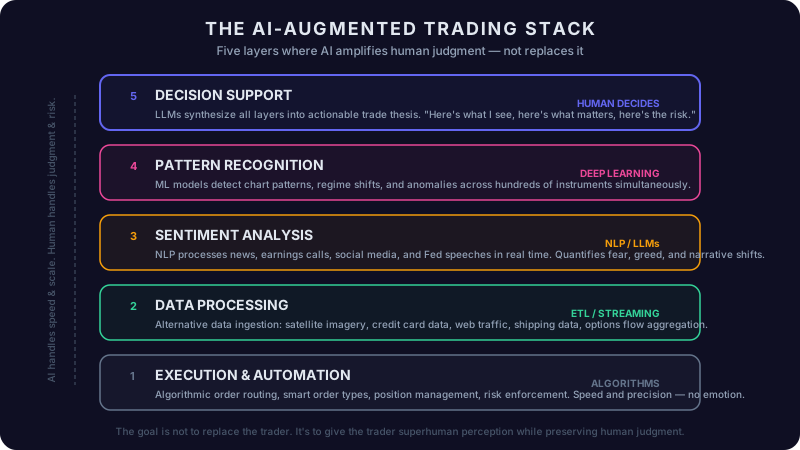
The modern AI trading stack operates in four layers, each building on the one below. Understanding this architecture helps you identify where retail traders can insert themselves to capture edge without replicating an entire institutional infrastructure.
Alternative Data: Beyond Price and Volume
Traditional market data (price, volume, fundamentals) is fully commoditized — everyone has the same access, the same data, the same analysis tools. Alternative data is the new frontier: datasets that reveal economic activity before it shows up in official statistics or earnings reports.
| Alternative Data Type | What It Measures | Lead Time | Retail Access |
|---|---|---|---|
| Credit Card Transactions | Consumer spending by company/sector | 4-8 weeks before earnings | Limited (some retail platforms) |
| Web Traffic Data | User engagement, e-commerce trends | 2-4 weeks lead | Good (SimilarWeb, free tiers) |
| Job Postings | Hiring plans, expansion signals | 3-6 months lead | Good (Indeed, LinkedIn trends) |
| Satellite Imagery | Retail traffic, shipping, oil storage | Real-time to 1 week | Expensive (institutional) |
| Earnings Call Sentiment | Management tone, confidence levels | Immediate post-call | Good (multiple free tools) |
| Social Sentiment | Retail momentum, short squeeze risk | Hours to days | Excellent (StockTwits, Reddit) |
AI Sentiment Analysis: From Noise to Signal
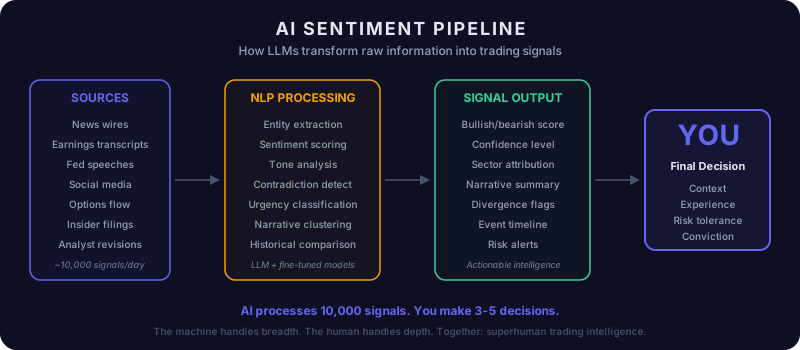
Sentiment analysis is the most accessible AI tool for retail traders. Modern NLP (natural language processing) models can process thousands of documents — earnings call transcripts, news articles, SEC filings, social media posts — and extract directional signals that a human analyst couldn't read in a month.
Earnings Call Transcript Analysis
Management teams reveal far more in how they talk than in the numbers they report. AI sentiment models score transcripts for hedging language, certainty/uncertainty markers, forward guidance tone, and changes in language versus prior quarters. A CEO who used to say "confident" is now saying "hopeful" — that's detectable at scale. Tools like Sentieo, AlphaSense, and Kensho provide institutional-grade transcript analysis; some have retail tiers.
News Flow Sentiment Scoring
Real-time news sentiment scoring aggregates thousands of news articles and research reports, scoring them for positive/negative sentiment toward specific tickers or sectors. When news sentiment diverges from price action — prices rising on deteriorating sentiment or falling on improving sentiment — it flags potential mean-reversion setups that are difficult to identify manually.
Social Sentiment for Crowd Psychology
Social sentiment is noisier than fundamental sentiment but faster. It captures retail momentum before it shows up in price — particularly relevant for meme stocks, short squeezes, and momentum plays. The key metric isn't raw sentiment volume but sentiment velocity: when positive mentions suddenly accelerate, the crowd is about to rush in. Use this for timing entries in momentum setups, not for fundamental analysis.
Regulatory Filing Analysis
10-K and 10-Q filings contain critical risk disclosures that most investors never read. AI tools can flag when language in risk factors changes materially between filings — a company that adds three paragraphs about "liquidity risk" to its risk section is signaling something that the headline numbers might not show. 13F filings (institutional holdings) analyzed at scale reveal smart money accumulation patterns before they're obvious in price.
Machine Learning Pattern Recognition
Beyond sentiment, ML models can identify complex, non-linear patterns in market data that traditional technical analysis misses. The most useful for retail traders:
The AI Arms Race: Where Retail Traders Can Win
Building Your AI-Augmented Workflow
| Workflow Step | Traditional Approach | AI-Augmented Approach | Time Savings |
|---|---|---|---|
| Market Scanning | Manual chart review, 30-50 tickers | AI screeners across 3,000+ tickers with custom signal criteria | 90% reduction |
| News Monitoring | Manual RSS feeds, news alerts | AI-scored news stream, filtered by relevance and sentiment shift | 75% reduction |
| Earnings Research | Manual transcript reading | AI sentiment summary + flagged language changes | 80% reduction |
| Pattern Identification | Manual chart pattern recognition | ML-identified patterns across timeframes and instruments | 85% reduction |
| Trade Journaling | Manual entry, basic tagging | AI-analyzed journals identifying behavioral patterns and edge erosion | 60% reduction |
What's Next
The AI tools are now in your toolkit. In Chapter 24, Options Income Strategies, we return to options — but this time from the seller's perspective. We'll build a complete framework for generating consistent income from the volatility risk premium, using the institutional volatility knowledge from Chapters 20-23 to time and select premium-selling strategies with precision.