Skip to content
v3 redesign is live — welcome to the trading cockpit.
Market updates, stock news, and futures insights — 3x/week, freeSubscribe free
Skip to content
build.logtraders.online=2,166trades.60s=74swings.ranked=308edge.latency_ms=42ms
Back to Blog
Trading Strategies

The Beginner's Guide to POC Bounce Trades

S
Sage

Head of Trading Education

11 min read
Updated June 17, 2026
The Beginner's Guide to POC Bounce Trades

What is "The Beginner's Guide to POC Bounce Trades" about?

A beginner-friendly POC bounce guide for futures traders: what Point of Control means, when a bounce is valid, confirmation rules, stops, targets, and when to pass.

Price pulls back to yesterday's POC. A beginner buys the first touch because the line is green on the chart. Two minutes later, price slices through it, the stop gets hit, and the trader says, "POC doesn't work."

POC was not the problem. The trade was.

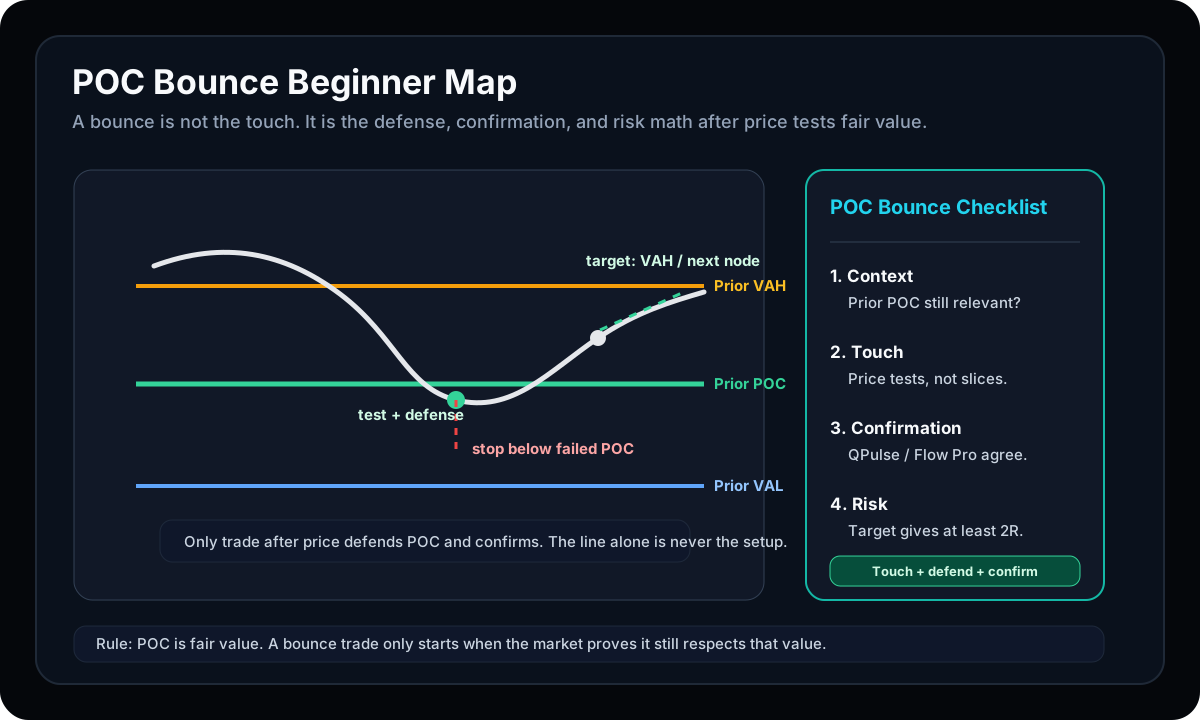
A POC bounce is not a touch. It is a test, a defense, a confirmation, and a risk decision. If one of those pieces is missing, you are not trading a playbook. You are buying a line.

POC bounce beginner trade map showing prior POC, pullback, confirmation, stop placement, and target

What POC Means

POC stands for Point of Control. In a Volume Profile, it is the price where the most volume traded during the selected session or profile period.

Plain English: POC is the price where the market did the most business. It is a fair-value reference, not automatic support or resistance.

That distinction matters. A prior POC can attract price because traders remember it as a high-participation area. But if today's auction is trending hard away from that old value, POC can become irrelevant fast.

If VAH, VAL, POC, HVN, and LVN are still new, read Volume Profile: The Institutional Levels That Actually Matter before treating this as an execution guide.

The Beginner POC Bounce Formula

A clean beginner POC bounce has four parts:

  1. Context: prior POC is still relevant to the current session.
  2. Test: price pulls back to POC without a news shock or liquidation move.
  3. Defense: price stops accepting below the level and begins to rotate.
  4. Confirmation: momentum, order flow, or candle structure supports the bounce.

The setup is not valid at step two. It becomes eligible after step four.

What a Good POC Bounce Looks Like

Phase What You Want What Fails It
ApproachControlled pullback into prior POCVertical selloff through every level
TouchReaction near the levelNo pause, no rejection, no reclaim
ConfirmationQPulse turns, Flow Pro supports, structure reclaimsOnly hope after a red candle
RiskStop is logical and target gives enough RTarget too close or stop placed randomly

The advanced version is the STS POC Bounce Long playbook. This beginner version is the ramp. Learn the behavior first, then add the full STS rules.

Start With the Morning Map

Before the open, mark:

  • Prior session POC.
  • Prior VAH and VAL.
  • Overnight high and low.
  • Current opening location.
  • Major news times.

This is the same workflow in How to Read a Volume Profile Before the Open. The POC bounce is much easier to judge when you know whether price is opening inside value, above value, or below value.

The Best POC Bounce Context

Beginners should look for POC bounce trades when the session is more balanced than directional.

  • Price opens inside or near prior value.
  • Overnight range is not extremely wide.
  • POC sits near a high-volume node, not in thin air.
  • The broader market is not reacting to fresh news.
  • The next target is not immediately blocked.

Positive or balanced regime days are friendlier for this idea than hard trend days. If the market is in a one-way liquidation move, prior fair value can get steamrolled.

Use the futures pre-market checklist before building the trade.

Confirmation: What You Need After the Touch

The beginner mistake is entering at POC because the line is there. Better traders wait for a reason to believe the level is defended.

Useful confirmations include:

  • Price tests below POC and reclaims it.
  • A higher low forms above or around POC.
  • QPulse turns in the bounce direction.
  • Flow Pro shows participation instead of no-go.
  • Delta divergence shows sellers are no longer being rewarded.

You do not need every confirmation. You do need enough evidence to avoid buying a level that the market is rejecting.

Where the Stop Goes

The stop belongs where the bounce idea is wrong. Usually that means below the failed POC test, below the structure that reclaimed POC, or beyond the low that proved buyers stepped in.

Do not place the stop at an amount you "feel comfortable losing" if that level has nothing to do with the chart. That creates a trade where the stop gets hit before the setup is actually invalid.

After choosing the stop, run the math with the futures position size calculator. If the stop is too wide, reduce contracts or pass.

Targets: Where the Bounce Should Go

Common POC bounce targets:

  • Prior VAH.
  • VWAP.
  • Overnight high.
  • Next high-volume node.
  • Measured 2R target if no clean auction level is closer.

The target must leave enough reward after the entry. If the bounce confirms too late and the next resistance is too close, the trade is gone. That is not unfair. That is market structure.

Review reward-to-risk examples if the R math is not automatic yet.

When to Avoid the POC Bounce

  • Price slices through POC without reaction.
  • The POC is stale and today's value has clearly migrated.
  • A major economic release is minutes away.
  • The market is in a strong trend day.
  • Flow Pro says no-go.
  • The stop is too wide for your account.
  • You are taking it because you missed the first move.

That last one matters. A POC bounce is often misused as a revenge entry. If you missed the decision point, log it with the missed trade journal process instead of chasing the second-best entry.

The Beginner Checklist

POC Bounce Pre-Flight

  1. Prior POC is marked before the session.
  2. Current context supports rotation, not a runaway trend.
  3. Price tests POC and shows defense.
  4. At least one confirmation appears after the test.
  5. Stop is structural.
  6. Target gives acceptable reward-to-risk.
  7. Contract size fits the stop.

If you cannot check those boxes, the answer is no trade. The best beginner improvement is not finding more POC bounces. It is refusing the weak ones.

Source and risk notes

  • NinjaTrader's Order Flow Volume Profile documentation references value area display, VAH/VAL labels, and profile display behavior: Order Flow Volume Profile.
  • NinjaTrader's Volume Profile strategy article describes watching for price to retrace back to the previous day's POC and reverse from there in a bullish signal example: 3 Volume Profile Trading Strategies.
  • Sierra Chart's Volume by Price documentation references Point of Control, Value Area High, Value Area Low, and VWAP outputs: Volume by Price study.
  • CME's E-mini S&P 500 page defines ES as a standardized futures product with a $50 times S&P 500 Index contract unit: CME E-mini S&P 500 futures.
  • NFA investor best-practice materials warn that futures trading is risky and should use only risk capital a trader can afford to lose: NFA Investor Best Practices.
  • This article is educational. POC bounce setups can fail, especially during trend days, news events, stale-profile conditions, poor liquidity, or when stop distance exceeds appropriate account risk.

Final rule: POC is not a buy button. It is a place to pay attention. Wait for the test, prove defense, confirm participation, and size from the real stop. If the trade cannot pass that process, let the line sit there without you.

Next Step

Graduate from the beginner map to the full playbook

The beginner version teaches the auction logic. The full STS playbook adds the exact confirmation sequence, timing layer, and execution discipline.

#POC bounce#Point of Control#volume profile#futures strategy#beginner futures
Share this articleTwitterLinkedIn

Frequently asked questions

What is a POC bounce trade?

A POC bounce trade is a setup where price returns to a prior Point of Control, shows that the level is still being defended, and then rotates away with confirmation from structure, momentum, or order flow.

Is every touch of POC a trade?

No. A POC touch is only location. Beginners should wait for defense, confirmation, a defined stop, and enough reward-to-risk before treating it as a trade.

Where should the stop go on a POC bounce?

The stop should go beyond the failed POC test or the structure that proves the bounce idea wrong. It should not be placed randomly just because the trader wants a smaller loss.

What confirms a POC bounce?

Useful confirmation can include a reclaim after a test, a higher low above POC, QPulse turning with the bounce, Flow Pro showing participation, or delta/footprint evidence that sellers are no longer being rewarded.

When should beginners avoid POC bounce trades?

Avoid POC bounces on strong trend days, major news releases, stale profile levels, poor reward-to-risk, or when price slices through POC without any sign of defense.

S
Sage

Head of Trading Education

Head of Trading Education at Nexural. A futures and swing trader who built the Nexural cockpit to survive his own trading — institutional-grade research, an event-sourced journal, and tools whose math is public. Writes the way he trades: receipts over marketing.

Trade with receipts, not vibes

The Nexural cockpit: regime-aware research, an event-sourced journal, and a copilot grounded in your own trades.