
The market opens above yesterday's value. One trader sees green candles and buys the first pullback. Another sees the open is above VAH, overnight inventory is already long, and prior POC is waiting below if buyers fail. Same chart. Different map.
Volume Profile before the open is not about predicting the session. It is about knowing where the auction is likely to make a decision before speed and emotion arrive.
If you can mark prior value, overnight range, and opening location in five minutes, the first thirty minutes become less chaotic. You still might not trade. That is part of the point.
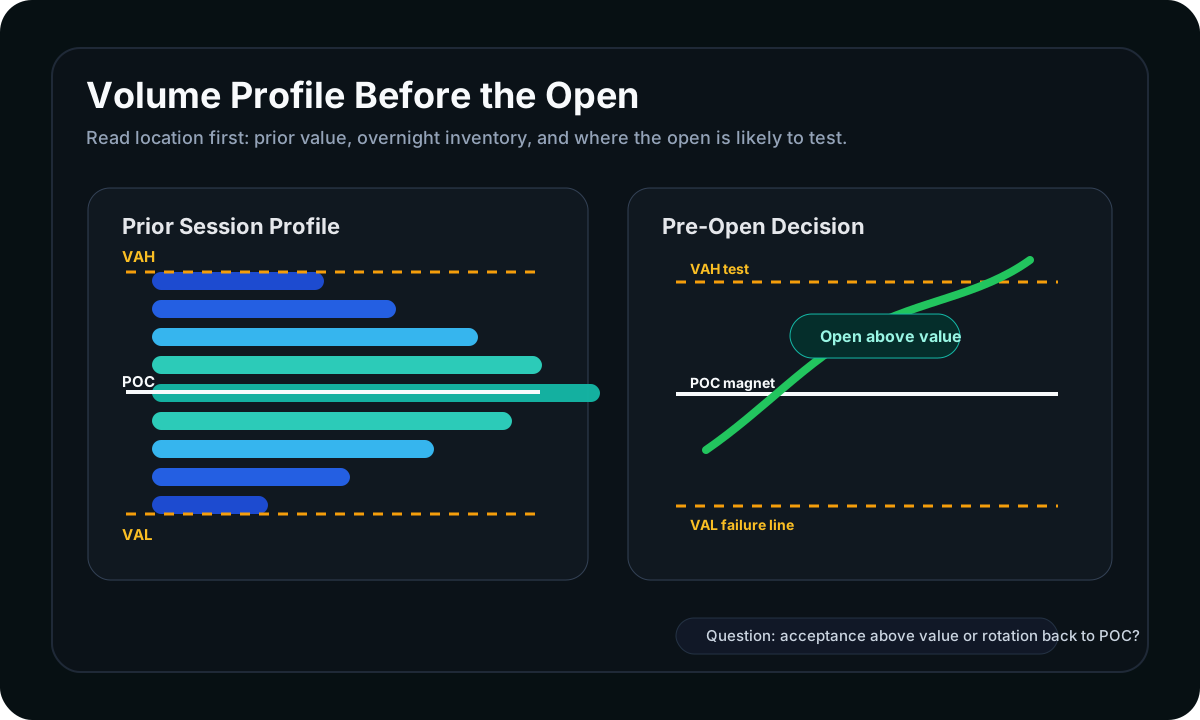
Before the open, mark prior POC, VAH, VAL, high-volume nodes, low-volume areas, overnight high/low, and current price relative to prior value.
The goal is one clean question: is the market accepting away from prior value, or is it likely to rotate back into value?
The Five-Minute Pre-Open Read
Mark these in order. Do not start with the smallest chart. Start with the auction map.
| Level | What it tells you | Pre-open question | Bad use |
|---|---|---|---|
| POC | Most traded price in the profile. | Will price rotate back to fair price? | Blind bounce entry. |
| VAH | Upper edge of prior accepted value. | Acceptance above value or rejection? | Automatic short. |
| VAL | Lower edge of prior accepted value. | Acceptance below value or reclaim? | Automatic long. |
| HVN | Accepted, busy price area. | Will movement slow or balance here? | Expecting fast travel. |
| LVN | Thin participation area. | Can price move quickly through it? | Expecting perfect support. |
Opening Inside Prior Value
When futures open inside prior value, the market starts where business was already accepted. That often favors patience. POC can act like a magnet, VAH and VAL become decision edges, and middle-of-value trades often have poor reward-to-risk.
The beginner mistake is trading every small move inside value. Inside value, location matters more than movement.
Opening Above Prior Value
An open above prior value asks whether higher prices are being accepted. If price holds above VAH, retests from above, and buyers continue to participate, the auction may be migrating higher.
If price fails above VAH and rotates back inside value, the breakout has failed. That is where the VAH breakout guide becomes the next read.
Opening Below Prior Value
An open below prior value is the mirror image. If price accepts below VAL, do not assume a bounce. If price reclaims VAL and holds, a rotation back toward POC becomes more likely.
The open below value is not bearish by itself. The response to VAL is what matters.
ES opens above prior VAH with overnight inventory already long. First trade is not automatic long. The plan is: wait for acceptance above VAH or failed acceptance back inside value.
If buyers hold the retest, continuation is allowed. If price re-enters value, the target becomes POC before any heroic breakout thesis.
No trade if price opens in the middle of value with no edge, news is about to hit, overnight range is unusually wide, POC/VWAP/current price are stacked in a tight grinder, or reward-to-risk is gone by the time confirmation appears.
Turn the Map Into Playbooks
A pre-open Volume Profile read should produce one to three possible plays: POC bounce, VAH rejection, VAL reclaim, or breakout continuation after acceptance and retest.
If the map does not produce a named playbook, the first trade is no trade. Use the futures pre-market checklist and the position size calculator before sizing anything.
Source and risk notes
- NinjaTrader's Order Flow Volume Profile documentation describes value area display, VAH/VAL labels, and a default 68% value-area setting: Order Flow Volume Profile guide.
- NinjaTrader's Volume Profile practice guide defines POC, value area, HVNs, and LVNs as key terms for repeatable practice: Volume Profile practice guide.
- Sierra Chart's Volume by Price documentation references Point of Control, Value Area High, Value Area Low, and VWAP outputs: Volume by Price study.
- This article is educational. Volume Profile can organize location and auction context, but it does not predict direction or guarantee fills, continuation, reversal, or profitability.
Final rule: Volume Profile before the open should reduce decisions, not create more of them. Mark value, locate the open, name the playbook, and wait. If the market never comes to a planned decision point, the best trade was the map that kept you out.
Turn the pre-open map into one playbook
The profile read should produce a level, a scenario, and a no-trade condition before the first order ticket opens.


