Skip to content
v3 redesign is live — welcome to the trading cockpit.
Market updates, stock news, and futures insights — 3x/week, freeSubscribe free
Skip to content
build.logtraders.online=2,166trades.60s=74swings.ranked=308edge.latency_ms=42ms
Back to Blog
Indicators

How to Know When a Trading Level Is Stale

S
Sage

Head of Trading Education

12 min read
Updated June 17, 2026
How to Know When a Trading Level Is Stale

What is "How to Know When a Trading Level Is Stale" about?

A practical futures trader's guide to stale levels: how to judge whether POC, VAH, VAL, prior highs, and support/resistance zones still deserve attention.

The level was perfect on Tuesday. Price hit it, rejected cleanly, and paid the trade. On Wednesday it paused there. On Thursday it chopped through it three times. By Friday you are still drawing the same line, but the market has stopped respecting it.

That is a stale level. It used to matter. Now it is mostly a memory.

The hard part is not finding levels. Most traders can mark prior highs, prior lows, POC, VAH, VAL, VWAP, and obvious supply or demand zones. The hard part is knowing when a level has lost authority.

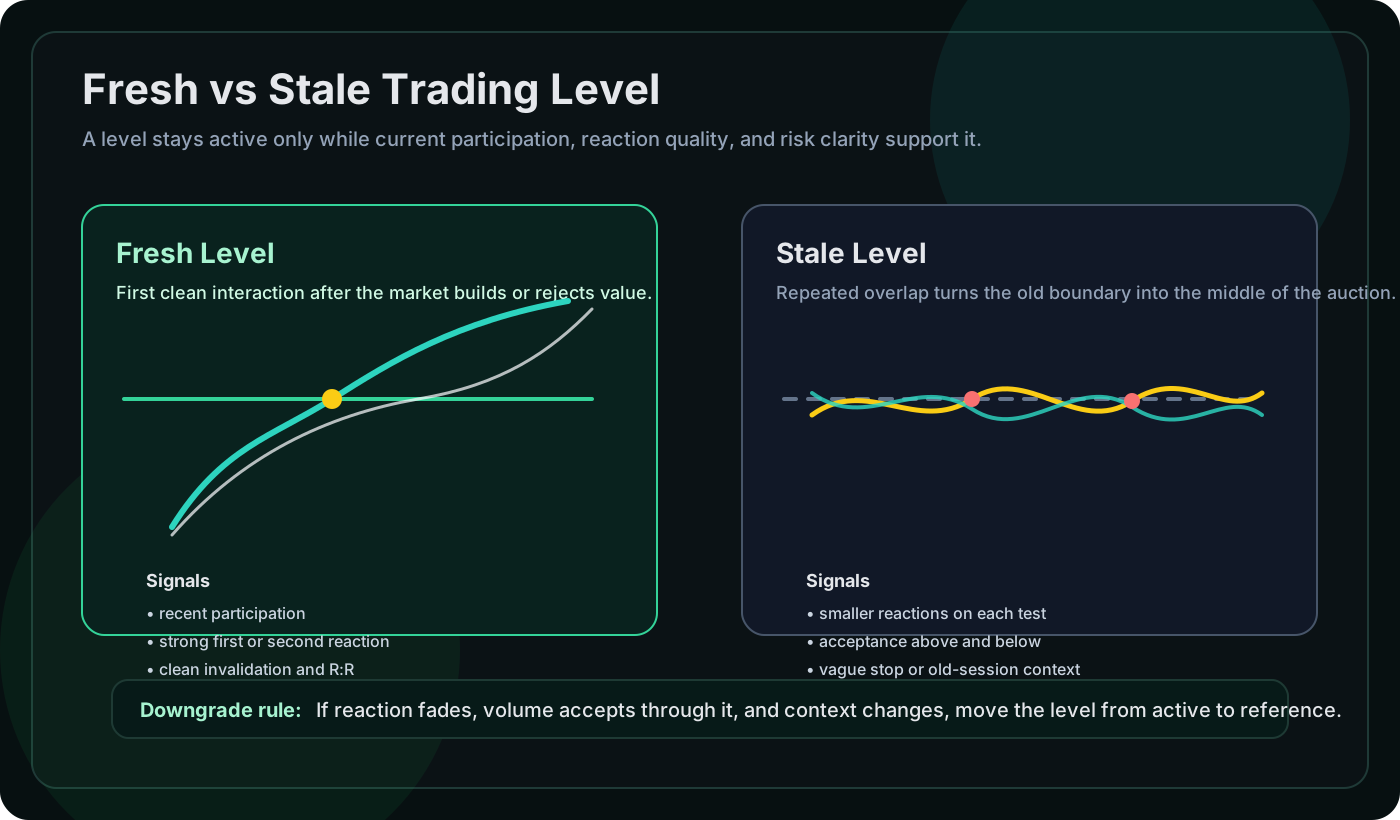
Fresh versus stale trading level scorecard showing reaction quality, time, tests, volume, context, and acceptance

A Level Is Not a Spell

A level is a place where something happened. It is not a guarantee that the same thing will happen again.

Support and resistance work because enough participants remember, defend, avoid, or transact around the same area. Volume profile levels work because they show where business was actually done. Market profile levels work because they reveal where activity concentrated or rejected.

But markets are auctions. Participation changes. Inventory changes. News changes. Volatility changes. A level that mattered during yesterday's balanced session can become irrelevant during today's trend day.

This is why reading volume profile before the open and running a pre-market checklist matter. The chart line is only useful after the current session gives it context.

The Fresh-Level Test

A fresh level has at least three traits:

  1. Recent participation: the level is still connected to current market behavior.
  2. Clear reaction: price does something decisive when it reaches the area.
  3. Clean invalidation: you know what it means if price accepts beyond it.

If you cannot define those three things, the level might still be interesting, but it is not an execution level yet.

The Stale-Level Scorecard

Use this before giving an old level another trade.

Signal Fresh Level Stale Level
Reactionfast rejection or clean acceptancesmall pauses, messy overlap
Testsfirst or second clean interactionmany touches with weaker moves
Volumenew participation appearsvolume builds through both sides
Contextmatches regime and playbookbelongs to an old regime
Riskinvalidation is close and obviousstop location is vague or too wide

When three or more columns point stale, downgrade the level. It can stay on the chart as information, but it should stop acting like a trade trigger.

Sign 1: The Reaction Is Getting Smaller

The first touch of a level rejects six points. The second rejects three. The third rejects one and a half. The fourth just sits there.

That is not "the level is getting stronger." That is often absorption. Participants keep leaning on the same area, and the response is fading.

If you trade POC bounce trades, this matters. A POC touch with sharp response is different from a POC that price has chewed through all morning. The first one may be a decision point. The second one may be fair value.

Sign 2: Price Accepts on Both Sides

A level loses authority when price spends time above it and below it without urgency.

Think about VAH. If price trades above VAH, fails, and returns inside value, a rejection trade can make sense. That is the logic behind the VAH Rejection Short playbook. But if price keeps rotating through VAH from both sides, the level has stopped being a boundary. It has become part of the auction.

Use the VAH breakout guide here. The question is not "is price near VAH?" The question is "is VAH acting like a boundary or has the market accepted it?"

Sign 3: The Level Belongs to the Wrong Session

Yesterday's level can still matter today, but only if today's market has a reason to care.

A prior POC from a slow balanced day may not carry the same weight during a high-volatility trend session. A prior high from a news spike may be less useful once the market has built new value somewhere else. A low-volume node can be useful until the market fills it in with fresh volume.

This is where timeframe selection matters. A five-minute level goes stale faster than a weekly level. A higher-time-frame level can remain relevant longer, but it still needs current reaction before it becomes a trade.

Sign 4: New Volume Has Rewritten the Map

Volume profile helps because it shows where business was done by price, not only when price moved.

If the POC shifts, value migrates, and a new high-volume node forms away from your old level, the market may be telling you the auction has moved. The old level can still be a reference, but the new distribution deserves more respect.

Pair POC vs VWAP with volume profile before the open. POC tells you where volume concentrated. VWAP tells you where the average participant is marked. When both have moved away from yesterday's line, do not pretend the old line is still the main story.

Sign 5: Flow Stops Defending It

A level needs behavior. Without behavior, it is just decoration.

Watch what happens at the level:

  • Do aggressive buyers show up at support?
  • Do aggressive sellers show up at resistance?
  • Does delta confirm the rejection?
  • Does price reject quickly or sit there comfortably?
  • Does the retest improve or degrade the trade location?

Use order flow for beginners and delta divergence as the confirmation layer. If the level has no fresh behavior, do not promote it to a trade.

Example: The Old POC Trap

MES Prior POC at 5324.00

Monday: POC forms at 5324.00 during a balanced session. Clean reaction on first retest.

Tuesday: Price opens above it, pulls back, and bounces. Still useful.

Wednesday: Price trades through 5324.00 seven times. Value builds around it.

Thursday: Trader buys the level because "POC held earlier this week" and gets chopped out.

Review: The level was no longer support. It had become the middle of a new auction.

The mistake was not marking POC. The mistake was treating old respect as current permission.

Downgrade, Do Not Delete Everything

Deleting every old level creates another problem. You lose historical context.

Use three labels instead:

  • Active: recent reaction, current context, clean invalidation.
  • Reference: still visible, but not a standalone trigger.
  • Removed: clutter, no current value, no higher-time-frame importance.

Most stale levels should move from active to reference before they disappear. That keeps the chart honest without letting old lines boss you around.

How to Refresh a Level

An old level can become useful again if the market gives it new evidence.

Refresh signals include:

  • a clean failed breakout and return,
  • new volume building at the same price,
  • a higher-time-frame level aligning with the same area,
  • order flow defending the level again,
  • a clean retest after a break and acceptance.

That last point matters for setup versus trade. A refreshed level is still only a setup until risk, confirmation, and execution all pass.

The Stale-Level Checklist

Before trading an old level, answer these:

  1. When did this level form?
  2. What made it important?
  3. Has new value formed somewhere else?
  4. How many times has it been tested?
  5. Are reactions getting stronger or weaker?
  6. Is price accepting on both sides?
  7. Does the current regime support the trade?
  8. Where is invalidation?
  9. Does reward-to-risk still work?
  10. Would I trade this if the line were not already on my chart?

That last question is brutal and useful. If the only reason you care is because the line is already there, downgrade it.

What to Journal

Add a level-quality field to your Nexural journal:

  • fresh level,
  • reference level,
  • stale level traded anyway,
  • refreshed level,
  • accepted-through level.

Then review the losing trades with the losing-trade review process. If a cluster of losses comes from stale levels, the fix is not more discipline in general. The fix is a better level-aging rule.

Risk Rule

A stale level should never get full-size treatment.

If you insist on testing a questionable level, reduce size, demand stronger confirmation, or skip until the level refreshes. Use the futures position size calculator and the R-multiple calculator before entering. A wide, vague stop around an old line is not risk management. It is nostalgia with leverage.

Source and risk notes

  • CME's technical analysis course frames support/resistance, trends, chart patterns, and indicators as techniques traders use when studying futures price behavior: CME Technical Analysis.
  • NinjaTrader's volume profile education explains using high-volume nodes and POC behavior to build data-driven levels and cautions that volume profile helps traders react rather than predict: NinjaTrader Volume Profile.
  • NinjaTrader's volume analysis guide describes futures volume as an important input for reading market trends and sentiment: Analyze Volume in Futures Markets.
  • Investopedia's support and resistance overview notes that support/resistance are often zones rather than exact prices and that flexibility is required because technical analysis is not exact: Support and Resistance Basics.
  • NFA investor best-practice materials warn that futures trading carries substantial risk and should use only risk capital a trader can afford to lose: NFA Investor Best Practices.
  • This article is educational. Level analysis can improve process, but it cannot remove leverage, liquidity, slippage, platform, event, or execution risk.

Final rule: a level earns attention from what the market is doing now, not from how well it worked last week. Keep the line if it helps context. Stop trading it when the auction has moved on.

Next Step

Downgrade stale levels before they cost you

A level deserves trade authority only while current reaction, participation, and risk clarity still support it.

#trading levels#volume profile#support and resistance#futures trading#market structure
Share this articleTwitterLinkedIn

Frequently asked questions

What is a stale trading level?

A stale trading level is a previously important price area that no longer has enough current participation, context, or reaction quality to justify trading it as a fresh support or resistance zone.

How many times can a level be tested before it gets weak?

There is no fixed number. A level gets weaker when each test produces smaller reactions, more overlap, weaker flow, or eventual acceptance through the area.

Can an old level still matter?

Yes. Older levels can still matter when they come from higher time frames, high-volume nodes, major auction extremes, or areas where new participation confirms the level again.

What is the best way to confirm a stale level?

Watch the next interaction. If price accepts through the level, volume builds on both sides, and rejection disappears, the level should be downgraded or removed.

Should stale levels be deleted from the chart?

Not always. Downgrade them first. Keep major higher-time-frame references visible, but stop treating them as automatic entry triggers unless current context refreshes them.

S
Sage

Head of Trading Education

Head of Trading Education at Nexural. A futures and swing trader who built the Nexural cockpit to survive his own trading — institutional-grade research, an event-sourced journal, and tools whose math is public. Writes the way he trades: receipts over marketing.

See the indicators on a live chart

The Nexural Swing Desk runs these reads in real time — volume profile, flow, and regime on one board.