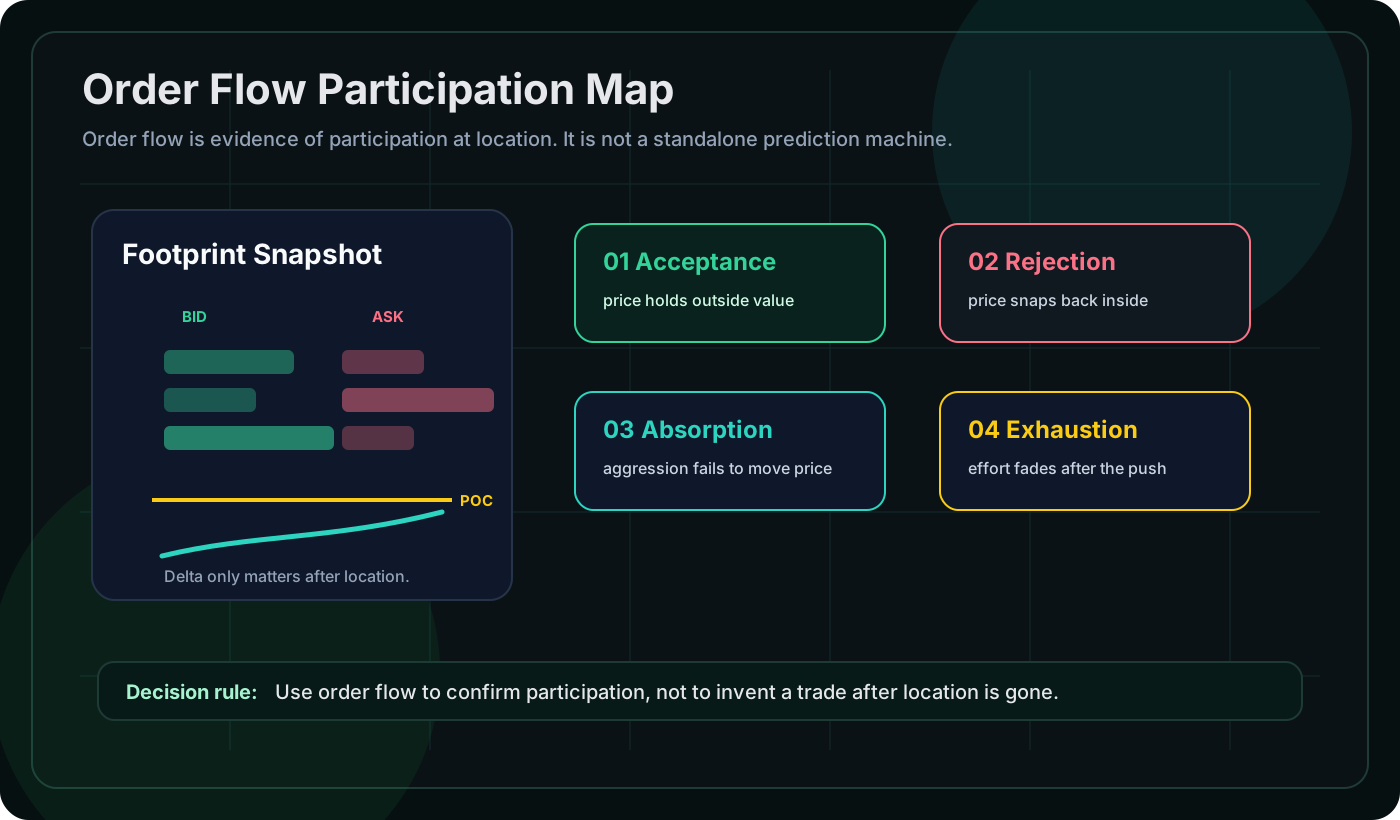
Last Tuesday at 10:14 AM, ES was sitting at 5,292 — 3 points below yesterday's VAH. The 5-minute candle was green. RSI was mid-range. MACD was neutral. From a chart perspective, it looked like a nothing setup. But the footprint told a different story: 4 consecutive price levels showed 3:1 buy imbalance, cumulative delta was making new session highs while price was flat, and a 214-lot block printed at the bid — an iceberg refilling as sellers hit it.
I entered long at 5,293. Stop at 5,288 (5 points, $250). ES hit 5,310 by 11:05 AM — a clean 3.4R trade. The chart never gave a signal. The order flow screamed it.
That's the difference between price-based trading and order flow trading. Price shows you the result. Order flow shows you the cause.
The bad belief this post is killing: order flow is a magic window into institutional intent. It is not. Order flow shows traded behavior, not motive. You can see aggression, absorption, and exhaustion. You cannot read a fund manager's mind. Anyone selling that fantasy is selling expensive candle astrology with a footprint chart.
The Auction Framework
Every futures market is a two-sided auction. Buyers and sellers negotiate prices in real time. At any given moment, the order book has two sides:
Passive orders (limit orders) sit in the book waiting to be hit. Aggressive orders (market orders) cross the spread to execute immediately. The direction of aggression is the core signal: when buyers are more aggressive (hitting the ask), they're paying a premium for urgency. When sellers are more aggressive (hitting the bid), they're accepting a discount to get out.
Order Flow Translation Desk
| What You See | Possible Meaning | Do This |
|---|---|---|
| price flat, delta rising | passive sellers absorbing buyers | wait for break |
| price flat, delta falling | passive buyers absorbing sellers | watch reversal |
| price up, delta up | buyers aggressive and rewarded | trend eligible |
| price up, delta down | hollow move, weak participation | do not chase |
The Three Tools That Matter
1. Cumulative Delta — The Aggression Barometer
Delta = volume at ask (aggressive buyers) minus volume at bid (aggressive sellers). Cumulative delta is the running total. Rising delta means sustained buying aggression. Falling delta means sustained selling aggression.
But here's the insight most order flow courses miss: the direction of delta doesn't matter as much as the relationship between delta and price.
| Pattern | Price | Delta | Reading | Action |
|---|---|---|---|---|
| Confirmation | ↑ New high | ↑ New high | Buyers are committed. Move has legs. | Trade with trend |
| Buyer exhaustion | ↑ New high | ↓ Declining | Move is running on momentum, not fresh demand. | Fade potential |
| Seller exhaustion | ↓ New low | ↑ Rising | Passive buyer absorbing all selling. Reversal building. | Buy signal |
| Confirmation | ↓ New low | ↓ New low | Sellers are committed. Downtrend valid. | Trade with trend |
The divergence rows are where the money is. When price makes a new high but delta is declining, the move is hollow — buyers aren't stepping up with fresh aggression. This is what Flow Pro detects automatically: the go/no-go filter that prevents you from chasing exhausted moves.
2. Footprint Charts — Inside the Candle
A regular candlestick shows open, high, low, close. A footprint chart shows every transaction at every price level within that candle. You see exactly how many contracts traded at the bid versus the ask at each tick.
The three footprint patterns I trade:
- Imbalance stacking: 3+ consecutive price levels showing 300%+ buy-to-sell ratio. This is institutional commitment — not a retail trader, not an algorithm probing. Someone with size is buying aggressively across multiple levels.
- Absorption: Heavy volume at the bid with price holding steady (not declining). A passive buyer is absorbing all selling pressure without letting price drop. This is how institutions accumulate — they don't lift the ask aggressively, they sit on the bid and let sellers come to them.
- Exhaustion print: A volume spike at the extreme of a move (highest tick on an uptrend, lowest tick on a downtrend) with price failing to extend. The last aggressive buyer just bought at the worst possible price. The move is done.
3. Volume Profile — Where Institutions Committed
Volume Profile is the third leg of the order flow trinity. Where delta shows who (aggressive buyers/sellers), and footprint shows how (the pattern of transactions), Volume Profile shows where — the price levels where the most volume concentrated.
POC (Point of Control), VAH (Value Area High), and VAL (Value Area Low) are the magnetic levels that price rotates around. The STS system is built on this: WHERE (Volume Profile levels) + WHEN (QPulse momentum) + GO/NO-GO (Flow Pro order flow filter).
The Institutional Signatures
Institutions don't announce their orders. They use algorithms to slice large positions into thousands of small fills to minimize market impact. But the signatures are visible if you know what to look for:
- The sweep-and-fill. ES drops 4 points in 90 seconds, sweeping through retail stop-losses clustered below the session low. Delta spikes negative during the drop — aggressive selling. Then immediately, within 2-3 bars, delta reverses hard. Price recovers 6 points. What happened? An institution used the retail stop cascade as liquidity to fill a large buy order at a better price. This is the most common institutional pattern in ES.
- The iceberg. A price level shows enormous volume in the footprint (500+ contracts at a single tick on ES) but price doesn't move through it. The order is refilling — every time it gets hit, it reloads. You can't see icebergs in the order book (they hide the true size). You can only see them in the footprint after they've traded.
- The block print. A single transaction of 100+ contracts on ES (or 200+ on NQ) appears in the tape. This is too large for retail. Someone with institutional conviction just entered or exited. Check which side it printed on: at the ask (aggressive buy) or at the bid (aggressive sell).
Putting It Together: The STS Order Flow Framework
Order flow alone isn't a strategy — it's confirmation. The strongest setups in the STS system combine three layers:
- Structural level from Volume Profile (WHERE the setup happens)
- Momentum signal from QPulse (WHEN the momentum shifts)
- Order flow confirmation from Flow Pro (GO/NO-GO based on delta, absorption, or imbalance)
When all three align, the probability of the setup working rises dramatically. When only one or two are present, the scorecard tells you to reduce size or sit out entirely.
The full indicator suite — Volume Profile, QPulse, Flow Pro, and 39 more — is free to download. No account, no email gate, no trial timer.
A Real Order Flow Trade: Step by Step
Let me walk through an actual trade from last week to show how these tools work together in practice.
Context: Wednesday, May 21, 2026. ES opened at 5,318. Yesterday's POC was at 5,304. GEX was positive — mean reversion environment. The overnight range was narrow (12 points), suggesting a balanced session ahead.
9:45 AM: ES sold off from the open, dropping to 5,306 — approaching yesterday's POC at 5,304. Standard pullback into a high-volume node. I'm watching, not trading yet.
9:52 AM: Price touches 5,304. Footprint chart shows the last 3 bars have heavy volume at the bid (sellers are aggressive), but the price isn't dropping further. Someone is absorbing. The bid volume at 5,304.00 reads 847 contracts over 3 bars — that's significant resting demand.
9:55 AM: QPulse on the 3-minute chart crosses zero from below — momentum shifting bullish. Cumulative delta, which had been declining all morning, starts rising even though price hasn't bounced yet. This is the divergence: sellers are exhausting themselves against a passive buyer.
9:57 AM: Flow Pro flips green — the go/no-go filter confirms order flow supports a long entry. I enter long at 5,305.25. Stop at 5,299.75 (5.5 points, $275 risk on 1 contract). Target: yesterday's VAH at 5,320 (14.75 points, $737.50 potential).
R:R at entry: 14.75 / 5.5 = 2.68:1. This passes the Asymmetric Filter minimum of 2:1.
10:22 AM: ES hits 5,316. I trail my stop to 5,310 (locking in 4.75 points / $237.50 worst case). Cumulative delta is still making new session highs — buyers are committed, not exhausting.
10:41 AM: ES reaches 5,319.75. One tick from my target. Delta starts flattening — buyers are losing aggression at resistance. I close at 5,319.50 for +14.25 points ($712.50). That's 2.59R on the trade.
What made this trade work:
- Volume Profile identified the level (yesterday's POC at 5,304)
- Footprint showed absorption (847 contracts resting at 5,304)
- Cumulative delta diverged (rising delta with flat price = seller exhaustion)
- QPulse confirmed momentum shift (zero-line cross from below)
- Flow Pro gave the go signal (order flow supportive)
- GEX confirmed regime (positive = mean reversion favored)
No single tool gave the signal. The confluence of all six is what creates high-probability setups. This is the STS framework in action — WHERE + WHEN + GO/NO-GO.
When Order Flow Lies
Order flow is not infallible. These are the conditions where I reduce my trust in flow signals:
- Low-volume sessions. During ETH (overnight), order flow signals are noisy. A 50-contract imbalance at 3 AM is meaningless — during RTH that same imbalance would be 500 contracts.
- Around major data releases. CPI, FOMC, NFP — the order book thins out 5-10 minutes before. Resting orders get pulled. The footprint shows fake absorption that evaporates the instant the number drops.
- During liquidation cascades. When stops are being swept en masse, delta goes extremely negative — but that doesn't mean sellers are in control. It means stops are being run. The reversal comes after the cascade, not during it. Wait for the delta to stabilize before trusting it.
- Options expiration days. Monthly and quarterly OpEx creates mechanical flows from delta hedging that look like directional order flow but are actually hedging artifacts. The GEX framework helps decode these.
Understanding when your tools fail is as important as understanding when they work. The Asymmetric Scorecard includes a "conditions" check — if the conditions are hostile (low volume, pre-news, OpEx), the scorecard reduces allowed size or says sit out entirely.
Final rule: order flow is confirmation, not permission. If the level is bad, the timing is late, or the regime is hostile, a beautiful footprint pattern is still a bad trade wearing better data.