Skip to content
v3 redesign is live — welcome to the trading cockpit.
Market updates, stock news, and futures insights — 3x/week, freeSubscribe free
Skip to content
build.logtraders.online=2,166trades.60s=74swings.ranked=308edge.latency_ms=42ms
Back to Blog
Order Flow

Why Clean Chart Setups Fail Without Flow

S
Sage

Head of Trading Education

12 min read
Updated June 17, 2026
Why Clean Chart Setups Fail Without Flow

What is "Why Clean Chart Setups Fail Without Flow" about?

Clean chart patterns fail when participation does not confirm the idea. Learn how futures traders can use order flow, delta, volume, and context before risking money.

The setup is clean. Prior high retest. Perfect little wick. Trendline touch. Candle closes exactly where the textbook says it should. You enter, the market pauses for three seconds, then drives straight through the level like it was painted on the screen for your personal entertainment.

That trade did not fail because the chart was ugly. It failed because the chart was alone.

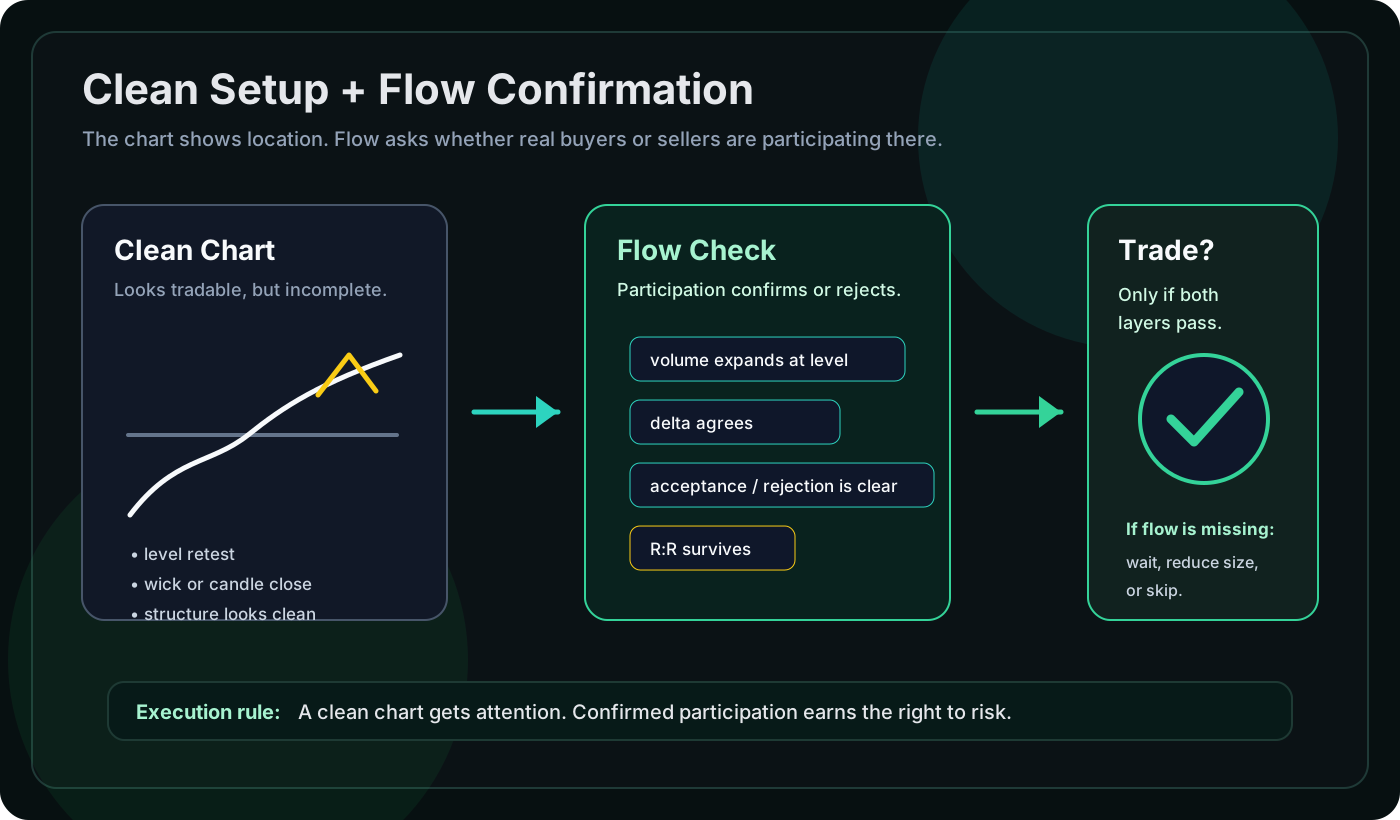
Clean price action can show you where a trade might happen. Order flow helps answer the better question: is anyone actually participating there?

Clean chart setup flow confirmation map showing level, context, volume, delta, acceptance, risk, and journal review gates

The Problem With Pretty Setups

Pretty setups are dangerous because they feel complete.

You see a flag, a retest, a wick, a POC bounce, a VAH rejection, or a double bottom. The shape is familiar. The brain relaxes. It wants to skip the boring checks and get paid for recognizing the pattern.

But a pattern is not participation. A level is not defense. A candle close is not proof that the other side is trapped.

This is the same lesson from the setup versus trade guide. A setup asks for attention. A trade needs confirmation, risk, timing, and context.

What Flow Adds

Order flow adds the participation layer beneath the chart.

It helps you ask:

  • Are aggressive buyers actually lifting offers?
  • Are aggressive sellers actually hitting bids?
  • Is volume expanding where the trade needs defense?
  • Is cumulative delta confirming or disagreeing?
  • Is price accepting beyond the level or rejecting quickly?
  • Is the move following through after the trigger?

If you are new to this, start with Order Flow for Beginners. You do not need to read every footprint cell. You need to know whether the market is supporting the idea or quietly refusing it.

The Clean Setup That Fails

Imagine a clean long setup at prior support:

  1. Price pulls into a mapped level.
  2. The candle wicks below and closes back above.
  3. The structure looks like a rejection.
  4. The target is prior value area high.

On the chart, it looks fine. Under the chart, the flow tells a different story:

  • Volume is thin on the bounce.
  • Delta stays negative while price lifts.
  • Buyers cannot hold above the trigger candle.
  • The retest accepts below support instead of rejecting.
  • The stop has to sit far away because the level is messy.

That is not a high-quality long. It is a nice-looking chart with weak participation.

Flow Confirmation Matrix

Use this matrix before trusting a clean setup.

Chart Signal Flow Must Confirm Warning Sign
Support bouncebuyers defend and delta improvesthin bounce, negative delta
Resistance rejectionsellers absorb and presshigher prices keep accepting
Breakoutvolume expands through the levelbreakout on weak volume
Pullbackselling fades into demandpullback turns into acceptance lower
POC bounceparticipation returns at valuePOC becomes chop center

This is not about adding clutter. It is about asking the setup to prove it has buyers or sellers behind it.

Example 1: POC Bounce Without Flow

The POC bounce is one of the easiest setups to overtrust because the level feels objective. Price returns to a high-volume area. It reacts. You want the bounce.

But read the sequence:

  • Price spends thirty minutes rotating around POC.
  • Each bounce gets smaller.
  • Delta stays heavy on the bid.
  • Volume builds on both sides of the level.
  • The next push above POC cannot hold.

That is not a clean beginner POC bounce. That is a level turning into the middle of the auction. Pair it with the stale-level guide before taking another trade there.

Example 2: VAH Rejection With Flow

Now compare a VAH rejection that has real participation.

Price pushes above VAH, fails to build value, then snaps back inside. Sellers press after the failed acceptance. Delta stops confirming higher prices. The next retest cannot reclaim VAH. The stop is clear above the failed auction.

That is not just a pretty reversal candle. It is a rejection with evidence.

This is the difference between randomly fading a level and trading the logic behind the VAH Rejection Short playbook. If you need the broader level framework, review the VAH breakout guide.

Three Flow Checks Before Entry

1. Volume at the level

Volume tells you whether the market is doing business there. A breakout with no volume is fragile. A reversal at support with expanding buying volume is more believable than a lonely wick.

For context, use volume profile before the open and POC vs VWAP. The best level is not the one that looks neat. It is the one where current participation lines up with location.

2. Delta agreement

Delta shows whether aggressive buying or selling supports the price move. It does not need to be perfect. It does need to make sense.

If price pushes higher but delta refuses to confirm, you may be seeing weak lift, absorption, or a trap. If price tests support and delta improves while sellers fail to press, the bounce has more evidence.

Use Delta Divergence Explained for Futures Traders for that read.

3. Acceptance versus rejection

The market can touch a level, wick through it, and still accept beyond it. That is how traders get trapped by clean candles.

Ask whether price is rejecting quickly or spending time comfortably beyond the level. Rejection gives you a boundary. Acceptance tells you the boundary may be gone.

Where Traders Misuse Flow

Order flow is not a magic permission slip.

Common mistakes:

  • using one delta print as a trade signal,
  • ignoring the higher-time-frame regime,
  • chasing after the flow confirmation arrives too late,
  • treating large volume as automatically bullish or bearish,
  • adding indicators until the trade becomes unreadable.

Flow should confirm a trade plan, not replace it. Use the pre-market checklist first. Then use flow at the level.

The Late Confirmation Problem

Sometimes flow confirms, but too late.

You wait for perfect evidence. The candle closes far from the level. Delta expands. Volume surges. Now the setup looks obvious, but your stop is wider, your target is closer, and your R:R is damaged.

That is why waiting for candle close can ruin R:R. Confirmation is useful only if the trade is still tradable after it appears. Check the math with the R-multiple calculator before chasing.

A Better Entry Script

Before entry, say this:

The chart setup is [setup] at [level]. Flow confirms because [volume/delta/acceptance evidence]. I am wrong if [invalidation]. The trade still offers [R].

If the flow sentence is vague, wait. If the invalidation is vague, skip. If the R is gone, the trade is gone too.

Journal the Failure Type

When a clean setup fails, do not just write "bad trade." Classify it:

  • No-flow failure: pattern looked good, participation never confirmed.
  • Late-flow failure: confirmation arrived after R:R decayed.
  • Absorption failure: aggressive activity appeared, but price could not move.
  • Acceptance failure: price accepted beyond the level you expected to hold.
  • Regime failure: flow was present, but the broader day type fought the trade.

Track that in the Nexural journal and review losses with the losing-trade review workflow. The goal is not to make every clean setup work. The goal is to stop paying full price for setups with no participation.

Risk Rule

If the setup is clean but flow is missing, size down or do nothing.

Use the futures position size calculator before the trade, not after the loss. A clean chart is not a substitute for stop distance, contract math, or daily risk limits.

Source and risk notes

  • NinjaTrader's Order Flow trading page describes volumetric bars as tracking buyers and sellers tick by tick for a fuller view of activity: Order Flow Trading & Volumetric Bars.
  • NinjaTrader's cumulative delta education describes cumulative delta as a way to summarize buying versus selling activity and help assess direction, trend strength, and support/resistance areas: What Is Cumulative Delta?.
  • CME's Market by Order overview explains that MBO data can show individual queue position, full depth of book, and order size at each price level: CME Market by Order.
  • Investopedia's volume overview notes that volume can help confirm support/resistance behavior and price movement strength: Volume Explained.
  • NFA investor best-practice materials warn that futures trading carries substantial risk and should use only risk capital a trader can afford to lose: NFA Investor Best Practices.
  • This article is educational. Order flow can improve confirmation, but it cannot remove leverage, slippage, liquidity, event, platform, or execution risk.

Final rule: a clean chart tells you where the trade might be. Flow tells you whether the market is showing up. If nobody is showing up, the prettiest setup on your screen is still allowed to fail.

Next Step

Add the participation check before the trigger

A clean setup deserves attention, but the trade needs volume, delta, acceptance, and risk math before it earns capital.

#order flow#clean chart setups#cumulative delta#futures trading#trade confirmation
Share this articleTwitterLinkedIn

Frequently asked questions

Why do clean chart setups fail?

Clean chart setups fail when the pattern looks good but current participation does not support it. The level may be real, but buyers or sellers are not defending it with enough volume, delta, or follow-through.

What does order flow confirm in a futures trade?

Order flow helps confirm whether aggressive buyers or sellers are actually participating at the level, whether pressure is expanding or fading, and whether the setup has enough real-time support to justify risk.

Is price action enough without order flow?

Sometimes, but price action alone can hide weak participation, absorption, late entries, and traps. Flow is useful because it adds a participation layer beneath the chart pattern.

What order flow signs matter most for beginners?

Beginners should focus on whether volume expands at the level, whether cumulative delta supports the direction, whether price rejects or accepts, and whether the move follows through after the trigger.

Can order flow still be wrong?

Yes. Order flow is confirmation, not certainty. It can improve trade selection, but it cannot remove slippage, event risk, liquidity changes, or normal losing trades.

S
Sage

Head of Trading Education

Head of Trading Education at Nexural. A futures and swing trader who built the Nexural cockpit to survive his own trading — institutional-grade research, an event-sourced journal, and tools whose math is public. Writes the way he trades: receipts over marketing.

Trade with receipts, not vibes

The Nexural cockpit: regime-aware research, an event-sourced journal, and a copilot grounded in your own trades.