Skip to content
v3 redesign is live — welcome to the trading cockpit.
Market updates, stock news, and futures insights — 3x/week, freeSubscribe free
Skip to content
build.logtraders.online=2,166trades.60s=74swings.ranked=308edge.latency_ms=42ms
Back to Blog
Trading Psychology

How to Review a Losing Trade Like a Professional

S
Sage

Head of Trading Education

11 min read
Updated June 17, 2026
How to Review a Losing Trade Like a Professional

What is "How to Review a Losing Trade Like a Professional" about?

A practical losing-trade review workflow for futures traders: separate normal losses from mistakes, grade setup and execution, tag the pattern, and turn the loss into one behavior rule.

The worst losing-trade review is the one that starts with a mood: "I was stupid." That sentence feels honest, but it teaches nothing. It does not tell you whether the setup was bad, the entry was late, the size was wrong, or the trade simply lost inside normal expectancy.

Professional review is colder than that. It turns one loss into evidence. It separates a normal losing trade from a correctable mistake.

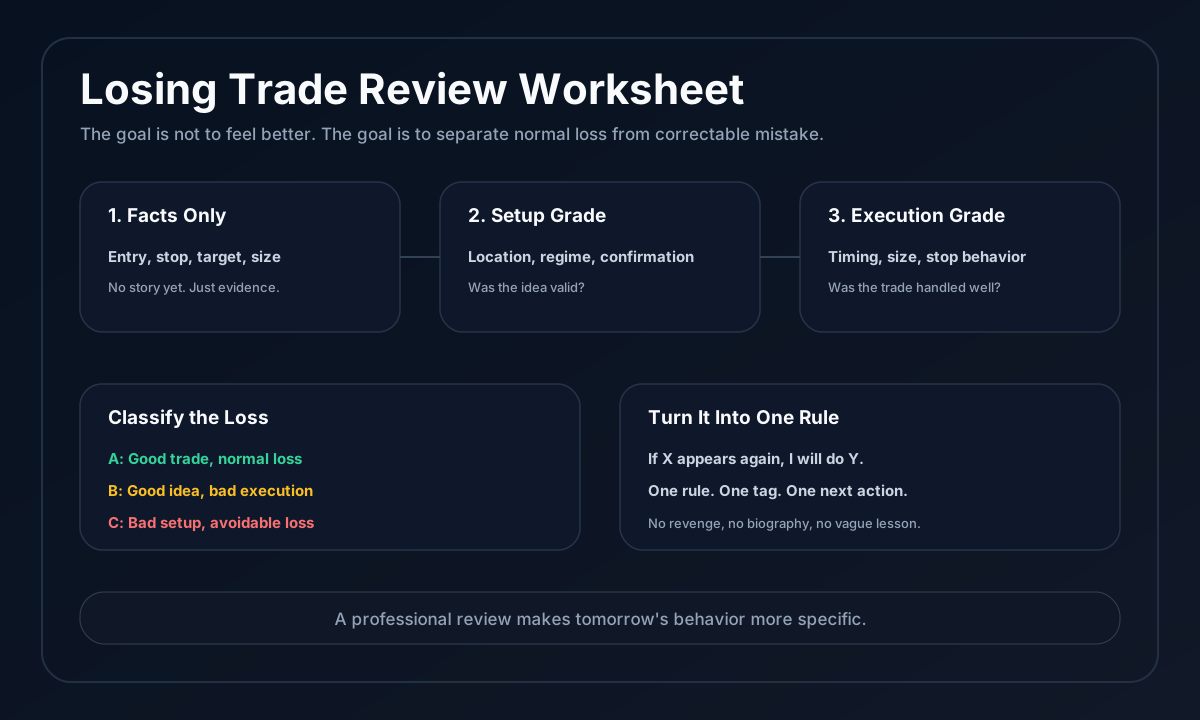
Losing trade review worksheet showing facts, setup quality, execution quality, loss classification, and next rule

The Rule: Facts First, Story Later

Right after a loss, your brain wants a story. The market was manipulated. The setup was cursed. You are terrible. The indicator failed. The one thing you should not do is let that story become the journal entry.

Capture facts first:

  • market and contract,
  • entry price, stop price, target price,
  • contract size,
  • setup name,
  • time of day,
  • regime,
  • confirmation,
  • planned risk, actual loss, and slippage.

Use the futures trading journal process for the structure. A professional review starts with evidence because emotion is a bad historian.

Classify the Loss

Every losing trade belongs in one of four buckets:

Bucket Meaning Action
Normal lossgood setup, followed rules, trade failedaccept and log
Execution errorgood idea, poor timing or handlingfix entry/exit behavior
Setup errortrade should not have been takentighten checklist
Rule violationyou knew better and did it anywayreduce size or stop trading

Do not put every loss in the mistake bucket. That creates fear. Do not put every loss in the normal bucket either. That creates denial.

Review the Setup

Ask whether the idea deserved a trade before you judge the outcome.

  1. Was the trade at a real level?
  2. Was the market regime compatible?
  3. Was there confirmation?
  4. Was the stop placed at invalidation or just at pain tolerance?
  5. Did reward-to-risk still work at the actual entry?

If you traded a POC bounce, compare it against the beginner POC bounce guide or the full POC Bounce Long playbook. If you faded VAH, compare it against the VAH breakout guide and the VAH Rejection Short playbook.

The question is not "did it lose?" The question is "would I want this same trade in the next 100 samples?"

Review the Execution

A valid idea can still become a bad trade.

  • Did you enter late?
  • Did you wait for candle close until R:R decayed?
  • Did you move the stop?
  • Did you take partials randomly?
  • Did you add size because you wanted to be right?

Use the candle-close R:R guide and reward-to-risk examples here. A trade can be right at the trigger and wrong at the fill.

Review the Risk

Risk review is where excuses go to die.

Write the planned risk and actual loss side by side. If they are not close, something happened:

  • slippage,
  • oversizing,
  • bad stop placement,
  • late exit,
  • or a rule violation.

Use the futures tick value cheat sheet, the position size calculator, and Futures Margin vs Risk. If the loss was larger than planned, the review is not complete until you know why.

Review the Regime

Many losing trades are not bad patterns. They are good patterns in the wrong environment.

A mean-reversion trade in negative GEX continuation is not the same trade as a mean-reversion trade in positive GEX rotation. A breakout attempt into a dampened range is not the same as a breakout with expanding participation.

Tag regime in the journal:

  • trend, range, or transition,
  • positive GEX, negative GEX, or unknown,
  • news day or normal day,
  • opening hour, midday, or close,
  • liquid or thin conditions.

If you do not tag regime, you will keep blaming the setup when the real problem was environment.

Example Review

MES Long, POC Bounce Attempt

Facts: Long MES at 5302.25, stop 5298.25, target 5310.25. Four-point stop, eight-point target, two contracts.

Setup: POC test was valid, but GEX was negative and prior VAH had already accepted higher value.

Execution: Entry was two candles late after the bounce started. R:R dropped from 2R to 1.1R.

Classification: Good location idea, bad regime and late execution.

New rule: If GEX is negative and price accepts outside value, no POC bounce unless flow shows failed continuation first.

That review is useful because it creates a next behavior. "I need discipline" does not.

The One-Rule Standard

Every losing-trade review should end with one rule, not seven.

Good rules look like this:

  • If the entry is more than three candles late, skip it.
  • If planned R:R falls below 1.5R, skip it.
  • If daily loss hits 50% of limit, reduce size or stop.
  • If negative GEX accepts outside value, do not fade without failed continuation.
  • If the setup has no screenshot, it does not count as reviewed.

Use the daily loss limit guide and the losing-streak reset if the loss is part of a bigger behavioral pattern.

What Not to Do

  • Do not rewrite the system after one normal loss.
  • Do not call every losing trade a psychology issue.
  • Do not judge a setup only by outcome.
  • Do not hide screenshots from the journal.
  • Do not increase size to "make the lesson back."
  • Do not review while revenge mode is still active.

If the trade was missed, use the missed-trade journal process. If it was taken and lost, use this one. Different error, different review.

Source and risk notes

  • CME's position and risk management education describes tracking P&L and using profit or loss targets to decide whether to exit a position: CME Position and Risk Management.
  • NFA investor best-practice materials warn that futures trading is risky and should use only risk capital a trader can afford to lose: NFA Investor Best Practices.
  • NinjaTrader's futures best-practices article emphasizes knowing contracts, managing risk, and continued education for futures traders: 6 Best Practices for Trading Futures.
  • E*TRADE's futures trading plan guide describes building a plan around objectives, risk tolerance, and key trading process areas: Building a Futures Trading Plan.
  • Schwab's loss aversion overview describes the tendency to prioritize avoiding losses over earning gains: Loss Aversion Bias.
  • This article is educational. A trade review can improve process, but it cannot remove futures leverage, slippage, liquidity, event, or execution risk.

Final rule: a professional review does not ask you to feel good about the loss. It asks you to make the next decision more specific. If the trade was good, log it and move on. If it was bad, name the mistake, write one rule, and make the next version harder to repeat.

Next Step

Turn the loss into one behavior rule

A professional review does not need a speech. It needs facts, classification, and one rule that changes the next decision.

#losing trade review#trading journal#trading psychology#trade review#futures trading
Share this articleTwitterLinkedIn

Frequently asked questions

How should traders review a losing trade?

Start with facts, then grade setup quality, execution quality, risk quality, and emotional behavior. Classify the loss as normal, execution error, setup error, or rule violation before changing anything.

Is every losing trade a mistake?

No. A good trade can lose. The review should identify whether the loss was part of the strategy's normal distribution or whether the trader broke process.

What should go in a losing trade journal entry?

Include entry, stop, target, size, reason for entry, regime, confirmation, screenshot, outcome, mistake tag, and one rule for next time.

How soon should you review a losing trade?

Capture the facts immediately, but do the deeper judgment after emotions cool down. Fast facts are useful; hot interpretations are often unreliable.

What is the best lesson from a losing trade?

The best lesson is a specific behavior rule: if the same condition appears again, what exactly will you do differently?

S
Sage

Head of Trading Education

Head of Trading Education at Nexural. A futures and swing trader who built the Nexural cockpit to survive his own trading — institutional-grade research, an event-sourced journal, and tools whose math is public. Writes the way he trades: receipts over marketing.

The journal that reads itself

Every fill auto-imports and gets annotated with stats from your last 90 days — the discipline layer.