Skip to content
v3 redesign is live — welcome to the trading cockpit.
Market updates, stock news, and futures insights — 3x/week, freeSubscribe free
Skip to content
build.logtraders.online=2,166trades.60s=74swings.ranked=308edge.latency_ms=42ms
Back to Blog
Trading Psychology

How to Journal a Missed Trade Without Lying to Yourself

S
Sage

Head of Trading Education

10 min read
Updated June 17, 2026
How to Journal a Missed Trade Without Lying to Yourself

What is "How to Journal a Missed Trade Without Lying to Yourself" about?

A practical missed-trade journal framework for separating valid missed setups from hindsight, revenge trades, fear, unclear invalidation, and over-sizing.

The trade ran without you. Your first instinct is to write, "I should have taken it." That sentence feels honest. Most of the time, it is not.

"I should have taken it" is usually the journal entry of a trader who already knows the outcome. It skips the only question that matters: was this actually your trade before it moved?

A missed trade journal is not a regret diary. It is a classification system. It separates valid missed setups from fake hindsight, late chases, fear, unclear rules, and oversized risk.

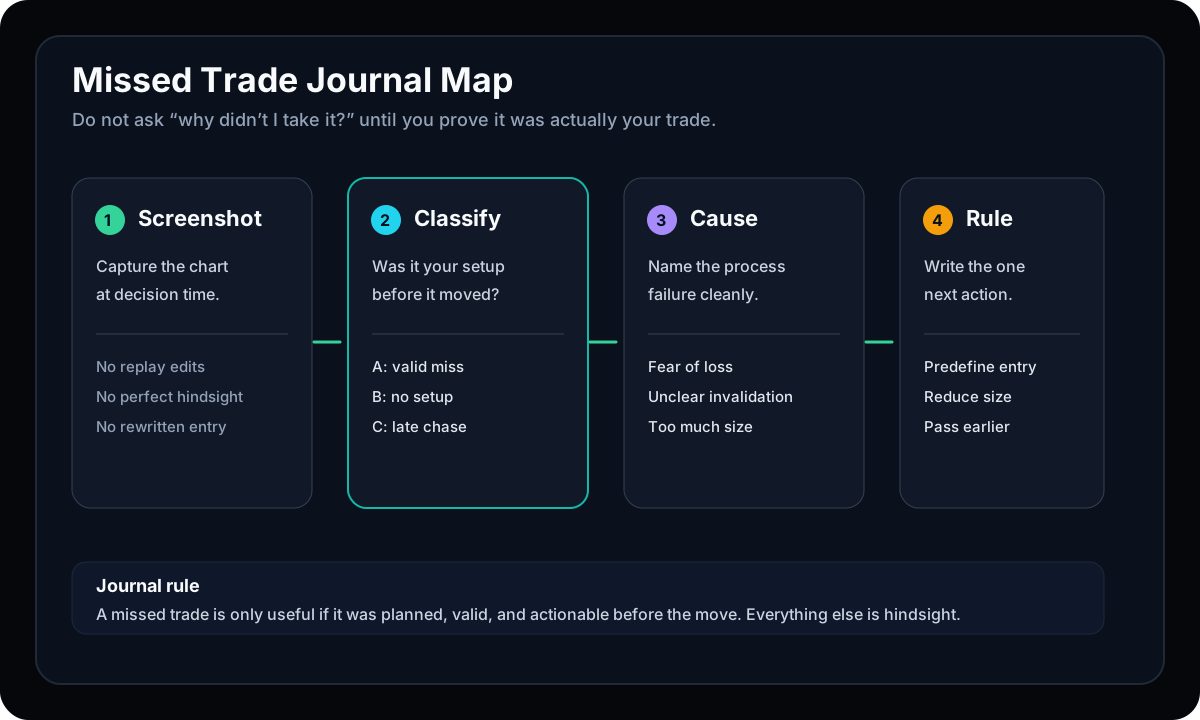
Missed trade journal workflow separating valid missed setups from hindsight and revenge trades

The First Rule: Prove It Was Your Trade

Before you write anything emotional, answer four questions:

  1. Was the setup in your playbook before the move?
  2. Did you know the entry trigger before it happened?
  3. Did you know the invalidation level before it happened?
  4. Was the reward-to-risk acceptable before it happened?

If the answer is no, you did not miss a trade. You noticed a move.

That distinction protects you. A trader who journals every move as a missed trade starts training the brain to chase everything. That is how a journal becomes an overtrading machine.

The Missed Trade Classification Table

Label What It Means What to Fix
Valid missThe setup matched the plan, but you froze or hesitated.Trigger clarity, size, or execution routine.
No setupThe move looked obvious only after it ran.Stop calling hindsight a trade.
Late chaseThe real entry passed and you wanted in anyway.Use the 1-3 Candle Rule.
Risk mismatchThe setup was valid, but size or stop distance made it uncomfortable.Reduce size or skip earlier.
Rule gapYou liked the trade but had no objective trigger.Rewrite the playbook.

This is where the Nexural trading journal should be brutally simple. Do not write paragraphs to sound wise. Label the miss, name the cause, write the next rule.

Screenshot the Decision Point, Not the Perfect Replay

The screenshot should show what you could see when the decision existed. Not five candles later. Not after the target was hit. Not after you cleaned the chart.

Mark:

  • Planned entry.
  • Invalidation.
  • Target zone.
  • Relevant level, such as POC, VWAP, VAH, VAL, overnight high, or prior day high.
  • The candle where the decision was actually available.

If you use the Volume Profile before-the-open map, include the value location. If you use a timeframe stack, include the setup chart, not just the tiny execution chart that makes everything look obvious.

Write the Cause Without Drama

Most missed trades come from a short list of causes:

  • Fear of loss: the stop was valid, but you did not want to feel wrong.
  • Too much size: the setup was fine, but the dollar risk made your hand freeze.
  • Unclear invalidation: you liked the idea but did not know where it was wrong.
  • Late recognition: you saw it after the entry window closed.
  • Rule conflict: one part of your plan said yes and another said no.

The journal does not need a confession. It needs a diagnosis.

If the cause is size, go back to micro futures position sizing or use the futures position size calculator. A lot of "discipline problems" are oversized trades wearing a psychology mask.

The Four-Line Missed Trade Entry

Use this format:

Missed Trade Template

Setup: What named setup was this?

Decision point: What candle or level required action?

Reason missed: Fear, size, unclear rule, late recognition, or no setup?

Next rule: What changes before the next similar trade?

Example:

Setup: VAH rejection after failed acceptance above value.
Decision point: second failed push above VAH, stop above session high.
Reason missed: size was too large for the stop distance.
Next rule: if stop is wider than planned risk, reduce to micros or pass before the trigger.

That entry can change behavior. "I should have taken it" cannot.

Do Not Reward Hindsight

A missed trade only counts if the entry was visible before the result. This is the line that keeps your journal honest.

Do not count:

  • A move that only looked clean after three candles.
  • A setup that violated your pre-market bias.
  • A trade with no defined stop.
  • A late entry you avoided correctly.
  • A news spike that would have been gambling.

This connects directly to how to stop overtrading in choppy markets. A trader who treats every missed move as evidence of failure will eventually start taking low-quality trades just to avoid regret.

If the missed trade came after a string of losses, review what to do after three trading losses in a row before deciding the problem was courage. Sometimes the correct action after a miss is not more aggression. It is smaller size, a cleaner reset, or the end of the session.

Track the Pattern After 20 Misses

One missed trade tells you very little. Twenty missed trades can show the pattern.

After twenty entries, count:

  • How many were valid misses?
  • How many were hindsight?
  • How many were late chases you correctly skipped?
  • How many came from oversized risk?
  • How many came from unclear playbook rules?

If most misses are hindsight, stop punishing yourself. If most are valid misses caused by size, trade smaller. If most are valid misses caused by unclear triggers, refine the playbook before adding another indicator.

Use the Asymmetric Scorecard pre-flight checklist to make the next valid setup easier to act on before the candle moves.

No-Trade Is Sometimes the Correct Grade

Some missed trades are wins.

If you skipped a trade because the reward-to-risk was gone, the entry was late, news was seconds away, or the setup did not match your plan, the journal should say that clearly. The outcome does not get to rewrite the process.

That is the point of journaling: to grade the decision that was available, not the chart that became obvious later.

Source and risk notes

  • APA's Speaking of Psychology episode on expressive writing summarizes research showing that structured writing can help people work through challenges and support mental health: Expressive writing can help your mental health.
  • APA's Monitor article on keeping a diary notes research suggesting expressive writing can reduce intrusive and avoidant thoughts and improve working memory: A new reason for keeping a diary.
  • A review in Advances in Psychiatric Treatment describes expressive writing as writing about stressful or emotional events for 15-20 minutes across several occasions and reports physical and psychological health benefits in clinical and non-clinical populations: Emotional and physical health benefits of expressive writing.
  • NFA investor best-practice materials warn that futures trading is risky and should use risk capital a trader can afford to lose: NFA Investor Best Practices.
  • CFTC advises the public to understand commodity futures markets and risks before acting on tips or hype: CFTC customer advisory.
  • This article is educational. Journaling can improve process awareness, but it does not remove market risk, guarantee discipline, or make a missed setup profitable if traded next time.

Final rule: a missed trade journal should make you more honest, not more aggressive. Prove the setup existed, label the miss, name the cause, and write one rule. If you cannot do that, it was probably not a missed trade. It was just a move you watched after the fact.

Next Step

Turn the miss into one behavior rule

A missed trade review should end with one next action: clearer trigger, smaller size, earlier pass, or a playbook rewrite.

#missed trade journal#trading journal#trading psychology#journaling missed trades#trade review
Share this articleTwitterLinkedIn

Frequently asked questions

How do you journal a missed trade?

Capture the chart at decision time, classify whether the setup was valid before it moved, record the cause of the miss, and write one rule for the next similar situation.

Should every missed trade go in a trading journal?

No. Only journal missed trades that were part of your plan or close enough to reveal a process issue. Random hindsight trades usually create noise, regret, and overtrading.

What is the biggest mistake when reviewing missed trades?

The biggest mistake is judging the setup after seeing the outcome. A missed trade is only useful if the entry, stop, target, and context were visible before the move.

How can journaling missed trades reduce hesitation?

A missed-trade log can show whether hesitation comes from fear, unclear invalidation, poor sizing, or weak setup definition. Once the cause is named, the next rule can be specific.

Can missed trade journaling cause revenge trading?

Yes, if the journal turns into self-criticism or outcome chasing. The journal should classify the decision, not punish the trader for not catching every move.

S
Sage

Head of Trading Education

Head of Trading Education at Nexural. A futures and swing trader who built the Nexural cockpit to survive his own trading — institutional-grade research, an event-sourced journal, and tools whose math is public. Writes the way he trades: receipts over marketing.

The journal that reads itself

Every fill auto-imports and gets annotated with stats from your last 90 days — the discipline layer.