Skip to content
v3 redesign is live — welcome to the trading cockpit.
Market updates, stock news, and futures insights — 3x/week, freeSubscribe free
Skip to content
build.logtraders.online=2,166trades.60s=74swings.ranked=308edge.latency_ms=42ms
Back to Blog
Trading Education

The Difference Between a Setup and a Trade

S
Sage

Head of Trading Education

12 min read
Updated June 17, 2026
The Difference Between a Setup and a Trade

What is "The Difference Between a Setup and a Trade" about?

Most overtrading starts when a trader treats pattern recognition as permission. Learn the practical difference between seeing a setup and having a complete trade.

At 10:14, price taps POC and bounces two points. You recognize the shape immediately. Your hand moves toward the mouse. That is the dangerous moment, because what you have is a setup. You do not have a trade yet.

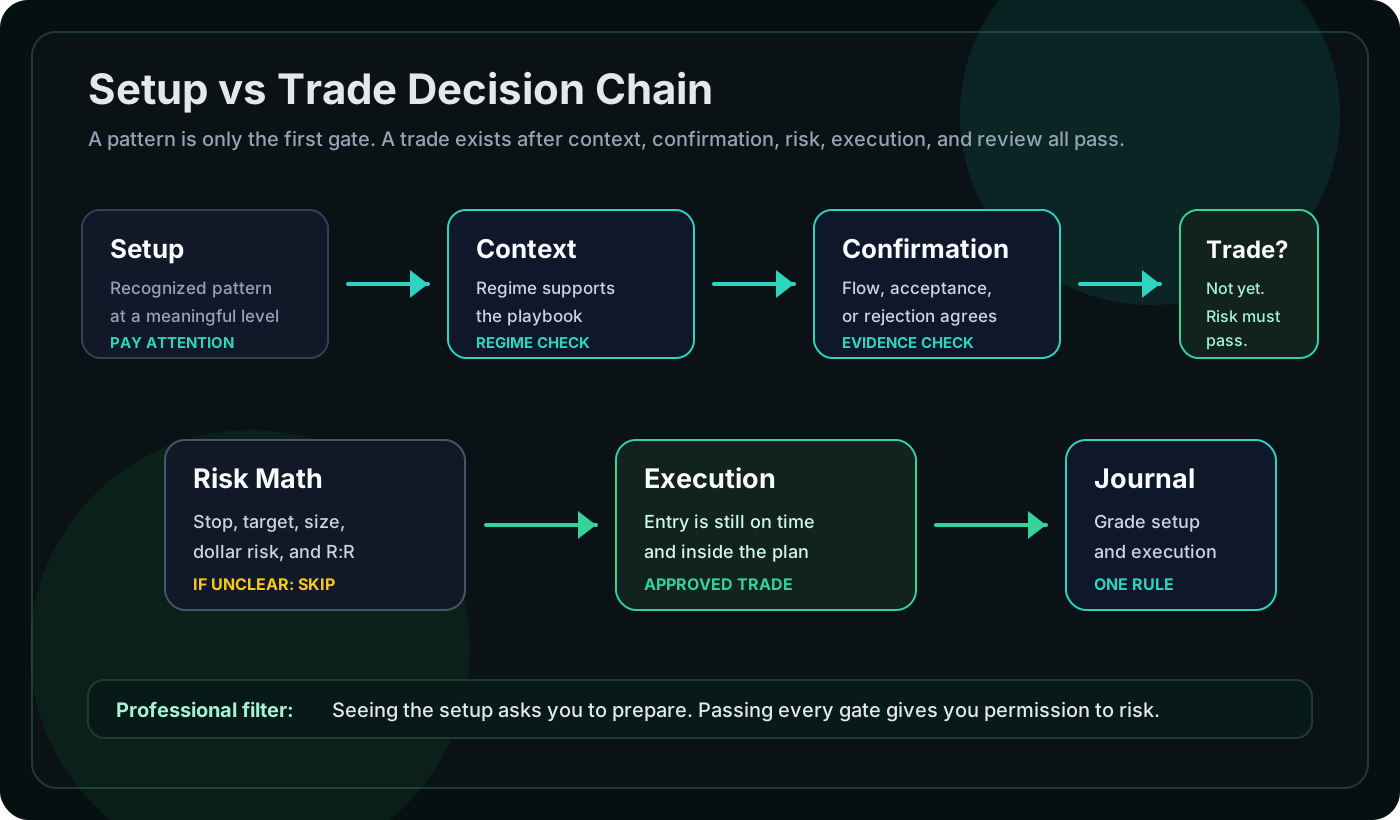
This is one of the biggest differences between amateur and professional execution. A setup is evidence. A trade is a decision. The setup says, "pay attention." The trade says, "risk money here, at this price, with this stop, in this regime, for this reason."

Most overtrading does not start with a trader who knows they are being reckless. It starts with a trader who sees something real and treats that recognition as permission.

Decision chain showing how a setup becomes a trade only after context, confirmation, risk math, execution timing, and journal rules pass

A Setup Is a Possibility

A setup is a market condition that might become tradable. It can be a POC bounce, a VAH rejection, a failed breakout, a delta divergence, an opening range retest, or a pullback into a level.

The setup has a job: it tells you where to look. That is all.

For example, a POC bounce setup means price has returned to a high-participation area and is showing some response. It does not automatically mean you should buy. The response may be weak. The day may be trending. The bounce may already be late. The stop may be too wide. The reward-to-risk may already be damaged.

Same with a VAH breakout or rejection. The level matters, but the level by itself is not enough. A level is a location. A trade needs a complete decision.

A Trade Is a Complete Risk Decision

A trade has six parts:

  1. Location: the setup is happening at a level that matters.
  2. Context: the market regime supports the play.
  3. Confirmation: flow, candle behavior, or acceptance confirms the idea.
  4. Risk: the stop, size, and dollar loss are known before entry.
  5. Timing: the actual fill still gives acceptable reward-to-risk.
  6. Behavior: the trade matches the plan you are willing to journal afterward.

If one of those is missing, you may still have a setup. You do not yet have a trade.

The Setup-to-Trade Checklist

Before clicking, run this checklist in order. Do not start with the entry. Start with permission.

Gate Question Fail Means
LevelIs this happening at a mapped level?Random chart pattern
RegimeDoes the day support this play?Good setup, wrong environment
FlowIs participation confirming the direction?Guessing at a level
RiskCan I define invalidation and size calmly?Hope-based stop
R:RIs reward still worth the risk at my actual fill?Late entry
JournalWould I be proud to screenshot and review this?Impulse trade

Use the futures pre-market checklist for the context gate. Use order flow for beginners and delta divergence for confirmation. Use the R-multiple calculator and the futures position size calculator for the risk gate.

Example 1: A Real Setup That Is Not a Trade

MES pulls into POC after the open. Buyers respond. The chart prints a clean bounce candle. On the surface, this looks like the kind of trade you studied in the POC Bounce Long playbook.

But look closer:

  • GEX is negative and the morning has accepted lower value.
  • The bounce candle closes far from the level.
  • The stop must go below structure, but that makes the trade too wide.
  • Reward-to-risk has fallen under 1.2R by the time you can enter.
  • Delta is not confirming aggressive buyers.

That is a setup. It is not a trade.

The correct action is not "take it smaller so it hurts less." The correct action is skip it, tag it as a watched setup, and wait for a better version. This is exactly where the negative GEX trading plan helps. In a directional regime, weak fades and late mean-reversion entries need more proof, not more courage.

Example 2: A Setup That Becomes a Trade

Price tests VAH after a strong push. It tries to accept higher, fails, then returns inside value. Sellers defend the level. Delta stops expanding upward. The stop can sit above the failed acceptance, and the first target is back toward value area midpoint.

Now the pieces are different:

  • Location is clear: VAH.
  • Context supports a rejection instead of a blind chase.
  • Confirmation appears through failed acceptance and seller response.
  • Invalidation is obvious.
  • Reward-to-risk is still acceptable.
  • The trade can be explained in one sentence.

That is closer to a trade. It resembles the logic inside the VAH Rejection Short playbook. The difference is not that the pattern looks prettier. The difference is that the decision is complete.

The Dangerous Middle: Good Idea, Bad Trade

The most expensive category is not "bad idea, bad trade." Those are usually obvious. The expensive category is good idea, bad trade.

That is what happens when you are correct about the level but wrong about the entry. Correct about direction but oversized. Correct about the move but late enough that your stop and target no longer make sense.

This is why waiting for candle close can ruin R:R. Confirmation is useful only if the trade is still tradable after the confirmation appears. A late entry can turn an A setup into a C trade.

Journal Setup Quality and Trade Quality Separately

If you only journal wins and losses, you blur the truth. Grade the idea and the execution separately.

Journal Tags

  • Setup grade: A, B, C, or no setup.
  • Context grade: aligned, mixed, or hostile.
  • Confirmation: present, weak, late, or absent.
  • Risk grade: clean, stretched, oversized, or unclear.
  • Execution grade: on plan, late, early, chased, moved stop, or revenge.
  • Review note: one behavior rule for next time.

Use the Nexural journal, the futures trading journal workflow, and the losing-trade review process to keep the categories separate. A loss from a good trade should not teach the same lesson as a loss from an impulse trade.

The One-Sentence Test

Before entry, say the trade out loud:

I am taking [setup] at [level] because [context] and [confirmation], risking [amount] to make [target], and I am wrong if [invalidation].

If you cannot fill in that sentence, do not trade yet. You may have an interesting chart. You do not have a complete order.

This test also reduces revenge trading. Revenge trades hate specifics. They prefer urgency, anger, and vague conviction.

What This Fixes

Separating setup from trade improves three things:

  • Fewer forced entries: you can see a setup and still do nothing.
  • Cleaner reviews: you know whether the idea failed or your execution failed.
  • Better sizing: risk is based on invalidation, not excitement.

It also makes reward-to-risk examples more useful because you stop calculating R:R after the fact. You calculate it before the trade exists.

A Simple Rule for Tomorrow

Write two boxes on your trade plan:

  1. Setup spotted: what did I see?
  2. Trade approved: why is risking money justified?

The second box should be harder to fill. That is the point.

If every setup becomes a trade, your filter is not filtering. If many setups become screenshots and only a few become trades, you are starting to act like a professional.

Source and risk notes

  • CME's position and risk management education emphasizes choosing contract exposure, contract count, and stops based on account profile and risk tolerance: CME Position and Risk Management.
  • CME's 2% rule lesson describes defining loss parameters before placing a trade and using stop-loss thresholds with risk/reward planning: CME The 2% Rule.
  • E*TRADE's futures trading plan guide frames trading around objectives, risk tolerance, methodology, and review instead of one-off impulses: Building a Futures Trading Plan.
  • NFA investor best-practice materials warn that futures trading carries substantial risk and should use only risk capital a trader can afford to lose: NFA Investor Best Practices.
  • This article is educational. A setup checklist can improve process, but it cannot remove leverage, liquidity, slippage, platform, news, or execution risk.

Final rule: do not ask, "Do I see something?" Ask, "Do I have enough to risk money?" The first question finds setups. The second question finds trades.

Next Step

Score the trade before the order ticket opens

A setup becomes a trade only when context, confirmation, risk, and execution all pass the same checklist.

#trading setup#trade execution#futures trading#trading plan#risk management
Share this articleTwitterLinkedIn

Frequently asked questions

What is the difference between a setup and a trade?

A setup is a possible opportunity. A trade is a setup that also passes context, confirmation, risk, timing, and execution rules.

Can a good setup still be a bad trade?

Yes. A good pattern can become a bad trade if the regime is wrong, the entry is late, the stop is too wide, reward-to-risk is poor, or the size is too large.

What turns a setup into a trade?

A setup becomes a trade when location, market regime, order-flow confirmation, invalidation, position size, and journal rules all line up before the order is placed.

Why do traders overtrade setups?

They confuse recognition with permission. Seeing a familiar pattern feels like action is required, even when context or risk math says the trade should be skipped.

How should I journal setup quality versus trade quality?

Grade the idea separately from the execution. Track setup quality, context quality, confirmation, entry quality, risk quality, and whether you followed the plan.

S
Sage

Head of Trading Education

Head of Trading Education at Nexural. A futures and swing trader who built the Nexural cockpit to survive his own trading — institutional-grade research, an event-sourced journal, and tools whose math is public. Writes the way he trades: receipts over marketing.

Run the system, not the screenshots

The Nexural Swing Desk ranks setups against the same composite-z gauntlet — no signals, no auto-execute.