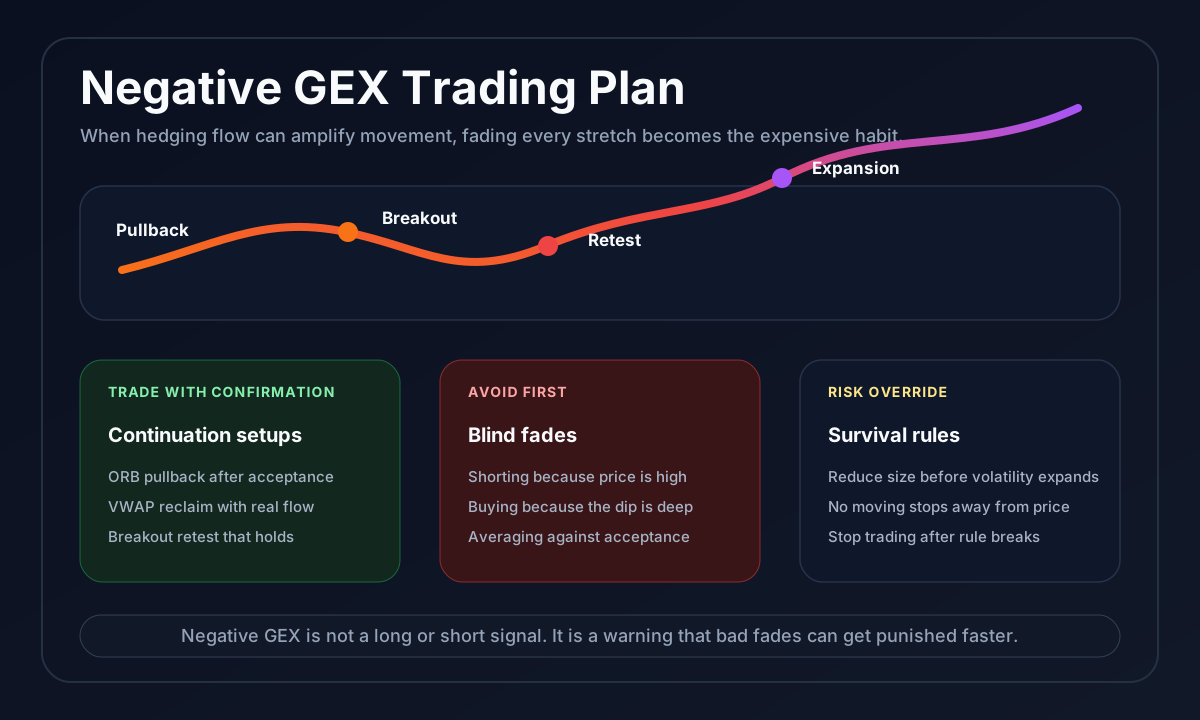
The most expensive sentence on a negative GEX day is: "It has to pull back now."
It does not. ES can push 18 points past the level. NQ can turn a normal breakout into a one-way auction. A short that looked "extended" at 10:08 can look cheap by 10:31. Negative GEX is where traders learn that expensive can get more expensive and cheap can get cheaper.
This is the companion to the positive GEX trading plan. Positive GEX says: range first, prove expansion. Negative GEX says: expansion risk first, prove the fade.
The Negative GEX Bias in Plain English
Negative GEX suggests dealer hedging may amplify movement instead of dampening it. In trader language: breakouts can keep going, failed pullbacks can rip, and support or resistance can stop behaving like a wall.
That does not mean "buy everything" or "short everything." It means the market deserves more respect when it accepts outside value. If price is trending and participation is expanding, the fade has to prove itself. Your opinion does not count as proof.
Use the main GEX guide to understand the regime mechanics. Use this article to stop donating money to trend days.
The First Job: Stop Fading Strength Blindly
Most negative GEX losses are not sophisticated. They are stubborn.
Price breaks VAH. Trader shorts because "it is too high." Price pulls back three points, holds above VAH, then drives another 20. Trader adds because now it is "really too high." That is not a setup. That is a fight with acceptance.
Negative GEX Fade Warning
Do not fade because price is stretched. Fade only after price fails to hold the stretch, order flow weakens, and your stop can sit behind a real invalidation point.
If the trade idea starts with "surely," skip it. Futures do not owe you symmetry.
What to Trade First
Negative GEX favors trades that align with accepted direction. The cleaner the acceptance, the less interested I am in being a hero at the other side.
| Setup | Why It Fits Negative GEX | Required Proof |
|---|---|---|
| Opening range breakout pullback | Expansion has room to continue | close beyond range plus clean retest |
| VWAP reclaim continuation | Trend reclaims benchmark and holds | buyers defend VWAP after reclaim |
| VAH accepted breakout | Value migrates higher instead of rotating | failed rejection plus expanding flow |
| LVN drive | Thin zones can move fast | momentum through low-volume area |
For the VAH version, study Why Most Breakouts Fail at Value Area High. That post teaches the difference between rejection and acceptance. Negative GEX makes that distinction urgent.
What to Avoid First
- Shorting highs only because the move feels extended.
- Buying dips only because price is near yesterday's level.
- Averaging into a fade after value accepts away from you.
- Using positive-GEX mean-reversion targets on a trend session.
- Waiting for the perfect candle close until the trade becomes a chase.
- Ignoring the daily loss limit because "trend days pay it back fast."
The candle-close R:R guide matters here. Negative GEX can make you late fast. Confirmation that arrives after the move has already paid is not confirmation. It is a receipt.
The Pre-Market Negative GEX Checklist
Before the open, build the plan around volatility expansion, not comfort.
Before 9:30, Mark These
- GEX state, flip level, and distance from current price.
- Overnight high, overnight low, prior VAH, prior VAL, and POC.
- Low-volume zones where price can travel quickly.
- Event risk: CPI, FOMC, NFP, Fed speakers, large earnings, or liquidity gaps.
- Continuation playbook, fade playbook, and the exact condition that disables each.
- Reduced starting size and hard daily loss lockout.
Use the futures pre-market checklist and the Volume Profile before-open workflow. If you do not know where acceptance changes the map, you will confuse a pullback with a reversal.
The Continuation Sequence
The best negative GEX trades usually do not require you to buy the top tick. They require patience for acceptance and retest.
- Price breaks a meaningful level: opening range, VWAP, VAH, VAL, or overnight high/low.
- The first pullback fails to return inside the prior range.
- Flow confirms participation in the breakout direction.
- QPulse or structure supports the direction instead of diverging against it.
- Entry is close enough to the retest that stop distance stays controlled.
That is the difference between trading continuation and chasing. Use reward-to-risk examples and the R-multiple calculator before taking a breakout that has already traveled most of the target.
How to Fade a Negative GEX Trend Without Getting Steamrolled
You can fade negative GEX. You just need better evidence than "stretched."
The fade needs three things:
- Exhaustion: the next push makes less progress.
- Failed acceptance: price cannot hold outside the level.
- Clean invalidation: the stop is close and obvious.
This is where delta divergence, order-flow basics, and the Flow Pro filter matter. The fade is not valid until participation weakens. A high price is not participation weakening.
Risk Rules for Negative GEX
Negative GEX is a size problem before it is a setup problem.
If volatility expands and your stop distance doubles, your normal contract size is no longer normal. It is oversized. Use the futures position size calculator before the session and after any major volatility shift.
Hard Rules
- Start smaller than normal if the open is already volatile.
- Never move a stop away from price to give the trend "room."
- Never add to a losing fade after price accepts outside value.
- Stop trading after two rule violations, even if the daily loss limit has not hit.
- Use the first big win to reduce pressure, not to justify reckless size.
Pair this with Futures Margin vs Risk and the daily loss limit guide. Margin tells you what you can open. Risk tells you what you can survive.
The Negative GEX Journal Template
The journal should tell you whether you traded the regime or fought it.
Journal Fields
- GEX state: negative, transition, or flipped.
- Trade type: continuation, pullback, breakout retest, fade, or rescue attempt.
- Acceptance state: inside value, outside value, reclaim, or failed reclaim.
- Flow evidence: expanding participation, exhaustion, absorption, or none.
- Risk adjustment: normal size, reduced size, or oversized.
- Behavior tag: followed trend, chased, faded early, averaged, or stopped correctly.
Use the futures trading journal guide and Nexural Journal. If you keep tagging every loss as "bad luck," negative GEX days will keep teaching the same lesson.
No-Trade Conditions
Some negative GEX days are tradable. Some are only survivable.
- Spread and slippage are worse than your model assumes.
- Price is moving faster than your execution process.
- You missed the retest and now the entry is in the middle of the move.
- The first two trades were emotional or late.
- You are trying to fade because you missed the continuation.
- Your daily stop, trade count, or behavior limit has already triggered.
Standing down is not weakness. It is a position. Use the overtrading guide and the losing-streak reset when the market is moving faster than your decision quality.
Source and risk notes
- Cboe's Options Institute explains the Greeks as option-price sensitivity measures, including variables such as underlying price, time, volatility, and rates: Learning the Greeks.
- CME's Greeks and implied volatility data describes real-time and historical option analytics used for trading and risk management: CME Greeks and Implied Volatility Data.
- CME's position and risk management education describes stops as a way to exit if a predefined price is triggered and to help avoid losses beyond a trader's tolerance: CME Position and Risk Management.
- CME's futures order type education covers stop and stop-limit order mechanics for futures traders: CME Futures Order Types.
- NFA investor best practices warn that futures trading is volatile, risky, and should use only risk capital: NFA Investor Best Practices.
- GEX is model-derived context. Vendor calculations can differ, and intraday price movement, implied volatility, open interest, expiration, liquidity, and news can change the read.
- This article is educational. Negative GEX can support a continuation-first plan, but it does not predict direction or remove leverage, slippage, event, liquidity, or execution risk.
Final rule: negative GEX does not tell you to chase. It tells you not to fight accepted direction without proof. Trade the retest, not the panic candle. Fade only after the market fails. And if the session is too fast for your process, the best trade is no trade.
Respect accepted direction before fading the move
Negative GEX can punish blind fades, so the next trade needs acceptance context, reduced size, and a hard invalidation point.