Skip to content
v3 redesign is live — welcome to the trading cockpit.
Market updates, stock news, and futures insights — 3x/week, freeSubscribe free
Skip to content
build.logtraders.online=2,166trades.60s=74swings.ranked=308edge.latency_ms=42ms
Back to Blog
Trading Education

Positive GEX Trading Plan: What to Trade and What to Avoid

S
Sage

Head of Trading Education

11 min read
Updated June 17, 2026
Positive GEX Trading Plan: What to Trade and What to Avoid

What is "Positive GEX Trading Plan: What to Trade and What to Avoid" about?

A practical positive GEX trading plan for futures traders: mean-reversion setups to prioritize, breakout traps to avoid, and the risk rules that keep regime data useful.

Positive GEX days punish traders who need the market to move. Price breaks VAH, looks clean for four minutes, then slides back into value. Price loses VWAP, looks heavy, then snaps back to the midpoint. The chart keeps offering momentum bait, and the trader keeps paying for it.

That is the trade plan problem. Positive GEX is not a magic prediction. It is a regime warning: stop using trend-day tactics until the market proves it deserves them.

This guide is the practical version of How GEX Controls Whether Your Day Trends or Chops. The pillar post explains the mechanics. This one answers the morning question: what should I trade today, what should I avoid, and when should I stand down?

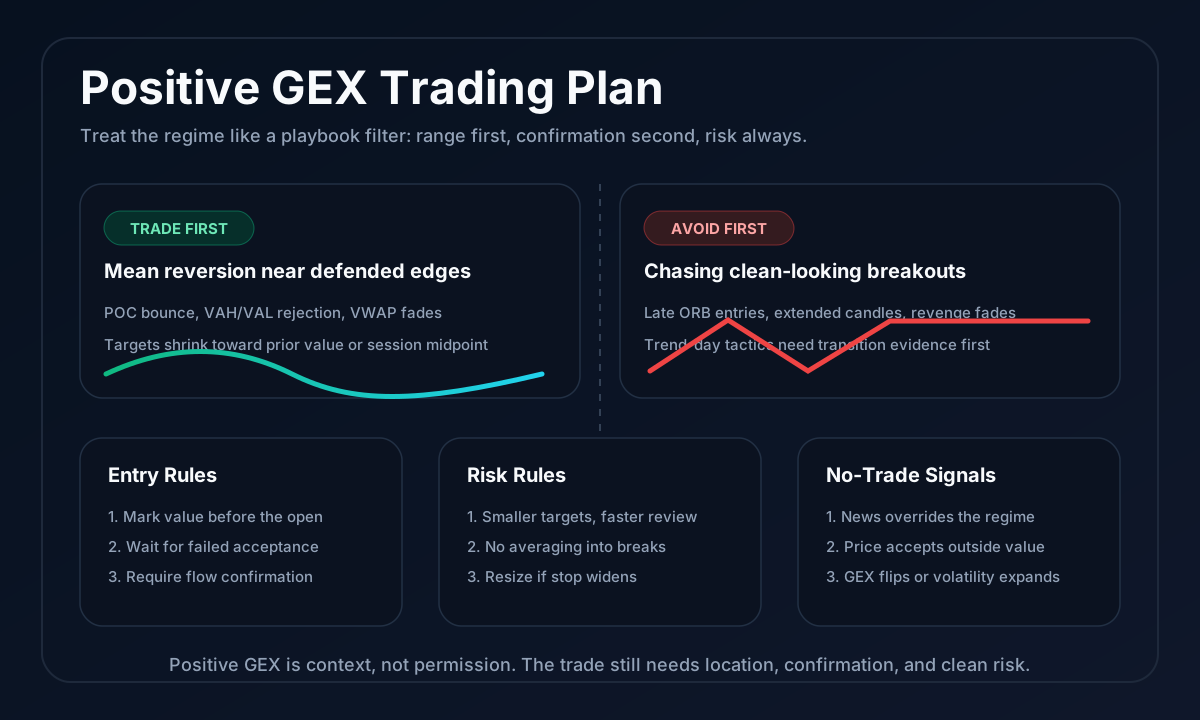
Positive GEX trading plan map showing what to trade, what to avoid, entry rules, risk rules, and no-trade signals

The Positive GEX Bias in Plain English

Positive GEX suggests dealer hedging may dampen price movement instead of amplifying it. In trader language: rips can get sold, dips can get bought, and clean breakouts can turn into traps unless real participation shows up.

The key word is may. GEX is an estimate built from options positioning, Greeks, open interest, expiration, and the current underlying price. It is useful because it frames likely behavior. It is dangerous when traders treat it like a weather report from the future.

My rule is simple: positive GEX gives mean reversion the first interview. It does not get the job without price, volume, and flow confirming.

The Best Positive GEX Setups

On positive GEX days, I want trades that start from defended structure and aim back toward reasonable value. I do not want heroic targets. I do not want late entries. I want the market to show an edge failed, then give me a clean invalidation point.

Setup Why It Fits Positive GEX Confirmation Needed
POC bouncePrice rotates back to fair valuedefended POC plus buyer response
VAH rejectionFailed acceptance above valuebuyers fail, sellers absorb
VAL rejectionFailed acceptance below valuesellers fail, buyers reclaim
VWAP fadeOverextension returns toward benchmarkexhaustion plus clean stop

The beginner POC bounce map is the cleanest training ground. The full POC Bounce Long playbook gives the advanced version. For shorts, pair this with the VAH Rejection Short playbook.

What to Avoid First

Positive GEX does not mean short every high and buy every dip. That is lazy. The better rule: avoid tactics that require immediate expansion unless the market proves the regime changed.

  • Late opening-range breakouts after the first clean impulse.
  • Chasing candles that have already crossed most of the reward window.
  • Adding to a fade after price accepts outside value.
  • Holding for trend-day targets when the session keeps rotating.
  • Ignoring news because the GEX read looked calm at 8:00 AM.

If you are tempted to chase a breakout, read Why Most Breakouts Fail at Value Area High before you click. Positive GEX turns that lesson from interesting to expensive.

The Pre-Market Positive GEX Checklist

The plan starts before the open. If you wait until the first breakout fails, you are already emotionally involved.

Before 9:30, Mark These

  1. Current GEX state and flip level.
  2. Prior session POC, VAH, VAL, high-volume nodes, and low-volume nodes.
  3. Overnight high and low.
  4. Major economic events and scheduled speakers.
  5. First two preferred playbooks and one no-trade condition.
  6. Max loss, max trades, and size reduction rule.

Use the futures pre-market checklist and the Volume Profile before-open map for this. Positive GEX without value levels is just a label.

The Trade Sequence

Here is the sequence I want on a positive GEX fade:

  1. Price pushes outside value or into a known edge.
  2. The breakout attempt loses pace instead of expanding.
  3. Order flow shows exhaustion, absorption, or failed follow-through.
  4. Price reclaims the edge or fails acceptance outside it.
  5. Entry is close enough to invalidation that reward-to-risk still works.

That last point matters. A positive GEX fade that is entered late can be just as bad as a breakout chase. Use the candle-close R:R guide and the reward-to-risk examples before treating confirmation as free.

How Flow Pro and QPulse Fit

On positive GEX days, I do not need Flow Pro to tell me the market is in a range. I need it to tell me whether the edge is actually defended.

For a short at VAH, I want buyers to fail above value and sellers to show up with enough pressure to justify the fade. For a long at VAL or POC, I want sellers to stop getting paid and buyers to defend. The signal has to arrive near the level, not halfway back to target.

Use Order Flow for Beginners, Delta Divergence Explained for Futures Traders, and the Flow Pro filter guide as the confirmation layer. Use QPulse zero-line crosses only after location is already clean.

Targeting on Positive GEX Days

The biggest mistake is using trend targets in a dampened regime. Positive GEX trades often pay faster and smaller. That is not a flaw. That is the regime.

  • From VAH rejection, first target is often prior POC or the session midpoint.
  • From VAL rejection, first target is often VWAP, POC, or the opposite side of the developing range.
  • From POC bounce, target the next high-volume node or prior value edge, not a fantasy extension.
  • If price accepts outside value, stop thinking fade and reassess the regime.

This is where the R-multiple calculator earns its keep. If the realistic target is only eight points away and the stop is six points away, the trade does not become premium just because the GEX read is positive.

When Positive GEX Stops Matter

The invalidation is not "I feel uncomfortable." It is the market accepting the level you expected it to reject.

For a VAH fade, invalidation may be a clean hold above VAH with expanding participation. For a POC bounce, invalidation may be price accepting below POC after buyers fail to defend. For a VWAP fade, invalidation may be a pullback that holds VWAP and launches again.

Once that happens, do not argue with the regime. Resize or stop. Use the futures position size calculator before the trade and the daily loss limit guide before the session.

The Positive GEX Journal Template

The journal entry should expose whether you actually traded the regime or only claimed you did.

Journal Fields

  • GEX state: positive, transition, or flipped.
  • Setup type: POC bounce, VAH rejection, VAL rejection, VWAP fade, or breakout.
  • Location quality: edge, midpoint, or no man's land.
  • Confirmation: flow, delta, QPulse, or none.
  • Target logic: POC, VWAP, value edge, or unrealistic trend target.
  • Result: traded the plan, chased, averaged, or stood down.

Use the futures trading journal guide and Nexural Journal to tag this properly. "Positive GEX trade" is too vague. "Positive GEX, VAH rejection, Flow Pro seller defense, target prior POC" can be reviewed.

No-Trade Conditions

The highest-quality positive GEX decision is often not taking the trade.

  • Major news is less than 15 minutes away.
  • Price accepts outside value instead of rejecting it.
  • GEX is near the flip level and the regime is unstable.
  • Volatility expands while your plan assumes compression.
  • The first two fades failed and you are trying to win the argument.
  • You already hit your session loss, trade count, or emotional limit.

If the right action is to stand down, log it. The overtrading guide and the missed-trade journal process both exist because good non-trades need proof too.

Source and risk notes

  • Cboe's Options Institute describes the Greeks as sensitivity measures for option prices, including variables such as underlying price, expiration, implied volatility, and interest rates: Learning the Greeks.
  • CME's Greeks and implied volatility dataset lists gamma as one of the essential option Greeks used for risk management and options analytics: CME Greeks and Implied Volatility Data.
  • CME's E-mini S&P 500 futures page identifies ES as a CME equity index futures contract with a $50 times S&P 500 Index contract unit: E-mini S&P 500 futures.
  • CME's Micro E-mini S&P 500 contract specs state that MES is $5 times the S&P 500 Index with a 0.25-point minimum tick: Micro E-mini S&P 500 contract specs.
  • NFA investor resources emphasize due diligence and risk awareness before trading derivatives: NFA Investor Education & Resources.
  • GEX is model-derived context. Different vendors can calculate exposure differently, and the read can change intraday as price, implied volatility, open interest, and expiration effects change.
  • This article is educational. Positive GEX can support a mean-reversion plan, but it does not remove futures leverage, slippage, liquidity, event, or execution risk.

Final rule: positive GEX should make you more selective, not more clever. Trade defended edges. Respect failed acceptance. Take smaller targets when the regime calls for it. And if the market stops behaving like a positive GEX day, stop forcing the old plan.

Next Step

Map the regime before choosing the playbook

Positive GEX can favor mean reversion, but the trade still needs value location, flow confirmation, and realistic target math.

#positive gex#gamma exposure#futures trading#mean reversion#market regime
Share this articleTwitterLinkedIn

Frequently asked questions

What does positive GEX mean for day trading?

Positive GEX means aggregate options gamma exposure may create a more stabilizing hedging environment. Traders often treat it as context for mean reversion, range behavior, and smaller targets, not as a standalone signal.

What should traders prioritize on positive GEX days?

Prioritize defended edges, failed breakouts, POC rotations, VAH or VAL rejection, VWAP fades, and smaller target windows. The trade still needs location, order-flow confirmation, and defined risk.

What should traders avoid in positive GEX?

Avoid chasing late breakouts, assuming every candle will trend, averaging into failed fades, or using negative-GEX momentum tactics before the regime changes.

Can positive GEX still produce trend days?

Yes. Major news, liquidity shocks, strong order flow, index concentration, and a GEX flip can overpower the positive-GEX read. Positive GEX is a regime input, not a guarantee.

How do you confirm a positive GEX mean-reversion trade?

Confirm with pre-market value levels, failed acceptance outside value, order-flow exhaustion or absorption, clean invalidation, and reward-to-risk that still works after entry timing.

S
Sage

Head of Trading Education

Head of Trading Education at Nexural. A futures and swing trader who built the Nexural cockpit to survive his own trading — institutional-grade research, an event-sourced journal, and tools whose math is public. Writes the way he trades: receipts over marketing.

Run the system, not the screenshots

The Nexural Swing Desk ranks setups against the same composite-z gauntlet — no signals, no auto-execute.