Skip to content
v3 redesign is live — welcome to the trading cockpit.
Market updates, stock news, and futures insights — 3x/week, freeSubscribe free
Skip to content
build.logtraders.online=2,166trades.60s=74swings.ranked=308edge.latency_ms=42ms
Back to Blog
Trading Education

Why Waiting for Candle Close Can Ruin R:R

S
Sage

Head of Trading Education

10 min read
Updated June 17, 2026
Why Waiting for Candle Close Can Ruin R:R

What is "Why Waiting for Candle Close Can Ruin R:R" about?

A practical futures execution guide showing how waiting for candle close can move entry away from invalidation, shrink reward-to-risk, and turn valid setups into bad trades.

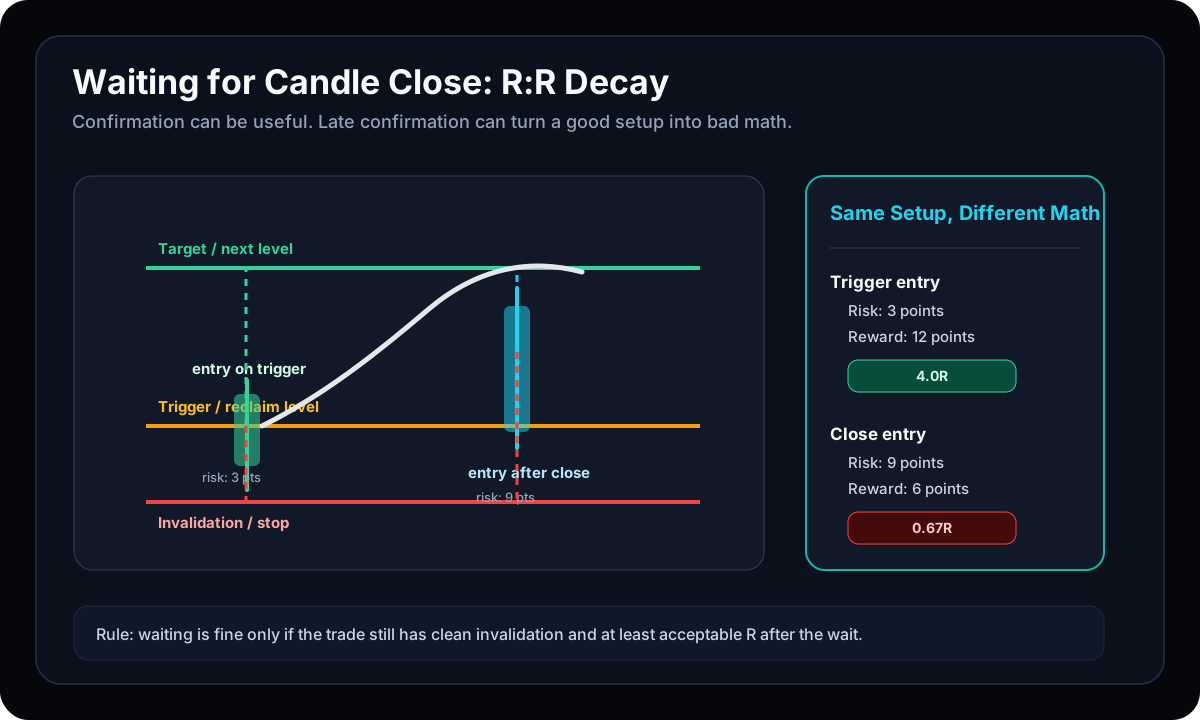
The setup appears at 9:42. Price reclaims the level, order flow confirms, and the stop is clean. You wait for the candle to close because that feels disciplined. By the time it closes, entry is nine points higher, the target is six points away, and the stop is still below the level.

You did not get safer. You got later.

Waiting for candle close can be useful when it filters noise. It becomes expensive when it turns a clean 3R setup into a 0.7R chase.

Candle close reward-to-risk decay map showing trigger entry versus late candle close entry

The Problem Is Not Waiting. The Problem Is Not Recalculating.

Waiting for confirmation is not automatically wrong. The mistake is acting as if the trade is unchanged after the wait.

Every candle changes the math:

  • Entry moves.
  • Stop distance changes.
  • Target distance shrinks or expands.
  • Slippage risk changes.
  • Emotional pressure changes.

If you wait for the close, you must recalculate the trade. Same idea, new price, new risk.

The R:R Decay Example

Entry Style Entry Stop Target R:R
Trigger entry5300529753124.0R
Candle-close entry5306529753120.67R

The thesis did not change. The math did.

That is the whole article.

Why Candle Close Feels So Safe

Waiting for close feels safe because it delays responsibility. The candle is finished. The signal looks confirmed. There is less uncertainty.

But markets do not charge you in emotional comfort. They charge you in distance from invalidation.

The longer you wait, the more likely the entry moves away from the level that made the setup attractive. That is especially true in futures, where one strong ES or NQ candle can cover the entire planned reward window before the candle even closes.

This is why the timeframe stack matters. A 1-minute close, 5-minute close, and 15-minute close produce very different entry delays and stop distances.

The 1-3 Candle Rule

The 1-3 Candle Rule exists because timing signals decay.

The rule is simple:

  • The first candle after the trigger is the cleanest window.
  • The second candle can still work if R:R remains intact.
  • The third candle is usually the last acceptable window.
  • After that, the setup must be reclassified, not chased.

That does not mean you blindly enter the first candle. It means you judge whether the trade is still mathematically alive while the trigger is fresh.

When Waiting for Close Is Useful

Waiting is useful when the market is noisy and the close is part of the setup definition.

Examples:

  • A level must be reclaimed on close.
  • A breakout must close outside value to prove acceptance.
  • A higher timeframe needs confirmation before lower timeframe execution.
  • You are filtering fake wicks around a news or liquidity zone.

But even then, the close is only useful if the trade still has acceptable risk.

If you are waiting for a value-area breakout, pair this with Why Most Breakouts Fail at Value Area High. Close location matters, but acceptance and follow-through matter more.

When Waiting for Close Ruins the Trade

  • The candle is already extended into the target zone.
  • The stop must remain behind the original level.
  • The target did not move but entry got worse.
  • The trade now offers less than your minimum R:R.
  • You are waiting because you are afraid, not because the plan requires it.

If the entry got worse, use reward-to-risk examples to make the decision mechanical. A trade that was good at 5300 may be bad at 5306.

The Execution Checklist

Before Entering After a Candle Close

  1. What was the original trigger?
  2. Where is invalidation now?
  3. How many points to the stop?
  4. How many points to the first realistic target?
  5. Does the trade still meet minimum R:R?
  6. Did the close add useful evidence or just emotional comfort?

If you cannot answer those questions in under ten seconds, the trade is probably moving faster than your process.

Apply It to POC Bounce Trades

On a POC bounce trade, the best entry often appears when price tests fair value and begins to defend it. If you wait for a large green candle to close, your stop may still belong below the POC test, while your target remains prior VAH or the next high-volume node.

That can turn a clean bounce into a late chase.

Use the Volume Profile before-the-open map to know the target and invalidation before the candle moves.

Apply It to QPulse and Flow Pro

QPulse and Flow Pro are timing tools. They are not permission to ignore price.

If QPulse crosses zero at a valid level and Flow Pro confirms participation, the next question is not "did the candle close pretty?" The next question is: does the entry still have a clean stop and enough reward?

For order-flow timing, also review delta divergence in futures. A flow warning is useful only if it appears early enough to act with good math.

Size From the New Stop, Not the Old Feeling

If you waited and the stop distance changed, position size has to change too.

Do not keep the same contract size just because the idea is the same. The trade at the close may carry two or three times the original risk.

Use the futures position size calculator before entering late. If the calculator says the size must shrink, listen to the math.

No-Trade Conditions

  • The close pushed entry into the target zone.
  • Stop distance expanded beyond planned risk.
  • R:R dropped below the trade plan.
  • The signal is now more than three candles old.
  • You are entering because missing it would feel worse than losing.
  • You are close to your daily loss limit.

If you missed the clean entry, log it with the missed trade journal process. A missed trade is cheaper than a late trade with bad math.

Source and risk notes

  • NinjaTrader's timeframe guide describes M1 as one-minute candles and explains that minute-based charts such as M5, M15, and M30 balance short-term trading with broader context: Trading Timeframes Guide.
  • NinjaTrader's chart timeframe guide explains how traders can customize chart timeframes and view multiple timeframes together: How to Apply Timeframes in NinjaTrader Charts.
  • CME's futures order type education describes stop orders and stop-limit orders as order types triggered by market trades at submitted price levels: CME Futures Order Types.
  • CME's position and risk management education describes using P&L information and risk management to decide whether to exit based on profit or loss targets: CME Position and Risk Management.
  • CME's Micro E-mini S&P 500 contract page states that MES is $5 times the S&P 500 Index with a minimum tick of 0.25 index points: Micro E-mini S&P 500 futures.
  • NFA investor best-practice materials warn that futures trading is risky and should use only risk capital a trader can afford to lose: NFA Investor Best Practices.
  • This article is educational. Faster entries can reduce stop distance but may increase false-trigger and slippage risk; waiting can filter noise but may reduce reward-to-risk. Neither approach guarantees profitability.

Final rule: confirmation is not free. If waiting for the close gives you better evidence but worse math, the trade may no longer be worth taking. Recalculate before entry. If the R:R is gone, the signal is gone.

Next Step

Apply the 1-3 Candle Rule before the math decays

Waiting for close only helps if the entry still has clean invalidation, enough target distance, and acceptable reward-to-risk.

#waiting for candle close#reward risk ratio#trade execution#1-3 candle rule#futures trading
Share this articleTwitterLinkedIn

Frequently asked questions

Is waiting for candle close bad for trading?

Waiting for candle close is not automatically bad. It becomes a problem when the close moves entry too far from invalidation and reduces reward-to-risk below the trade plan.

Why can waiting for candle close ruin reward-to-risk?

Because the entry often moves farther from the stop while the target stays the same or gets closer. That increases risk and reduces available reward.

Should beginners wait for confirmation?

Beginners should wait for defined confirmation, but they still need to recalculate R:R after waiting. Confirmation that arrives after the math is gone is not useful.

What is the 1-3 Candle Rule?

The 1-3 Candle Rule says a timing signal is only actionable while the trade still has location, confirmation, and acceptable R:R in the first few candles after the trigger.

How do you know if a candle-close entry is too late?

It is too late if invalidation is now far away, the target is too close, the entry chases an extended candle, or the setup no longer offers the required reward-to-risk.

S
Sage

Head of Trading Education

Head of Trading Education at Nexural. A futures and swing trader who built the Nexural cockpit to survive his own trading — institutional-grade research, an event-sourced journal, and tools whose math is public. Writes the way he trades: receipts over marketing.

Run the system, not the screenshots

The Nexural Swing Desk ranks setups against the same composite-z gauntlet — no signals, no auto-execute.