Skip to content
v3 redesign is live — welcome to the trading cockpit.
Market updates, stock news, and futures insights — 3x/week, freeSubscribe free
Skip to content
build.logtraders.online=2,166trades.60s=74swings.ranked=308edge.latency_ms=42ms
Back to Blog
Risk Management

Reward-to-Risk Examples: 1R, 2R, 3R, and Why It Matters

S
Sage

Head of Trading Education

10 min read
Updated June 17, 2026
Reward-to-Risk Examples: 1R, 2R, 3R, and Why It Matters

What is "Reward-to-Risk Examples: 1R, 2R, 3R, and Why It Matters" about?

Concrete reward-to-risk examples for traders: 1R, 2R, 3R, long and short trade math, win-rate pressure, expectancy, and the R-multiple calculator workflow.

Two traders both make $300. One risked $100 and followed the plan for a clean +3R. The other risked $600, moved the stop twice, and escaped with half an R. Same dollars. Completely different trade quality.

That is why traders use R. Dollars tell you what happened to the account. R tells you whether the decision was good relative to the risk.

Reward-to-risk is not a motivational phrase. It is the math test a trade must pass before the entry. If the target is too close, the stop is too wide, or the setup needs perfection to work, the trade may be exciting but still not worth taking.

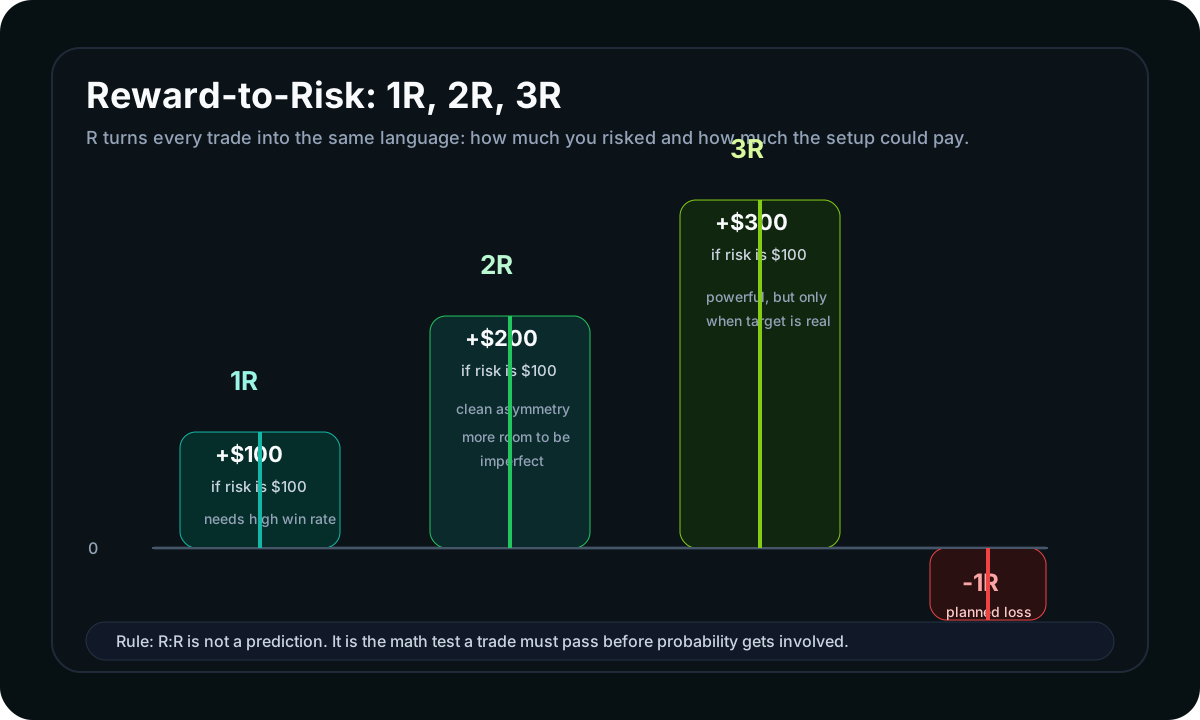
R-multiple reward-to-risk ladder showing 1R, 2R, 3R, and -1R outcomes

The Simple Definition

R is one unit of planned risk.

If you risk $100, then 1R = $100. A +2R trade makes $200. A -1R trade loses the planned $100.

The point is not to make every trade the same dollar size. The point is to make every trade comparable. A $75 win can be excellent if it was +3R on a $25 risk. A $500 win can be sloppy if it required $1,500 of open risk.

1R, 2R, and 3R Examples

Planned Risk 1R Target 2R Target 3R Target
$25$25$50$75
$100$100$200$300
$500$500$1,000$1,500

The target changes because the risk changes. A beginner mistake is saying, "I want to make $300 today," then forcing every setup to serve that dollar goal. The cleaner question is: what is the setup risking, and what multiple can it realistically pay?

Long Trade Example

Suppose MES is trading near 5400. A trader wants to buy a pullback at 5400 with invalidation at 5390. The stop is 10 points.

  • MES is $5 per point.
  • 10-point stop = $50 risk per contract.
  • 1R target = 5410, or +$50.
  • 2R target = 5420, or +$100.
  • 3R target = 5430, or +$150.

If the nearest real resistance is 5408, this is not a good 2R long. The chart does not care that the spreadsheet wants 5420. R:R has to respect structure.

Short Trade Example

Now suppose NQ rejects Value Area High and a trader shorts MNQ at 19000 with invalidation at 19040. The stop is 40 points.

  • MNQ is $2 per point.
  • 40-point stop = $80 risk per contract.
  • 1R target = 18960, or +$80.
  • 2R target = 18920, or +$160.
  • 3R target = 18880, or +$240.

If prior POC is at 18925, the 2R target is realistic. If the trader demands 3R into a major high-volume node, the extra target may be fantasy. Use the Value Area High breakout guide to make sure the target has auction logic behind it.

Why 1:1 Requires a Higher Win Rate

The lower the reward relative to risk, the more often you need to be right.

Average Winner Average Loser Approx. Breakeven Win Rate
1R1R50%
2R1R33.4%
3R1R25%

This does not mean 3R is automatically better. A 3R target that only works 10% of the time is not an edge. It means higher R:R gives you more room to be wrong, if the target is actually reachable.

Expectancy: The Missing Piece

Reward-to-risk and win rate have to be read together. The rough expectancy formula is:

Expectancy = (win rate x average win) - (loss rate x average loss)

Example:

  • 40% win rate.
  • Average winner = 2R.
  • Average loser = 1R.
  • Expectancy = (0.40 x 2R) - (0.60 x 1R) = +0.20R per trade.

That is the point of the math of asymmetry. You can be wrong often and still have a positive system, but only if losses stay controlled and winners are allowed to be meaningfully larger.

The Bad R:R Traps

Reward-to-risk can be abused. Watch for these:

  • Fake 3R: the target is technically 3R but sits beyond obvious resistance, prior value, or session range.
  • Moving the stop: a planned 2R trade becomes garbage when the stop expands after entry.
  • Tiny stop theater: the trader uses a stop so tight that normal noise knocks it out.
  • Ignoring fees and slippage: a paper 1R scalp may be much worse after execution costs.
  • Judging by one outcome: one winning bad trade does not validate the math.

Use the asymmetric filter before entry. If the trade does not have room, timing, and structure, the target is just a wish.

The Calculator Workflow

Before judging a trade, run the numbers:

  1. Define the invalidation point.
  2. Calculate the dollar risk to the stop.
  3. Mark the realistic target based on structure.
  4. Divide reward by risk.
  5. Ask whether the setup still makes sense after fees, slippage, and probability.

The R-multiple calculator exists for exactly this. Do the math before the trade, then use the journal after the trade to record whether the planned R matched the executed R.

Source and risk notes

  • Investor.gov defines financial risk as uncertainty about return and possible harm when returns differ from expectations: Investor.gov risk glossary.
  • FINRA explains the basic risk/reward relationship and describes reward as the possibility of returns or profits: FINRA risk overview.
  • CME Group's position and risk management education notes that risk can be limited directly by the trader and that all parties in the futures process carry risk exposure: CME position and risk management.
  • The CFTC futures glossary is a public reference for specialized futures-market language used in risk education: CFTC Futures Glossary.
  • This article is educational. R:R calculations simplify planned trade math, but they do not guarantee fill quality, target achievement, or profitability.

Final rule: do not ask whether the trade can make money. Ask whether the money it can make is worth the risk it requires. That is the difference between a chart idea and a trade.

Next Step

Calculate R before judging the trade

A setup is not attractive until the reward, risk, and realistic target are visible in the same unit.

#reward risk ratio examples#R multiple#risk management#expectancy#trading math
Share this articleTwitterLinkedIn

Frequently asked questions

What does 1R mean in trading?

1R means one unit of planned risk. If you risk $100 on a trade, then +1R is a $100 gain and -1R is a $100 planned loss.

What is a 2R trade?

A 2R trade targets twice the amount risked. If the stop risks $100, a 2R target is $200 before fees, slippage, and execution differences.

Is a 3R trade always better than a 1R trade?

No. A 3R target is only better if it is realistic for the setup and market condition. A far target with low probability can be worse than a clean 1R or 2R plan.

How do I calculate reward-to-risk ratio?

Divide the potential reward by the planned risk. If you risk $50 to make $150, the reward-to-risk ratio is 3:1, or 3R.

Why does reward-to-risk matter if win rate is high?

A high win rate can still lose money if losses are much larger than wins. Reward-to-risk shows whether the average winner is large enough relative to the planned loser.

S
Sage

Head of Trading Education

Head of Trading Education at Nexural. A futures and swing trader who built the Nexural cockpit to survive his own trading — institutional-grade research, an event-sourced journal, and tools whose math is public. Writes the way he trades: receipts over marketing.

Trade with receipts, not vibes

The Nexural cockpit: regime-aware research, an event-sourced journal, and a copilot grounded in your own trades.