

ES opens above VWAP, so the session looks bullish. But price is still pinned under yesterday's POC, where the heaviest volume traded. One level says buyers are paying above the session average. The other says the market has not reclaimed prior value. Which one matters?
That question is where traders get tangled. They treat POC and VWAP like rival indicators, then force the chart to pick a side. POC and VWAP are not rivals. They answer different questions.
POC tells you where the auction accepted price. VWAP tells you where the session's volume-weighted average participant is positioned. One is a map of value. The other is a participation benchmark. Confusing those jobs is how a clean chart turns into a confused trade.
The difference between POC and VWAP is simple: POC shows the price where the most volume traded inside a selected profile. VWAP shows the volume-weighted average price for the current session or chosen anchor.
Use POC when the question is auction memory: where did the market accept value? Use VWAP when the question is participation: are buyers or sellers controlling the session average?
| Level | Question it answers | Best use | Bad use |
|---|---|---|---|
| POC | Where did the most volume trade? | Auction memory, value, acceptance, rotation. | Blind entry trigger. |
| VWAP | Where is the volume-weighted average price? | Session bias, execution benchmark, participation. | Pretending it is structural support by itself. |
What POC Actually Means
POC stands for Point of Control. Inside a Volume Profile, it is the price level with the highest traded volume for the selected range. If you are looking at yesterday's profile, it is yesterday's highest-volume price. If you are looking at a composite profile, it is the highest-volume price across that larger range.
That matters because high volume usually means acceptance. The market spent time there. Buyers and sellers agreed enough for volume to build. That does not make POC magic support or resistance. It makes it auction memory.
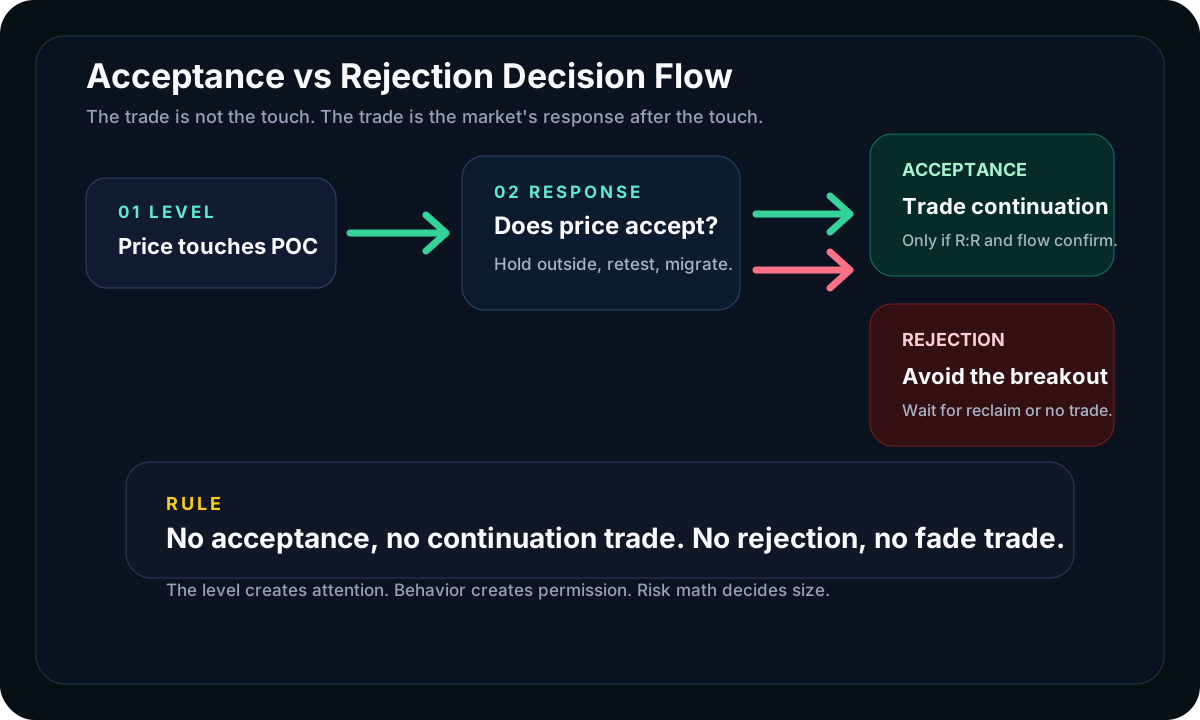
The distinction saves money. A prior POC can act like a magnet because the market remembers the level. It can also fail instantly if price accepts above or below it with strong participation. The trade is not "POC touched, buy." The trade is "POC touched, what did the auction do next?"
What VWAP Actually Means
VWAP stands for Volume Weighted Average Price. It measures the average traded price weighted by volume. A price where more contracts traded gets more influence than a price where almost nothing traded.
Session VWAP usually resets each day. Anchored VWAP can begin from a chosen high, low, date, event, or swing point. Either way, the idea is the same: VWAP gives you a participation average, not a structural auction node.
Institutions care about VWAP because it is a benchmark. If a desk is buying and gets filled below VWAP, that can be a better-than-average execution for that window. If price holds above VWAP all morning, buyers are willing to keep paying above the average traded price. Useful information, but not a trade by itself.
When POC Matters More
POC matters more when the question is structural. You are asking where value formed, where two-sided trade might return, and whether price is accepting or rejecting prior value.
- Where did yesterday's auction accept value?
- Where is the market likely to rotate if price re-enters value?
- Is price accepting above prior value or rejecting it?
- Where should I expect two-sided trade to appear?
This is why POC is central to the POC Bounce Long. The level gives location. Then QPulse gives timing and Flow Pro confirms participation. The level alone is never the trade.
POC is also more useful when you are comparing sessions. A prior-day POC, weekly POC, or composite POC can remain relevant after today's VWAP has reset. VWAP forgets at the session boundary unless it is anchored. Volume Profile can preserve the market's memory.
When VWAP Matters More
VWAP matters more when the question is participation. You are asking whether buyers or sellers control the current session, whether your entry is extended from average traded price, and whether the move is still being accepted.
- Are buyers holding price above the session average?
- Are sellers rejecting every reclaim attempt?
- Is the trade chasing far from average participation?
- Would my entry be better or worse than the session benchmark?
If price is trending above VWAP and pullbacks keep holding it, shorting every prior POC touch can become expensive. The auction level may matter, but session participation is telling you buyers are in control right now.
VWAP is also useful as a discipline tool. If you want to buy 20 points above VWAP into a prior value high, the journal should force the question: am I buying structure, or am I chasing extension?
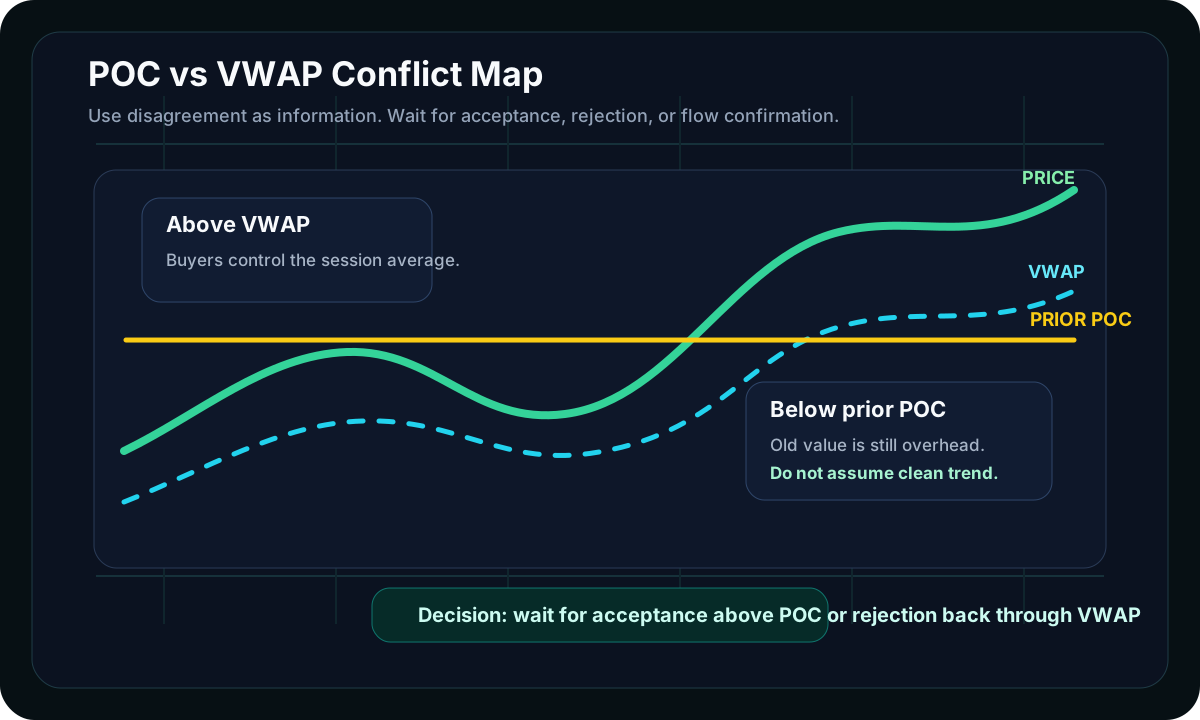
Scenario: ES is above session VWAP but still below prior POC.
Bad read: "Above VWAP, long only." That ignores the overhead acceptance level.
Better read: buyers control the current session, but prior value is still overhead. Wait for acceptance above POC, rejection back through VWAP, or clean order-flow confirmation at the level.
Journal note: "Long idea only after 5-minute acceptance above prior POC. If price rejects POC and loses VWAP, no long. Reassess for failed reclaim."
When POC and VWAP Agree
Confluence is clean. If VWAP sits near prior POC and price pulls into both with buyers defending, you have a real location. The level has auction memory and current participation relevance.
That still does not mean automatic long. It means the level deserves attention. The trade needs price reaction, timing shift, flow confirmation, reward-to-risk that still pays, and position size that fits the stop.
If those pieces line up, POC plus VWAP can give you one of the cleanest intraday reads: structure and participation in the same place.
POC and VWAP agreement is only useful when price reacts cleanly, the timing trigger appears before the move is extended, order flow confirms participation, and the stop still produces acceptable reward-to-risk.
When POC and VWAP Disagree
Disagreement is where the real teaching lives. A trader wants the chart to resolve the conflict immediately. The professional response is usually slower: wait for the market to show which reference is being respected.
| Condition | Interpretation | Action |
|---|---|---|
| Price above VWAP, below prior POC | Buyers control session, prior value still overhead. | Wait for acceptance or rejection. |
| Price below VWAP, above prior POC | Session weak, but prior value may support. | Watch flow at POC. |
| VWAP far above POC | Session repriced higher from old value. | Avoid stale fade bias. |
| VWAP far below POC | Session repriced lower from old value. | Avoid blind dip buying. |
The point is not picking your favorite line. Acceptance above POC changes the map. Rejection back through VWAP changes the tape. Until one of those happens, you are guessing which group wins.
The Mistakes
Using POC as a Button
POC is context, not an order type. If price hits POC with no reaction, no timing shift, and no flow, there is no trade. A high-volume level can break like any other level.
Using VWAP as Moral Authority
"Price is above VWAP, so long only" is too simple. Price can be above VWAP and still run into prior value resistance. Price can be below VWAP and still be testing a major POC where sellers are exhausted.
Ignoring the Profile Range
POC depends on the selected range. Yesterday's POC, weekly POC, and composite POC can all be different. If you do not know which profile created the level, you do not know what the level represents.
Forgetting VWAP's Session Logic
Standard VWAP resets. That makes it useful for the current session, but weaker for older auction memory unless you are using an anchored VWAP from a meaningful event.
- Map structure: prior POC, VAH, VAL, HVN, LVN.
- Map participation: session VWAP and whether price is accepting above or below it.
- Wait for behavior: rejection, acceptance, rotation, or failed reclaim.
- Time the entry: QPulse trigger at the level.
- Confirm participation: Flow Pro agrees or the trade is downgraded.
- Size the risk: stop beyond invalidation, not beyond comfort.
That sequence keeps the indicators in their lanes. POC handles location. VWAP handles participation. QPulse handles timing. Flow Pro handles go/no-go. The Scorecard decides whether the whole thing deserves risk.
Source and Indicator Notes
- NinjaTrader's Order Flow Volume Profile documentation defines POC as the highest-volume price in the profile settings: Order Flow Volume Profile help guide.
- NinjaTrader's volume profile education describes POC as where the market agreed most and value area as the broader zone of acceptance: Volume Profile concepts.
- TradingView describes VWAP as an average price weighted by volume: VWAP indicator reference.
- Interactive Brokers describes VWAP as a daily average trade price benchmark used to compare execution quality: IBKR VWAP glossary.
- This article is educational. POC, VWAP, and volume profile tools do not guarantee support, resistance, fills, or future trade outcomes.
Final rule: do not ask whether POC or VWAP matters more in the abstract. Ask what question you are trying to answer. If the question is auction memory, start with POC. If the question is session participation, start with VWAP. If both agree and flow confirms, now you have something worth scoring. If they disagree, patience is usually the trade.
Learn Volume Profile before trading POC
POC matters only when you understand the auction around it. Build the map before treating any line as a setup.


