It was 9:47 AM on a Tuesday in March, and I was staring at a NinjaTrader chart loaded with fourteen indicators. The candles were barely visible beneath a maze of colored lines, bands, histograms, and dots. RSI said overbought. MACD said bullish crossover. Bollinger said contracting. I froze. Took no trade. ES ripped 18 points in the next forty minutes without me.
That was the session that broke me free from indicator addiction. I deleted every one of those overlays and started over with a single question: what do institutional traders actually use to make decisions? Not what retail YouTube recommends. Not what comes pre-loaded on the platform. What actually works in futures markets where algos dominate volume and retail edge is razor-thin?
Eighteen months later, I trade with exactly seven indicators. Three form the core of the STS system. The other four provide context, confirmation, and risk calibration. This article breaks down each one: how it works mechanically, a specific trade example, when it fails, and how it integrates into a complete system.
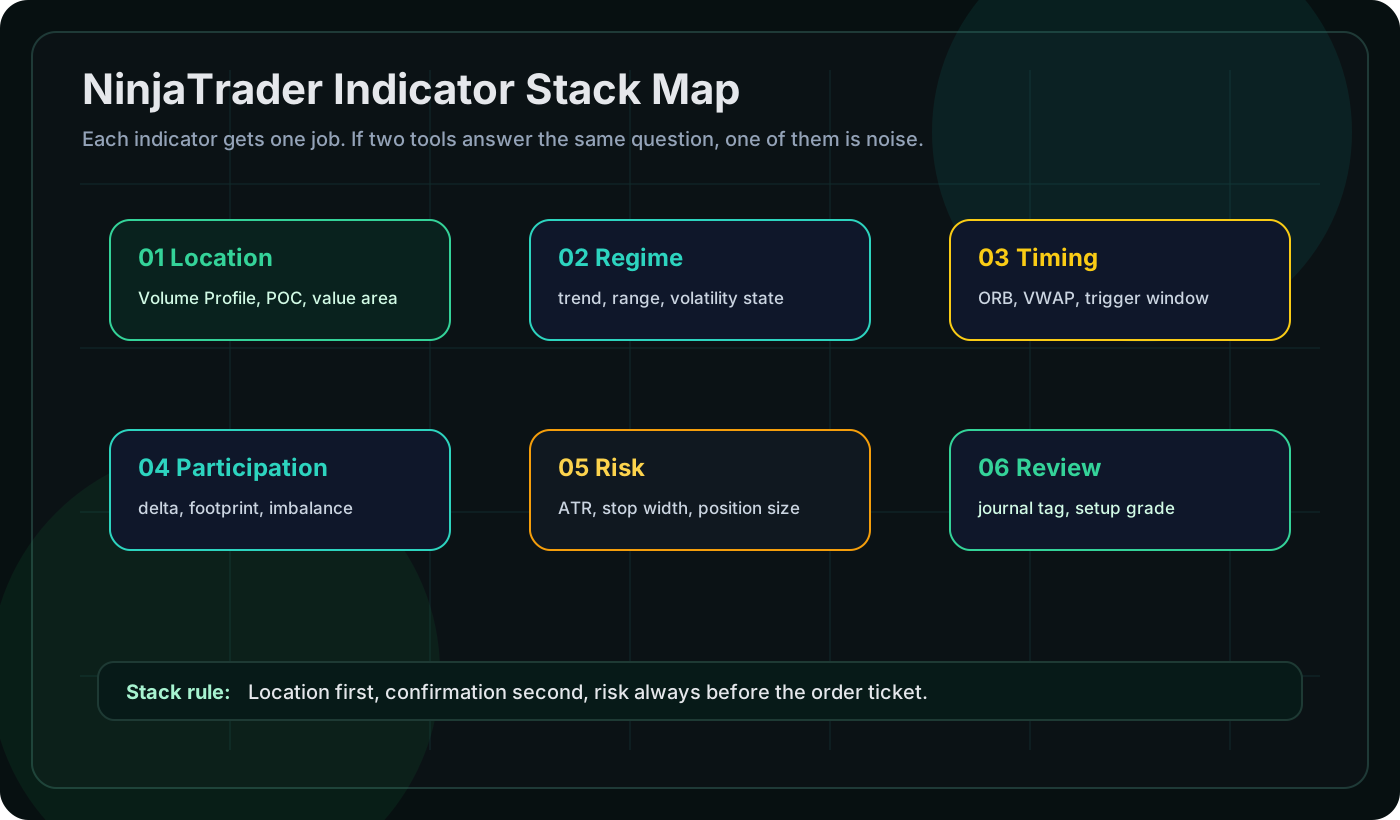
The point is not to own more indicators. The point is to assign one job per tool. If two indicators answer the same question, one of them is getting fired.
My Indicator Desk: One Job Per Tool
1. Volume Profile: The Map of Where Money Sits
Volume Profile builds a horizontal histogram showing exactly how much volume was transacted at each price level. The Point of Control (POC) is fair value — where the most business happened. VAH and VAL encompass the 70% zone. High Volume Nodes (HVNs) act as magnets during retracements. Low Volume Nodes (LVNs) are transit zones where price accelerates through.
Trade Example
April 14 — ES opened at 5,318, gapping above prior session VAH of 5,312. Overnight session built a thin LVN between 5,300-5,308, with a dense HVN at 5,294 from the prior three sessions' composite. At 9:42 AM, ES pulled back and entered the LVN — sliced through 5,308, 5,304, barely pausing. At 10:03 AM, it tagged the HVN at 5,294 and bounced. I entered long at 5,295, stop at 5,289. ES rotated back to the POC at 5,312 within 90 minutes. 17-point winner on 6-point risk: 2.8R. Read the full breakdown: Volume Profile and Institutional Levels.
When It Fails
On trending days driven by macro catalysts (CPI, FOMC, geopolitical shocks), prior profiles become irrelevant because the entire value area is migrating. Also fails on low-liquidity sessions — profiles built from 60,000 contracts are fundamentally different from 1.8 million.
2. Cumulative Delta: Reading the Tug-of-War
Cumulative Delta tracks the running difference between buying volume (contracts hitting the ask) and selling volume (contracts hitting the bid). The magic is not the absolute value but the divergences between delta and price.
Trade Example
March 28 — NQ grinding higher from 18,440 to 18,512 between 10:15-11:30 AM. Price making clean higher highs. But Cumulative Delta sloped downward the entire time, from +14,200 to +8,600. Buyers were exhausted. The push was driven by sellers pulling bids, not genuine buying aggression. Shorted NQ at 18,508 with stop at 18,528. NQ reversed to 18,430 by 1:15 PM. 78-point winner on 20 points of risk: 3.9R.
When It Fails
Delta divergences can persist for hours on trend days. During the March 12 CPI rally, ES delta diverged bearish for 90 minutes while price climbed 35 points. The lesson: delta divergence is a warning, not a trigger. It needs confluence with a structural level from Volume Profile or a signal from QPulse.
3. QPulse: The Momentum Heartbeat
QPulse measures rate of change normalized against recent volatility, centered on a zero line. When it crosses above zero, momentum has shifted bullish. Below zero, bearish. The critical STS signal is the zero-line cross on the 3-minute chart, confirmed by direction on the 15-minute. Full breakdown: QPulse Zero-Line Cross.
Trade Example
April 22 — GC consolidating between 2,348-2,362 all morning. 15-minute QPulse flat, just below zero. At 10:14 AM, 15-minute QPulse turned positive for the first time since prior session. Two bars later on 3-minute, QPulse crossed zero upward at 10:20 AM, price at 2,356. Entered long at 2,357, stop at 2,349. GC broke out to 2,384 by 12:30 PM. 27-point winner on 8 points: 3.4R.
When It Fails
QPulse generates false crosses in choppy, range-bound markets. On April 3, CL produced seven zero-line crosses on the 3-minute chart — only one led to a meaningful move. The 15-minute QPulse filter eliminates roughly 60% of false signals.
4. Flow Pro: The Go/No-Go Gate
Flow Pro identifies when unusually large orders are entering at specific price levels. Unlike standard volume, it decomposes volume into size buckets and highlights institutional-size orders (20+ contracts in ES, 10+ in NQ). These commitment zones function as support/resistance with significantly higher reliability than arbitrary horizontal lines. Read: Flow Pro Is an Account Killer (If You Use It Wrong).
Trade Example
February 19 — ES at 5,264. Flow Pro flagged dense cluster of large buy orders between 5,258-5,261, over 2,400 contracts in that 3-point range. At 10:48 AM, ES pulled back to 5,260. Flow Pro showed commitment zone holding with additional large buys at 5,259. Entered long at 5,261, stop at 5,255. ES bounced to 5,281 by noon. 20-point winner on 6 points: 3.3R.
When It Fails
Large orders are not always directional. Market makers place large orders for hedging and inventory management. A cluster at 5,260 might be a hedge fund building a long or a market maker hedging an options portfolio. Flow Pro cannot distinguish intent, only activity. When large orders get pulled (iceberg fakeouts), the commitment zone evaporates.
5. VWAP: The Institutional Benchmark
Volume Weighted Average Price is the benchmark every execution desk on Wall Street measures against. If you bought below VWAP, you got a good price. Above, you underperformed. The standard deviation bands provide dynamic support/resistance — the second band captures 95% of price action. When price reaches the third, it is statistically extreme and tends to mean-revert.
Trade Example
March 6 — ES dropped from 5,340 to 5,308 on weak jobs data. VWAP anchored at 5,332. At 10:22 AM, ES reached VWAP -2 standard deviations at 5,305. Selling pressure exhausting, delta flattened, composite HVN at 5,304. Entered long at 5,306, stop at 5,298. ES mean-reverted to 5,325 by 12:30 PM. 19 points on 8 risk: 2.4R.
When It Fails
VWAP mean-reversion fails on genuine trend days. Also, VWAP resets each session — no memory from prior days. Fading VWAP on CPI day is a recipe for destruction.
6. ATR: Sizing Every Trade to Current Volatility
ATR tells you how much the market is moving — and that governs how much capital you risk. A 14-period ATR on a 15-minute ES chart reads 6.5 points during quiet sessions and 14.2 during volatile ones. If you use a fixed dollar stop regardless of volatility, you will either get stopped out too early on volatile days or risk too much on quiet days.
Trade Example
January 30 — CL long at 73.42. 15-minute ATR reading 0.38, 40% above its 20-day average of 0.27. CL moving fast. Instead of normal 0.30 stop, widened to 0.45 (1.2x ATR) and reduced from 3 contracts to 2 to keep total risk at 1R. CL hit target of 2R at 74.18. Without ATR adjustment, my normal 0.30 stop would have been clipped by the 10:52 AM retracement that pulled back 0.34 before continuing higher. Full framework: Position Sizing: Why the 2% Rule Is Wrong.
7. GEX Overlay: The Invisible Hand of Options Dealers
GEX measures aggregate gamma exposure of options dealers at each strike. When dealers are long gamma (positive GEX), they hedge by selling rallies and buying dips — creating mean reversion. When short gamma (negative GEX), they hedge in the same direction as price — creating explosive trends. The GEX flip line is where gamma switches from positive to negative. Full breakdown: How GEX Controls Your Trading Day.
Trade Example
April 8 — ES at 5,275. GEX flip at 5,250, meaning positive gamma territory. Call wall at 5,300, put wall at 5,200. Session would be rangebound 5,250-5,300 unless a catalyst broke structure. At 10:45 AM, ES pushed to 5,296, just under the call wall. QPulse peaked and rolled over. Shorted at 5,295, stop at 5,304. ES rotated to 5,272 by 1:30 PM. 23-point winner on 9 risk: 2.6R.
When It Fails
GEX levels change as options are opened and closed throughout the day. The map at 9:30 AM may look different by 2:00 PM. Major 0DTE expirations reshape gamma rapidly. Also, different data providers calculate GEX differently — I cross-reference at least two sources.
The Comparison Table
| Indicator | Type | STS Role | Best For | Failure Mode |
|---|---|---|---|---|
| Volume Profile | Structure | Core (1/3) | S/R levels | Trend/catalyst days |
| Cumulative Delta | Order Flow | Confirmation | Divergence | Strong trends |
| QPulse | Momentum | Core (2/3) | Entry timing | Choppy ranges |
| Flow Pro | Order Flow | Core (3/3) | Commitment | Iceberg fakeouts |
| VWAP | Benchmark | Context | Mean-reversion | Genuine trends |
| ATR | Volatility | Sizing | Position sizing | Regime changes |
| GEX Overlay | Positioning | Context | Session type | Intraday shifts |
What Is NOT on This List (and Why)
RSI, MACD, Bollinger Bands, Stochastic, CCI — none made the cut. These were designed in the 1970s-80s for daily stock charts. They measure lagging price derivatives that are already priced in by the time they generate signals.
| Indicator | Era | Designed For | Works in Futures? | Why Not |
|---|---|---|---|---|
| RSI | 1978 | Daily stocks | No | Trends persist past OB/OS for hours |
| MACD | 1979 | Daily stocks | No | Too lagging for intraday futures |
| Bollinger Bands | 1983 | Daily stocks | No | Assumes normal distribution (futures are fat-tailed) |
| Stochastic | 1950s | Daily stocks | No | Too noisy on fast timeframes |
The indicators on my list share a common trait: they all measure what participants are doing, not what a mathematical formula calculates from past prices. Volume Profile shows where money is committed. Cumulative Delta shows who is aggressive. QPulse measures momentum relative to actual volatility. Flow Pro tracks institutional orders. These are structural tools that describe market reality, not lagging derivatives.
When the Whole Stack Fails
Here is the part indicator vendors prefer to skip: even a clean stack can lose. News can detonate the tape. Liquidity can vanish. A beautiful Volume Profile level can become a trapdoor. QPulse can cross during a fake impulse. Flow Pro can light up on hedging activity that has no follow-through. If your plan requires every indicator to be right all the time, your plan is a fantasy with a toolbar.
The professional answer is not "add more indicators." It is to define invalidation before entry. What price proves the idea wrong? What flow behavior cancels the trade? What regime makes the setup lower quality? If you cannot answer those three questions before clicking buy or sell, you are not trading a system. You are decorating hesitation with software.
My hard rule: every indicator gets one job, and every trade gets one reason to die. That is how you avoid the worst trader disease on earth: moving from signal to signal until you find one that agrees with your bias.
How They Work Together in the STS System
Pre-session: Check GEX for session type classification. Mark prior session's Volume Profile levels (POC, VAH, VAL, HVNs, LVNs). Note current ATR for sizing.
Entry sequence: (1) Price at a significant VP level, (2) QPulse crosses zero on 3-minute in trade direction, (3) Flow Pro confirms large orders committed. All three align = enter. Two = wait. One = nothing.
Confirmation: Watch Cumulative Delta for divergence. If long and delta diverges bearish, tighten to breakeven. If VWAP overhead, take partial profits early.
Sizing: Stop at structural invalidation level, verified against 0.8-1.5x ATR. Too wide = reduce size. Too tight = add buffer.
Final rule: do not add another indicator until every tool on your chart has one job, one failure mode, and one reason to stay. Seven indicators. Three core, four context. Two timeframes. One system. The full suite is available at nexural.io/indicators — free, forever. Use it like a desk, not a junk drawer.