Skip to content
v3 redesign is live — welcome to the trading cockpit.
Market updates, stock news, and futures insights — 3x/week, freeSubscribe free
Skip to content
build.logtraders.online=2,166trades.60s=74swings.ranked=308edge.latency_ms=42ms
Back to Blog
Trading Education

Futures Trading Routine: From Pre-Market to Post-Trade Review

S
Sage

Head of Trading Education

13 min read
Updated June 17, 2026
Futures Trading Routine: From Pre-Market to Post-Trade Review

What is "Futures Trading Routine: From Pre-Market to Post-Trade Review" about?

A complete futures trading routine for serious retail traders: pre-market prep, level mapping, risk planning, execution, journaling, and post-trade review.

The trade usually goes wrong before the entry. Not always on the chart. Sometimes it goes wrong at 8:42 AM, when you skip the news check. Or 9:17, when you mark seven levels and decide all of them matter. Or 10:08, when your first loss turns into a negotiation instead of a stop.

A futures trading routine is not a productivity ritual. It is a way to reduce the number of decisions you have to invent while price is moving.

The goal is simple: by the time the market opens, you know what kind of day you are preparing for, where you care, what you are allowed to trade, how much you can lose, and what will make you stop.

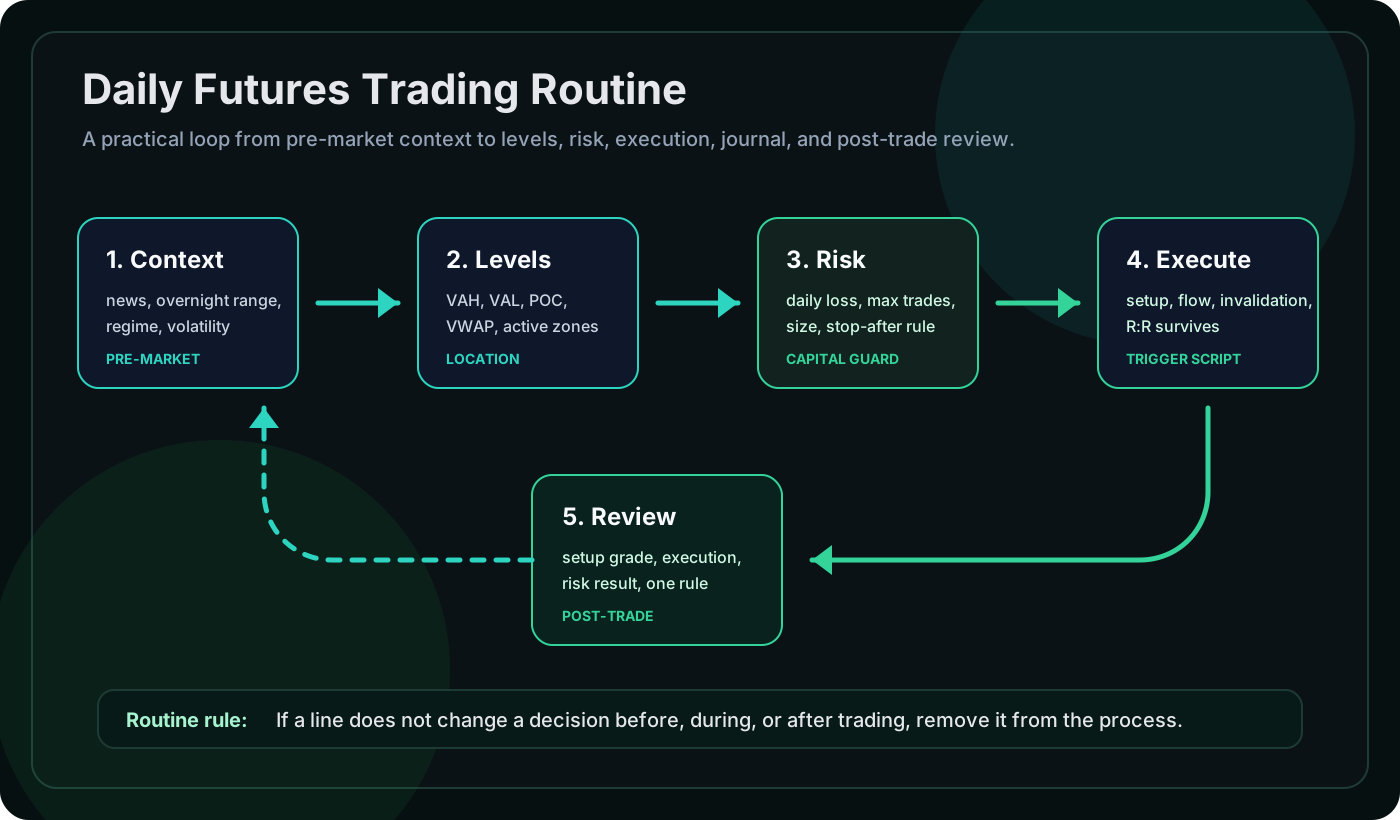
Futures trading routine workflow from pre-market context to level map, risk plan, execution, journal, and post-trade review

The Routine Has Five Jobs

A good futures routine does not need to be long. It needs to answer five questions:

  1. Context: what kind of session am I walking into?
  2. Location: where could good trades happen?
  3. Risk: what is my max loss before the first order?
  4. Execution: what must be true before I click?
  5. Review: what did I learn after the session?

Everything else is decoration unless it changes one of those decisions.

Stage 1: Pre-Market Context

Start with the market before you start with your setup.

Your pre-market read should include:

  • economic news and scheduled catalysts,
  • overnight high, low, and range,
  • prior day high, low, close, VAH, VAL, and POC,
  • whether value is migrating or staying balanced,
  • current volatility and expected stop distance,
  • positive GEX, negative GEX, or unknown regime,
  • the first two scenarios you are willing to trade.

Use the futures pre-market checklist as the base. Then layer in the GEX regime guide, the positive GEX plan, and the negative GEX plan when regime matters.

Stage 2: Build the Level Map

Do not mark every visible line. Mark the places where you would actually make a decision.

Your morning map should separate:

  • active levels: fresh, current, tradeable with confirmation,
  • reference levels: useful for context but not automatic triggers,
  • stale levels: old lines that should not receive full-size trades.

Read How to Read a Volume Profile Before the Open, How to Know When a Trading Level Is Stale, and POC vs VWAP before treating a line as a signal.

Stage 3: Define Risk Before the First Trade

Risk is not a feeling you check after the first loss. It is the budget for the session.

Write these numbers before trading:

Risk Field Example Why It Matters
Max daily loss$300defines the hard stop
Max trade risk$75prevents one trade from owning the day
Max trades3caps decision fatigue
Stop-after rule2 losses or 1 rule breakprotects behavior
Contract sizeMES 2 maxturns risk into exact exposure

Use the daily loss limit guide, the futures tick value cheat sheet, the futures position size calculator, and the R-multiple calculator. If you are trading an evaluation account, add the prop firm drawdown rules guide.

Stage 4: Approve Setups, Not Impulses

Before the open, choose the setups you are allowed to trade.

For example:

  • POC bounce only if context is balanced and flow confirms.
  • VAH rejection only after failed acceptance back inside value.
  • Breakout only if volume expands and R:R survives the trigger.
  • No mid-range trades in the first 15 minutes.
  • No stale-level trades at full size.

This is where The Difference Between a Setup and a Trade matters. A setup is a candidate. A trade is a candidate that passed context, flow, risk, and timing.

For playbook examples, review the beginner POC bounce guide, the POC Bounce Long playbook, the VAH breakout guide, and the VAH Rejection Short playbook.

Stage 5: Execute With a Trigger Script

When price reaches a level, do not ask, "Do I like it?" Ask the same four questions every time:

  1. Is this one of my approved setups?
  2. Does flow confirm participation?
  3. Where am I wrong?
  4. Does R:R still work at the actual fill?

Use Order Flow for Beginners, Delta Divergence Explained, and Why Clean Chart Setups Fail Without Flow for the confirmation layer.

Then check timing. Waiting for candle close can ruin R:R if the confirmation arrives after the trade location is gone.

During the Session: Keep a Running Log

Your journal should not start after the damage is done.

Keep a running log with short tags:

  • setup spotted,
  • trade approved,
  • trade skipped,
  • flow missing,
  • R:R gone,
  • stale level,
  • rule break,
  • stop for day.

Use the Nexural journal and the futures trading journal workflow. You are not writing a diary. You are creating evidence for the next improvement.

Post-Trade Review

After each trade, separate the idea from the execution.

Two-Minute Review

  • Setup: A, B, C, or no setup.
  • Context: aligned, mixed, or hostile.
  • Execution: on time, late, early, chased, or rule break.
  • Risk: planned risk matched actual loss or not.
  • Lesson: one rule for the next session.

If it was a loss, use How to Review a Losing Trade Like a Professional. If it was a missed trade, use How to Journal a Missed Trade Without Lying to Yourself. If the day became a sequence of bad decisions, use the losing-streak reset and the overtrading guide.

End-of-Day Review

At the end of the session, do not grade yourself by P&L first.

Grade the process:

  1. Did I follow my risk limits?
  2. Did I trade only approved setups?
  3. Did I respect stale levels and bad R:R?
  4. Did I stop when my stop rule triggered?
  5. What one behavior should change tomorrow?

One good review rule beats ten vague observations. The point of the routine is not to produce more notes. The point is to make tomorrow's first bad decision harder to take.

A Complete Routine Template

Use this as the daily version:

Daily Futures Routine

  1. Check news, calendar, and overnight range.
  2. Map prior day high/low, VAH, VAL, POC, VWAP, and active levels.
  3. Label regime: trend, range, transition, positive GEX, negative GEX, or unknown.
  4. Write max daily loss, max trade risk, max trades, and stop-after rule.
  5. Choose one to three approved setups.
  6. Require flow, acceptance/rejection, and R:R before entry.
  7. Journal screenshots, setup grade, execution grade, and risk result.
  8. End with one rule for tomorrow.

Source and risk notes

  • CME's position and risk management education emphasizes managing profitable and losing positions, using stops, and thinking through P&L targets: CME Position and Risk Management.
  • CME's pre-trade risk management page describes limit, order, permission, dashboard, report, and audit-trail controls designed to protect participants before and after trades: CME Pre-Trade Risk Management.
  • E*TRADE's futures trading plan guide explains that a trading plan helps define goals, risk tolerance, trading style, and rules for entries and exits: Building a Futures Trading Plan.
  • NinjaTrader's futures best-practices article emphasizes knowing contracts, managing risk, and continuing education as traders evolve: 6 Best Practices for Trading Futures.
  • NFA investor best-practice materials warn that futures trading carries substantial risk and should use only risk capital a trader can afford to lose: NFA Investor Best Practices.
  • This article is educational. A routine can improve consistency, but it cannot remove leverage, slippage, liquidity, platform, event, or execution risk.

Final rule: your routine is only real if it changes what you do when the trade is tempting. If it does not reduce bad trades, cut it down until every line has a job.

Next Step

Turn the routine into a daily trading checklist

The routine is useful only when it is visible before the open, active during execution, and reviewed after the session.

#futures trading routine#pre-market checklist#trading journal#risk management#trade review
Share this articleTwitterLinkedIn

Frequently asked questions

What should a futures trading routine include?

A futures trading routine should include pre-market context, key levels, market regime, risk limits, approved setups, execution rules, trade journaling, and post-trade review.

How long should pre-market prep take for futures trading?

For most retail futures traders, 15 to 30 focused minutes is enough if the process is repeatable: check news, overnight range, value, levels, regime, risk, and approved playbooks.

Should I journal before or after trading?

Both. Before trading, journal the plan and risk limits. After trading, record screenshots, execution quality, setup quality, mistakes, and one rule for the next session.

What is the biggest mistake in a trading routine?

The biggest mistake is making the routine a checklist theater exercise. The routine must change behavior: what you will trade, what you will skip, how much you can lose, and when you stop.

How do I make a trading routine easier to follow?

Keep it short, visible, and binary. Use yes/no checks for risk, regime, setup permission, and stop rules instead of long notes that never affect the next decision.

S
Sage

Head of Trading Education

Head of Trading Education at Nexural. A futures and swing trader who built the Nexural cockpit to survive his own trading — institutional-grade research, an event-sourced journal, and tools whose math is public. Writes the way he trades: receipts over marketing.

Run the system, not the screenshots

The Nexural Swing Desk ranks setups against the same composite-z gauntlet — no signals, no auto-execute.