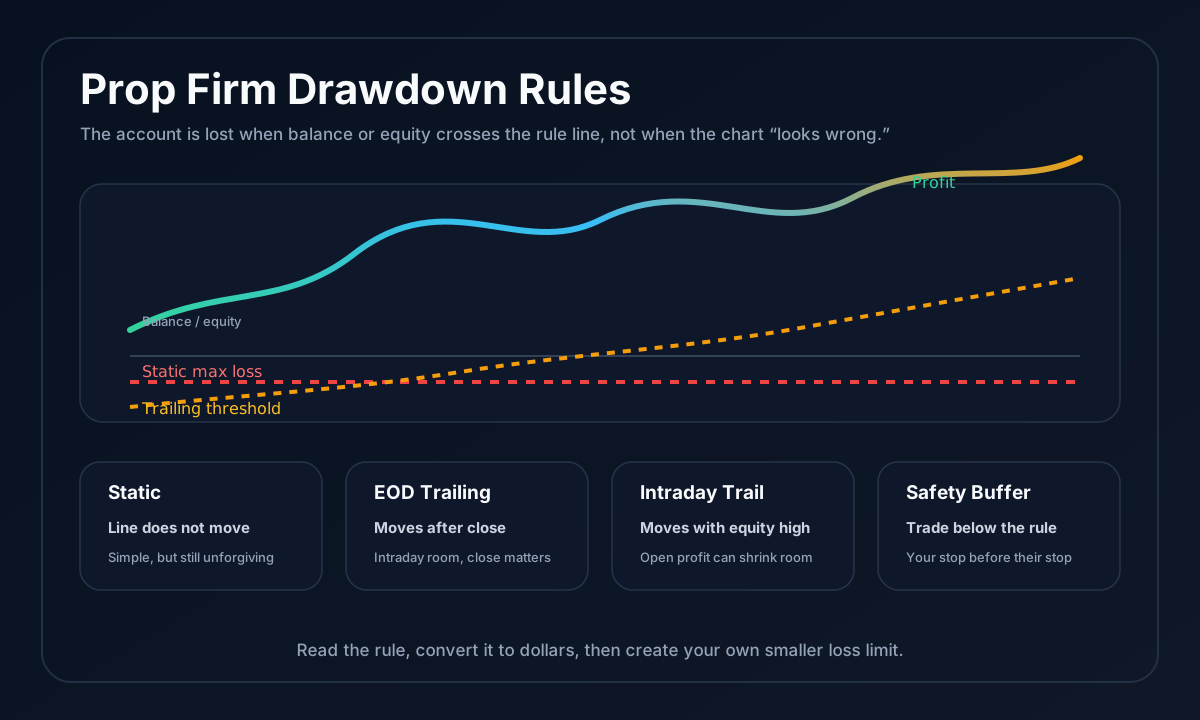
The trader did not blow the account on a huge red day. He blew it after being up $900, giving back $700, and forgetting that the trailing threshold had moved.
That is why prop firm drawdown rules feel unfair to new traders. The chart might look manageable, the trade might still be open, and the day might still be green. But if account equity crosses the rule line, the account is done or locked out. The rule does not care how close the bounce looked.
This article explains the rule types, shows examples, and gives you a practical safety buffer. It is educational, not legal or firm-specific advice. Prop firm rules change, so always verify the current help-center page before trading.
The Four Rule Types You Need to Separate
Most confusion comes from mixing four different ideas:
| Rule | What It Controls | Trader Mistake |
|---|---|---|
| Daily loss limit | one session's damage | treating it like a target to use fully |
| Static max loss | fixed account floor | ignoring how close the account is to failure |
| End-of-day trailing drawdown | threshold updates from closing balance | forgetting the close changes tomorrow's room |
| Intraday trailing drawdown | threshold can move with open equity highs | giving back open profit after the line moved |
Do not trade until you know which rule your account uses. "Trailing" is not enough information. You need to know whether it trails end-of-day balance, intraday equity, realized balance, unrealized profit, or a capped safety level.
Example 1: Static Max Loss
Assume a $50,000 evaluation has a $2,000 max loss. The failure line is $48,000.
- Start: $50,000.
- Maximum loss line: $48,000.
- You make $800: balance is $50,800.
- If the rule is truly static, the line stays $48,000.
Static is the easiest to understand, but it still punishes oversized risk. A trader with a $2,000 account-level floor should not be risking $500 per trade just because the platform allows it.
Use the prop firm risk calculator and the daily loss limit guide to create a personal stop smaller than the firm's stop.
Example 2: End-of-Day Trailing Drawdown
End-of-day trailing drawdown usually updates after the session closes. Intraday swings may matter less than the closing balance, but the closing balance can move tomorrow's threshold up.
Example:
| Day | Close | Trailing Amount | New Threshold |
|---|---|---|---|
| Start | $50,000 | $2,000 | $48,000 |
| Day 1 | $50,600 | $2,000 | $48,600 |
| Day 2 | $51,200 | $2,000 | $49,200 |
The danger is psychological. The account is up $1,200, but the room to failure may still be only $2,000 from the new threshold. Profit does not mean freedom. Sometimes profit just drags the line closer behind you.
Example 3: Intraday Trailing Drawdown
Intraday trailing drawdown is harder. The threshold may move during the session as open equity makes new highs.
Example:
- Start: $50,000.
- Trailing amount: $2,500.
- Open equity reaches $51,000 during a trade.
- The trailing threshold may move to $48,500.
- If the trade reverses and equity falls to $48,500, the account can fail even though that high was never locked in as a closing balance.
That is why open profit is not harmless. If the rule trails intraday equity, giving back a winner can reduce account room faster than a normal realized loss.
This is where the tick value cheat sheet and the futures position size calculator matter. If a two-contract NQ pullback can move the account hundreds of dollars in seconds, the drawdown rule is not an abstract policy. It is live risk.
Daily Loss Limit Is Not the Same Rule
A daily loss limit may stop trading for the day without necessarily failing the entire account, depending on the firm and account type. A maximum loss or drawdown breach can close or fail the account.
The practical rule: treat your personal daily loss as smaller than both.
Personal Safety Buffer
- If firm daily loss is $1,000, personal stop might be $500-$650.
- If account drawdown room is $2,000, never risk $500 on one idea.
- If open equity trails, reduce size before scaling winners.
- If you hit two rule mistakes, stop even if the platform still lets you trade.
Use the overtrading guide and the losing-streak reset because drawdown breaches are often behavior problems wearing a math costume.
The Drawdown Worksheet
Before trading any evaluation or funded account, write this down:
- Account size.
- Maximum loss line.
- Daily loss line.
- Whether drawdown is static, end-of-day trailing, or intraday trailing.
- Whether the line stops trailing and where.
- Whether unrealized profit affects the threshold.
- Your personal daily stop.
- Your maximum risk per trade.
- Your stop-trading rule after mistakes.
Then put it in your futures trading journal. If the rule is not visible, you will remember it only after it matters.
Position Sizing Example
Assume the firm drawdown room is $2,000 and your personal rule is to never lose more than 20% of that room in a day. Your daily stop is $400.
If your trade stop is $80 per contract, your max size is five contracts only in theory. In practice, you should size below that because slippage, commissions, second trades, and bad fills exist.
The better answer may be two or three contracts, not five. Passing a prop evaluation is not about using every inch of room. It is about staying alive long enough for your edge to repeat.
Read the position sizing guide, micro futures position sizing, and Futures Margin vs Risk before assuming the contract limit is a recommendation.
Common Ways Traders Fail Drawdown Rules
- They count profit target distance but ignore drawdown distance.
- They let open profit trail the line, then give the trade back.
- They size from account size instead of drawdown room.
- They think daily loss and max loss are interchangeable.
- They pass the evaluation with risk that cannot survive funded rules.
- They do not stop after the first rule mistake.
This is why reward-to-risk and R-multiple tracking matter. Prop firm survival is not just "make the target." It is make the target without letting the rule line catch you.
Source and risk notes
- Topstep's Maximum Loss Limit help page describes the MLL as a trailing limit that rises with end-of-day balance, does not move down, and can lock permanently once it reaches starting balance: Topstep Maximum Loss Limit.
- Topstep's Daily Loss Limit page distinguishes a daily forced break from a rule violation in specified account contexts: Topstep Daily Loss Limit.
- Apex Trader Funding's intraday trailing drawdown documentation explains threshold behavior for intraday trailing drawdown accounts and when trailing stops in certain account types: Apex Intraday Trailing Drawdown.
- Apex's end-of-day drawdown documentation explains EOD threshold behavior and examples for certain account types: Apex EOD Drawdown.
- NFA investor best-practice materials warn that futures trading is volatile and risky and should use only risk capital: NFA Investor Best Practices.
- Prop firm rules can change by firm, product, account type, platform, and date. Always verify the current official rule page before trading or requesting payouts.
Final rule: the firm's drawdown line is not your risk plan. It is the emergency exit. Build your own smaller stop, size from drawdown room, and stop trading before the rule has to do the job for you.
Set your personal stop before the firm sets it for you
Prop firm rules are emergency boundaries. The trading plan needs a smaller daily stop, smaller per-trade risk, and a visible drawdown buffer.