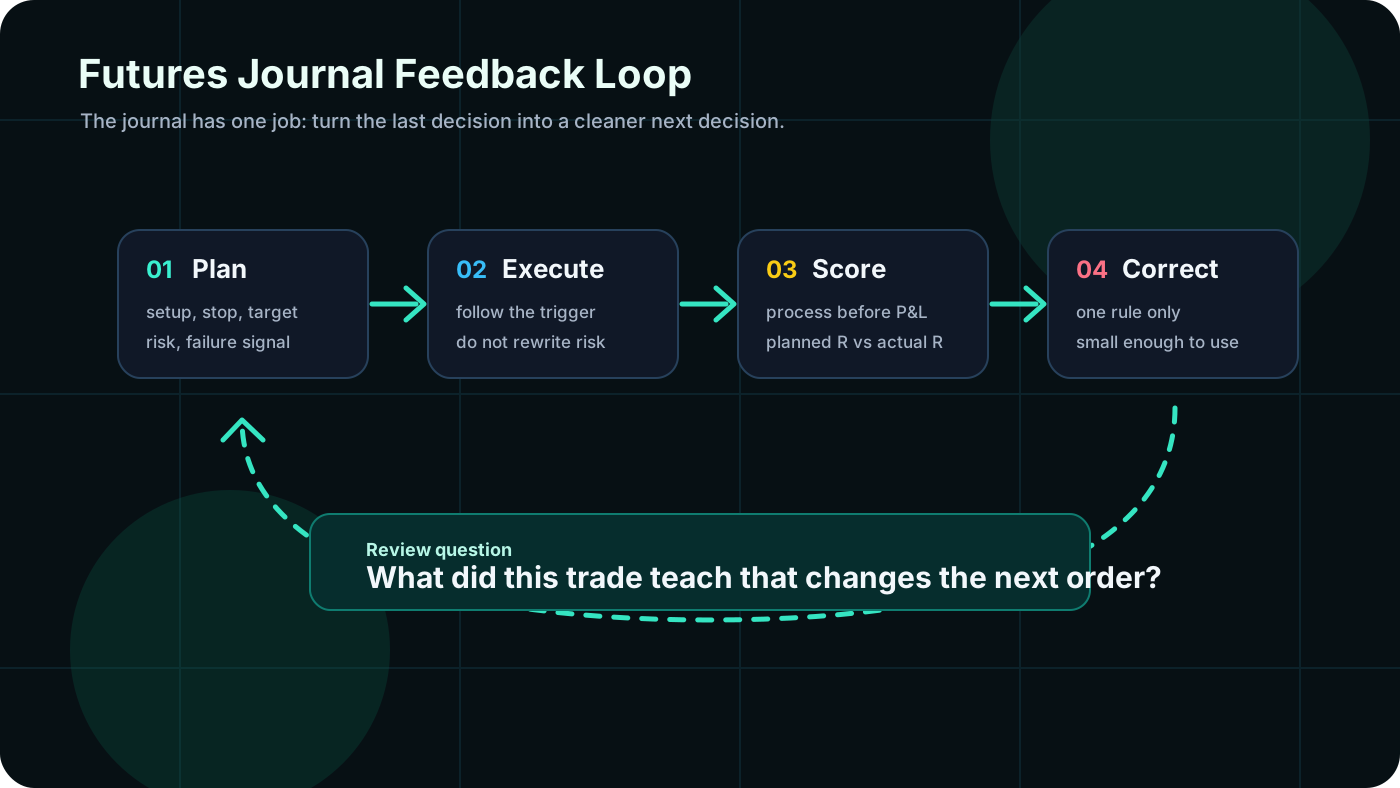
A trader logs every futures trade for three months. Date, ticker, entry, exit, P&L. The spreadsheet looks responsible. Then the same mistake appears again on Tuesday: late entry, oversized stop, revenge trade after the first loss. The journal recorded the damage. It did not change the behavior.
A futures trading journal is not a receipt drawer. It is a behavior correction system. If it cannot tell you which mistake is costing the most R, which setup should be paused, and what rule gets violated after the first loss, it is not a journal yet. It is bookkeeping with candles.
One correction per review. Not seven lessons. Not a motivational speech. One rule small enough to use on the next trading day.
The Bad Journal: P&L With Decoration
Most journals fail because they worship outcome. They ask whether the trade made money before asking whether the trade deserved to exist.
Outcome first
- Did I win?
- How much did I make?
- What was the ticker?
- What was the setup name?
This creates a dangerous lesson: repeat whatever paid last time, even if the process was broken.
Process first
- Was the setup valid before entry?
- Was risk sized from the stop?
- Was the trigger followed without delay?
- What is the one correction?
This separates good decisions from lucky winners and bad decisions from normal losses.
| Trade result | Process result | Journal grade |
|---|---|---|
| Won +2.1R | Entered late, moved target, ignored Flow Pro. | Process loss |
| Lost -1R | Valid setup, correct size, honored stop. | Process win |
| Lost -2.4R | Widened stop after entry. | Critical leak |
That distinction is not cosmetic. It protects you from outcome bias, the habit of treating profitable decisions as good decisions. A lucky winner after a broken rule can poison the next two weeks.
The Three-Part Futures Journal
A real futures journal has three sections: before the trade, during the trade, and after the trade. Most traders only journal after. That is why the entries read like court testimony from someone trying to defend a bad decision.
Write the plan while calm
- Market and session context
- Named setup or no trade
- Trigger and invalidation
- Planned R and contract size
Track the expensive moment
- Stop moved?
- Added outside plan?
- Exited early?
- Hesitated or chased?
Review process before P&L
- Process score from 1 to 5
- Planned R vs actual R
- One mistake tag
- One correction
The Fields That Actually Matter
Here is the futures journal schema that earns its space. Every field has to either improve the next decision or expose a repeated leak.
| Field | Why it exists | What good looks like |
|---|---|---|
| Setup | Find which ideas deserve capital. | POC bounce, VAH rejection, VWAP reclaim, or no named setup. |
| Time of day | Expose when edge or discipline decays. | Morning continuation works; late lunch revenge does not. |
| Planned stop | Anchor risk before emotion arrives. | Stop is defined by invalidation, not by comfort. |
| Actual exit | Catch stop movement and early exits. | Exit matches thesis failure or planned target logic. |
| Planned R vs actual R | Measure execution damage in normalized units. | The original trade and actual trade are not confused. |
| Process score | Separate decisions from outcome noise. | A clean loser can score higher than a lucky winner. |
| Correction | Turn review into the next rule. | One specific behavior rule for tomorrow. |
ES long, POC bounce attempt, positive GEX, QPulse trigger on candle two. Planned stop: below POC rejection low. Planned R: 2.2. Actual entry: one candle late, actual R: 1.3. Process score: 3/5. Mistake tag: late entry. Correction: no entry after candle three from original trigger.
If you are using a spreadsheet, build those columns. If you are using the Nexural journal, those fields should become the spine of your review. The tool matters less than the discipline of capturing decisions before hindsight rewrites them.
The Worksheet: Original Trade vs Actual Trade
The journal has to show the trade you planned and the trade you actually took. Those are often not the same thing.
Stop Discipline and Late Entries
Stop movement and late entries are the two leaks that hide behind smart language. Traders do not write "I panicked and moved my stop." They write "I adjusted for liquidity." Sometimes that is true. Usually it is fear with better vocabulary.
- Original stop price
- Final exit price
- Was the stop widened?
- Did thesis fail or did P&L hurt?
- Minutes waited before next trade
- Trigger candle
- Actual entry candle
- Original entry price
- Actual entry price
- Original R:R vs actual R:R
If stopped trades average -1.6R, you do not have a strategy problem first. You have a stop execution problem. Pair this with The Psychology of Taking the Stop and the 1-3 Candle Rule.
The Mistake Tag Matrix
Do not tag every emotion. Tag the repeatable behavior that actually costs R. A good journal turns five messy trades into one visible pattern.
| Mistake tag | What it usually means | Correction rule |
|---|---|---|
| Late entry | You waited for comfort and paid worse R. | No entries after candle three from original trigger. |
| Stop move | You changed invalidation after risk became emotional. | Any widened stop ends the session review. |
| Oversize | You sized from confidence instead of stop distance. | Full size only when Scorecard passes the threshold. |
| Revenge | You traded to repair emotion, not to execute a setup. | No second trade within 15 minutes of a -1R loss. |
| No setup | You traded movement instead of a named playbook. | No named setup, no order ticket. |
The Weekly Review That Changes Behavior
The daily journal catches emotion. The weekly review catches pattern. Every Friday after the close, sort the week by setup, time of day, mistake tag, process score, and R-multiple.
Be more disciplined
This sounds serious but gives the next version of you nothing to execute.
No second trade within 15 minutes of a -1R loss
This is a behavioral circuit breaker. It can be followed, measured, and reviewed.
Spreadsheet vs Software
A spreadsheet is enough if you are honest and consistent. It becomes weak when screenshots, tags, broker imports, and weekly pattern review start taking more effort than the trading itself. That is when software helps.
The real question is not spreadsheet or software. The real question is whether the journal creates friction before bad decisions and clarity after them. If all you need is rows and formulas, use a spreadsheet. If you need screenshots, filters, behavior tags, imported executions, and structured review, use software. I wrote the deeper comparison in Trading Journal Spreadsheet vs Software.
- Kahneman and Tversky's prospect theory explains why traders may become risk-seeking around losses and why process scoring matters more than judging one outcome: Prospect Theory.
- Investor.gov describes day trading as extremely risky and capable of producing substantial losses quickly: Day Trading glossary.
- The SEC warns that day trading requires continuous attention, high concentration, and can be stressful and expensive: Day Trading: Your Dollars at Risk.
- FINRA notes that frequent intraday trading carries risks, especially on margin, including losing some or all of the investment: Frequent Intraday Trading.
- This article is educational. It is not individualized trading, investment, tax, or legal advice. A journal can improve process visibility, but it cannot eliminate market risk.
Journal the next trade before checking P&L
Do not journal to prove you worked hard. Journal to make the next mistake harder to repeat. Before the next trade, write the stop, failure signal, planned R, and one rule that blocks the behavior you are trying to remove.
Open the Nexural JournalJournal the next trade before checking P&L
The article gives the fields. The next move is to capture the plan before the trade can rewrite the story.