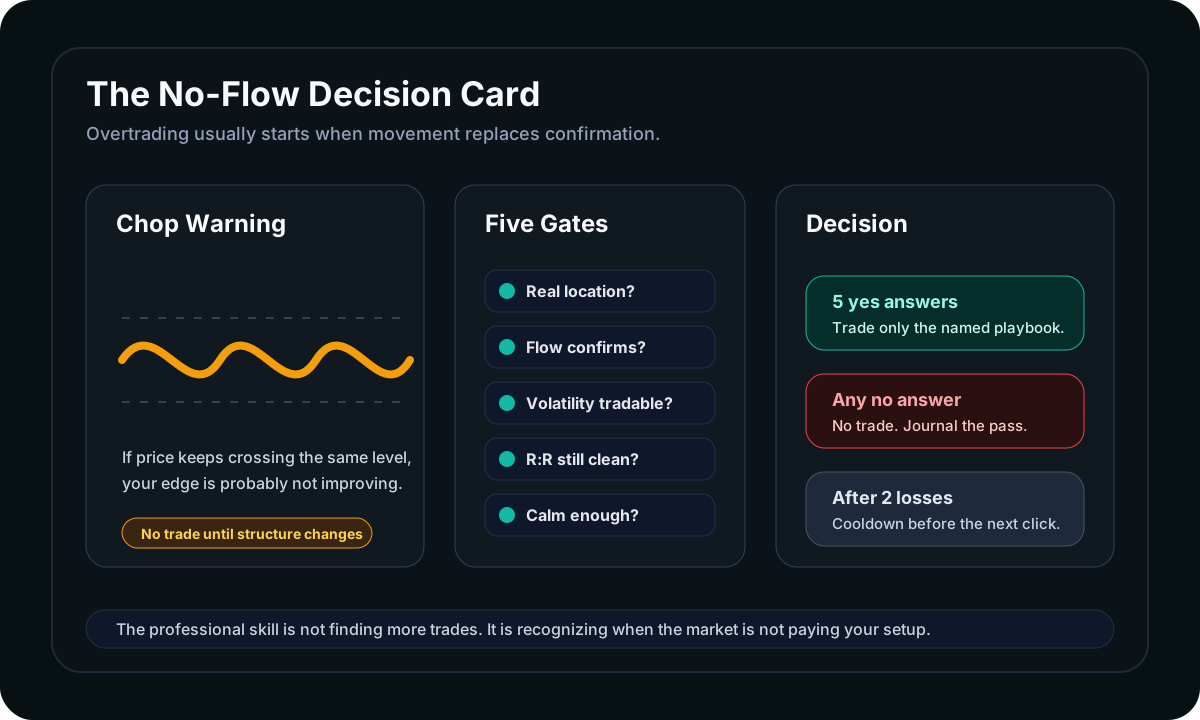
The day does not blow up on trade one. It bleeds out on trades four, five, and six. ES chops around VWAP, NQ keeps snapping back through the same level, and the trader keeps saying, "This one is different." It is not different. It is the same no-flow market charging another commission.
Overtrading is usually described as a discipline problem. Sometimes it is. But in choppy markets, overtrading is often a market-reading problem first. The trader is not seeing that the market has stopped paying the setup.
The fix is not to become less emotional by force. The fix is to build a workflow that makes low-quality trades obvious before the order ticket opens.
What Overtrading Really Looks Like
Overtrading is not just taking many trades. A scalper with a tested edge may take many trades by design. Overtrading is taking trades that your plan did not earn.
Common versions:
- Taking a second setup because the first one lost.
- Re-entering the same idea without new evidence.
- Trading the middle of a range because the edges feel too far away.
- Chasing a candle after missing the planned entry.
- Lowering confirmation standards because the session feels slow.
- Adding size to make back a small loss faster.
The common thread is simple: the trade exists because the trader wants action, not because the market offered a clean opportunity.
Chop Is Movement Without Payment
Choppy markets still move. That is why they are dangerous. The candles are not dead; they are just not paying your setup consistently.
From a Volume Profile and order-flow perspective, chop often looks like:
- Price rotating around VWAP or POC without clean acceptance.
- Repeated crosses through the same level.
- Breakouts that fail before building value.
- Positive delta that does not lift price, or negative delta that does not break price.
- Low-volume pushes that look dramatic on a small timeframe.
That is why Volume Profile, POC vs VWAP, and order-flow confirmation matter. They help separate movement from participation.
The No-Flow Problem
When traders say, "I overtraded," the post-trade review often reveals a no-flow problem:
- The level was not clean.
- The trigger was late.
- The R:R had already collapsed.
- Flow did not confirm the direction.
- The trader was trying to recover, not execute.
That is why the rule should not be "be more disciplined." The rule should be more mechanical:
Use Flow Pro after location and timing align. Do not use it to justify trades that should not exist.
The Five-Gate No-Trade Checklist
| Gate | Pass | Block |
|---|---|---|
| Location | Price is at a planned level | Middle of range, no edge |
| Timing | Trigger appears before R:R collapses | Late candle chase |
| Flow | Participation confirms the idea | Effort without result |
| Risk | Stop and target still make sense | Stop is too wide or target too close |
| State | Calm enough to follow the stop | Revenge, boredom, or urgency |
All five gates need a yes. One no is enough to block the trade. This feels strict until you compare it with the cost of taking six mediocre trades because the morning felt slow.
How QPulse Can Mislead You in Chop
Any momentum or pulse-style trigger can look attractive in chop because chop produces little bursts of movement. The problem is that the burst often happens after the edge has already been spent.
The safer rule:
- QPulse can time a trade only at a planned level.
- QPulse cannot turn a bad location into a valid setup.
- QPulse should be ignored when price is ping-ponging through VWAP or POC.
- QPulse needs Flow Pro confirmation if the market is rotating.
This connects directly to the 1-3 Candle Rule. If the signal comes late and the stop no longer fits, the correct trade is no trade.
Daily Stop Rules That Actually Work
Daily stop rules need to be written before the session. If you invent them after losing, they become negotiations.
Overtrading Circuit Breakers
- Two-loss pause: after two losses, take a mandatory cooldown before the next trade.
- Three-attempt cap: no more than three attempts at the same idea or level.
- Daily loss limit: stop trading when the planned daily risk is hit.
- Chop lockout: if price crosses VWAP or POC three times without acceptance, wait for a new structure.
- Journal gate: no new trade until the prior trade has a one-sentence review.
The circuit breaker is not punishment. It protects the account from the version of you that appears after frustration starts writing the plan.
Journal Good Non-Trades
Most traders only journal entries. That teaches the brain that action is the only thing worth recording. In choppy markets, the best decision of the day may be the trade you did not take.
Log good non-trades in the journal with this format:
That last sentence matters. If you skip a bad trade and it works without you, the pass was still correct. The rule is judged by process, not by the one candle that happened after.
The Recovery Protocol After You Already Overtraded
If the damage is already done, do not try to fix it with one more trade. Use this sequence:
- Close the platform or disable order entry for 15 minutes.
- Write the exact trade that broke the plan.
- Name the failed gate: location, timing, flow, risk, or state.
- Calculate whether the daily loss limit has been reached.
- If still allowed to trade, write the only setup that can be taken next.
This is not about feeling better. It is about stopping the account from becoming the emotional outlet.
Source and risk notes
- Investor.gov notes that day trading is fast moving, speculative, requires close monitoring, and that leverage can increase risk: Thinking of Day Trading? Know the Risks.
- FINRA warns that frequent intraday trading can involve significant risk and may be inappropriate for traders with limited resources, experience, or risk tolerance: Frequent Intraday Trading.
- NinjaTrader describes Order Flow Volumetric Bars as a detailed view into aggressive buying and selling activity at each price level: Order Flow Volumetric Bars guide.
- NinjaTrader's Order Flow Volume Profile documentation describes value area, VAH, VAL, and the configurable value-area display: Order Flow Volume Profile guide.
- This article is educational. Checklists and journal rules can reduce impulsive behavior, but they cannot remove market risk, slippage, leverage risk, or execution risk.
Final rule: the goal is not to take fewer trades for its own sake. The goal is to stop paying for trades the market never offered. In chop, the professional edge is often the ability to sit through movement without calling it opportunity.
Make the next non-trade visible
Overtrading improves when the journal rewards good passes, not just entries. Log the setup you skipped and the gate that blocked it.