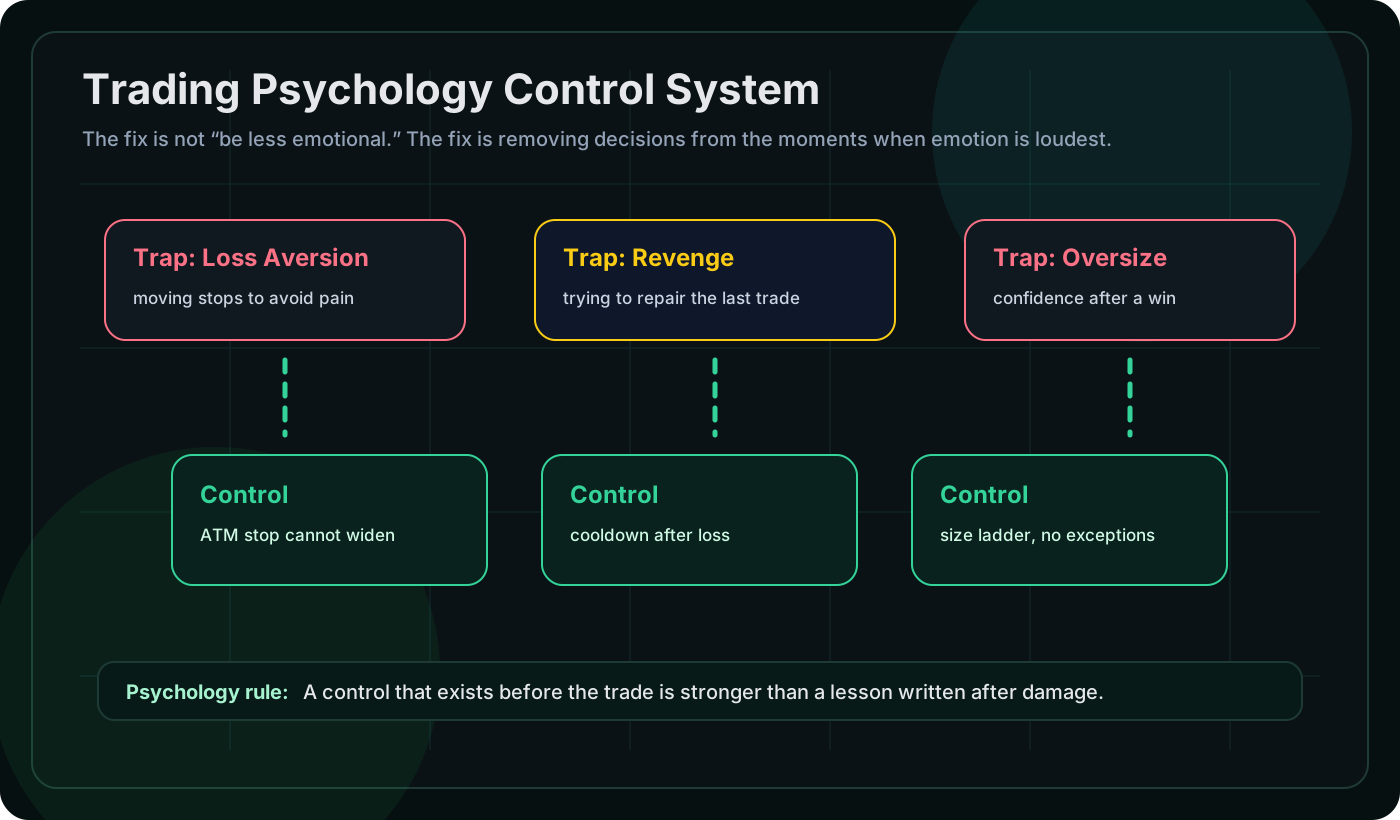
It was a Tuesday in March, and I was staring at a crude oil chart that was about to teach me a $1,800 lesson. CL was trading at 78.42, and I had a short position with a stop at 78.65 — a clean $460 risk on two contracts, well within my rules. The trade was textbook: a VAH rejection with QPulse rolling over, Flow Pro showing aggressive selling. Everything said this trade should work. But then price ticked up to 78.58, and my finger hovered over the mouse. I moved my stop to 79.10. Fifteen minutes later, I was stopped out for $1,360 — three times my planned risk. The setup was right. The system was right. My brain was wrong.
That trade changed how I think about trading psychology forever. Not because I lost money — I lose money all the time, and so does every profitable trader. It changed me because I realized that my biggest enemy was not the market, not my strategy, not my indicators. It was the three pounds of evolutionary hardware between my ears, running software optimized for surviving on the savannah, not for navigating leveraged futures markets.
After seven years of trading ES, NQ, CL, GC, SI, HG, ZB, and RTY on NinjaTrader, I have identified five specific mental traps that destroy profitable systems. Not five vague concepts from a psychology textbook — five concrete patterns that I have personally fallen into, that I have watched dozens of traders in our community fall into, and that I have built mechanical fixes for inside the STS system and the Asymmetric Scorecard.
The bad belief this post is killing: psychology is something you fix by becoming more disciplined. No. Psychology is something you engineer around. Discipline matters, but if your entire risk system depends on you being calm, fresh, humble, patient, and emotionally pristine at 10:47 AM after two stops, congratulations, you built a fantasy machine.
Trap 1: Loss Aversion — The $1,800 Stop That Should Have Been $460
The Neuroscience
Loss aversion is the most well-documented cognitive bias in behavioral economics. Daniel Kahneman and Amos Tversky demonstrated that humans feel the pain of losses roughly 2.0 to 2.5 times more intensely than they feel the pleasure of equivalent gains. This is hardwired neurology — your amygdala fires with significantly greater intensity when processing potential losses than when processing potential gains.
In evolutionary terms, this made perfect sense. On the African savannah, the downside of losing your food supply was death. But in trading, this wiring creates a devastating feedback loop: your brain screams to avoid the small, planned loss, so you widen your stop, and in doing so you create the large, unplanned loss that actually threatens your account.
The Trade That Taught Me
Back to that CL trade at 78.42. The entry was clean. Volume Profile showed price rejecting from the Value Area High at 78.50. QPulse had crossed below zero on the 3-minute chart. Flow Pro was printing red. My Asymmetric Filter scored 5 out of 6 questions as "go."
Price dropped to 78.28 immediately. I was up $280 in the first three minutes. Then it bounced. At 78.48, I was down $120. My stop was 17 ticks away. The rational move was obvious: let the stop do its job. But my amygdala was firing hard. The P&L was red. And then the thought arrived: "If I just move my stop a little wider, price will probably come back down."
I moved my stop from 78.65 to 79.10. Forty-five additional ticks of risk that I had not planned for, had not sized for. Price hit 78.65 — my original stop level — paused for 90 seconds, and then continued higher. It hit 79.10 at 11:47 AM. I lost $1,360 instead of the planned $460. And CL closed that day at 77.85. If I had honored my original stop and re-entered on the next valid signal, I would have made money.
The Mechanical Fix
Once a stop is placed, it cannot be widened. Only tightened. Inside NinjaTrader, I use an ATM strategy that locks the stop at entry. There is no discretionary override. The machine does not have an amygdala. Taking the stop is a skill, not a failure.
Trap 2: Recency Bias — The Three-Winner Spiral
The Neuroscience
Recency bias is your brain's tendency to overweight recent experiences. After two winning trades, the dopamine response is strong. After three, your brain concludes you have discovered a pattern, and it begins to predict the next trade will also win. This is the same neural mechanism that makes slot machines addictive — variable reinforcement on a short timescale.
The problem: trade outcomes are not sequentially correlated. Your fourth trade has approximately the same probability of success as your first, regardless of what happened on trades one through three. But your brain thinks you are "hot."
The Trade That Taught Me
September 2024. Three consecutive NQ winners — a POC bounce at 19,420 for 1.8R, a VAH rejection at 19,580 for 2.1R, and a VWAP reclaim at 19,340 for 1.4R. Combined profit: $3,740. I felt invincible. My journal entry: "Everything I touch is turning to gold."
On the fourth trade, I sized up from two contracts to four. The setup was marginal — QPulse was near zero, the Scorecard scored it 3/6, below my minimum of 4. But I took it because I was "hot."
NQ dropped 28 points. On four contracts at $20/point: $2,240 loss. I chased. Took a fifth trade, also oversized, also below threshold. Another $1,680. By end of day, I had given back all $3,740 plus $180 more. One day. Because three winners convinced me my edge had doubled.
The Mechanical Fix
Position size is determined by the setup, not by recent results. Every trade gets sized using the same formula: account risk percentage divided by stop distance in dollars. After three consecutive winners, I take a mandatory 30-minute break. The math drives the size, never the emotion. This is exactly what we cover in position sizing.
Trap 3: Confirmation Bias — Seeing What You Want to See
The Neuroscience
Your brain processes approximately 11 million bits of sensory information per second, but your conscious mind handles only about 50 bits. To bridge this gap, your brain uses heuristics that filter information based on existing mental models. Once you form a directional bias ("NQ is going up"), your reticular activating system literally filters incoming information to prioritize data that supports that view.
The Trade That Taught Me
January 2025. I had formed a strong bullish view on NQ after the holiday rally. I was looking for longs. Only longs. I ignored QPulse rolling over on the 15-minute chart. I ignored Flow Pro showing persistent institutional selling. I dismissed the GEX data showing negative gamma exposure.
I took three long trades. Every one hit my stop. NQ dropped 180 points from the open. I lost $1,960 — not because the market was unpredictable, but because I had blinded myself to information that contradicted my thesis. When I reviewed my journal that evening, every indicator in the STS system was screaming "short" or "sit out."
The Mechanical Fix
The Asymmetric Filter forces six objective questions before every trade. Question 3 asks: "What is the strongest case against this trade?" Question 5: "If this trade fails, what will I see first?" You cannot answer them honestly and maintain a one-sided view. Before taking any trade, I must identify at least two specific, observable reasons it could fail.
Trap 4: Revenge Trading — When Biology Hijacks Your System
The Neuroscience
When you take a loss, your hypothalamic-pituitary-adrenal axis activates. Cortisol floods your bloodstream. Your prefrontal cortex literally goes offline as blood flow shifts to your amygdala. Studies by Andrew Lo at MIT have shown that traders experiencing acute stress make decisions that are statistically worse than random. Not just slightly worse — worse than flipping a coin.
The Trade That Taught Me
October 2024. ES at 5,780 on FOMC day. My rules explicitly say "flat before the 2:00 PM announcement." But I had taken a loss on a gold short that morning — down $640. I was agitated. I told myself I would "just scalp" the ES around the announcement.
First trade after the announcement: stopped out, -$380. Now down $1,020. Cortisol pumping. Another trade within 60 seconds — no scorecard, no checklist, no filter. Stopped. Another. And another. By 3:15 PM, I had taken eight trades in 75 minutes. Win rate: zero. Total damage: $3,420, roughly four times my maximum daily loss.
I sat at my desk at 3:30 PM, hands shaking, staring at the P&L. I pulled up the trade log. Eight trades. The first two had reasonable setups. The last six had no setup at all — I was literally clicking buy and sell based on tick movement. That is not trading. That is gambling with a negative edge, fueled by cortisol and desperation.
The Mechanical Fix
I have a hard daily loss limit programmed into NinjaTrader. When my daily P&L hits -$800, the platform locks me out. I cannot place another trade. The password for the override is held by a non-trading friend who will not give it to me regardless of what I say. Calculate your own limit using the risk calculator. Beyond the lockout: after any loss greater than 1R, I wait 15 minutes and do a breathing exercise (4 seconds in, 7 hold, 8 out) to activate the parasympathetic nervous system and lower cortisol.
Trap 5: Outcome Bias — The $2,400 Trade That Ruined Two Weeks
The Neuroscience
Outcome bias is the tendency to evaluate decision quality based on results rather than process. When a rule-breaking trade profits, the dopamine hit is massive — you made money while breaking rules, which your brain interprets as evidence that the rules are wrong. This creates a deeply destructive feedback loop: break rules, get rewarded, break more rules, eventually get destroyed.
The Trade That Taught Me
December 2024. Silver at 30.80. I saw a "breakout" above 31.00. QPulse was flat, Volume Profile showed no excess at the level, Flow Pro was neutral. The Scorecard scored it 2/6. My rules said clearly: do not trade. But I had a "feeling." I went long two contracts at 31.02 with a wide stop at 30.60.
Silver ripped to 31.48. I covered for $2,400 profit. My journal entry reads: "Sometimes you just have to trust your gut. The system is too conservative." Those two sentences were the most expensive words I have ever written.
Over the next two weeks, I took eleven trades that violated my filter criteria. Results: two winners, nine losers, net loss of $4,860. The $2,400 silver profit had cost me $4,860 plus opportunity cost. Total damage from one rule-breaking "winner": approximately $7,260.
The Mechanical Fix
Every trade in my journal is tagged with two scores: outcome (P&L) and process (did I follow rules?). A trade that follows all rules but loses is a process win. A trade that breaks rules but profits is a process loss. My goal: 90%+ process win rate weekly. The rule-breaking silver trade would have been flagged as a process loss despite its $2,400 profit.
The Five Traps at a Glance
| Trap | Symptom | Typical Cost | System Fix |
|---|---|---|---|
| Loss Aversion | Moving stops wider during live trades | 2-4x planned risk | ATM-locked stops; no manual widening |
| Recency Bias | Sizing up after 3+ winners | 100% of streak gains | Formula-based sizing; 30-min cooldown |
| Confirmation | Ignoring bearish signals on bullish thesis | 3-5 consecutive losers | Asymmetric Filter with forced disconfirmation |
| Revenge Trading | Rapid-fire trades after a loss | 4-6x daily risk budget | Hard daily loss lockout at -$800 |
| Outcome Bias | Repeating rule-breaking after lucky win | 3-5x the lucky profit | Process scoring separate from P&L |
Psychology Guardrail Map
| Trap | Guardrail | Non-Negotiable Rule |
|---|---|---|
| Loss aversion | ATM stop lock | tighten only |
| Recency bias | formula sizing | size ignores streaks |
| Confirmation | forced disconfirmation | name two failure signals |
| Revenge trading | platform lockout | done means done |
| Outcome bias | process scoring | P&L gets scored second |
The Psychological Operating System
Psychology is not a "soft skill." It is an engineering problem. You do not solve it with willpower. You solve it with mechanical, automated, non-negotiable systems that remove decisions from your impaired biological hardware.
Pre-Session (Before 9:00 AM ET)
- Physical state check: 6+ hours sleep? No impairment? If no, reduce size 50% or sit out.
- Emotional state check: Angry, anxious, euphoric? Resolve before open or don't trade.
- Daily risk budget: Write max daily loss in journal before open. Fixed for the day.
- Market context: Check GEX, economic calendar, overnight action. FOMC/CPI/NFP = different rules.
Pre-Trade (Before Every Entry)
- Scorecard: Minimum 4/6 to take the trade. No exceptions.
- Position size: Calculated from formula, not confidence level.
- Pre-mortem: State out loud: "If this fails, I will see [specific indicator reading] first."
During Trade
- No stop widening. ATM strategy enforces mechanically.
- Trail rules: Breakeven at 1R, trail at 2R using STS methodology.
Post-Trade
- Process score first. Score the trade on process (1-5) before looking at P&L.
- Cooldown: 15 min after loss > 1R. 30 min after 3 consecutive winners. Half size after 50% of daily budget used. Done after daily budget hit.
End of Day
- Journal entry. Screenshot, entry/exit prices, R-multiple, process score, one sentence about emotional state. Non-negotiable.
When Psychology Advice Lies to You
Most trading psychology advice lies by making the problem sound poetic. "Control your emotions." "Stay disciplined." "Trust the process." Nice poster. Useless in a live CL trade when your stop is three ticks away and your hand is already reaching for the mouse.
The real work is uglier and more useful: automated lockouts, ATM stops, scorecards, journal tags, cooldown timers, and rules that make your worst impulses irrelevant. You do not rise to the level of your market opinions. You fall to the strength of your guardrails.
The Uncomfortable Truth
You cannot think your way out of these traps. You cannot read about loss aversion and then stop being loss averse. Your brain has been running this software for 200,000 years. You are not going to override it with a motivational quote.
What you can do is build systems that make these biases irrelevant. You do not need to stop feeling the urge to move your stop — you need an ATM strategy that will not let you. You do not need to stop wanting to revenge trade — you need a lockout mechanism that makes it physically impossible.
The best traders I know are not the ones with the best psychology. They are the ones with the best systems for managing bad psychology. Every tool in the Nexural ecosystem — the Scorecard, the Filter, the R-multiple tracking, the position sizing calculator — exists because I blew through these traps myself and realized that willpower is not a trading strategy. Systems are.
Your edge is not your ability to predict the market. Your edge is your ability to execute a positive-expectancy system without your brain sabotaging it. And that ability is something you build, one guardrail at a time.
Final rule: do not try to become a trader who feels nothing. That trader does not exist. Become the trader whose system keeps working while you feel everything. Start with taking the stop cleanly, then make your position size boring enough that one trade cannot hijack the rest of your day.