Skip to content
v3 redesign is live — welcome to the trading cockpit.
Market updates, stock news, and futures insights — 3x/week, freeSubscribe free
Skip to content
build.logtraders.online=2,166trades.60s=74swings.ranked=308edge.latency_ms=42ms
Back to Blog
Order Flow

Order Flow for Beginners: Delta, Imbalance, Absorption, Exhaustion

S
Sage

Head of Trading Education

9 min read
Updated June 17, 2026
Order Flow for Beginners: Delta, Imbalance, Absorption, Exhaustion

What is "Order Flow for Beginners: Delta, Imbalance, Absorption, Exhaustion" about?

Order flow is not magic tape-reading. Learn what delta, imbalance, absorption, and exhaustion can show you, what they cannot prove, and how to use them only after location and timing line up.

Price touches yesterday's value area low. The chart looks like a long. Then the footprint prints heavy selling into the bid, QPulse is still red, and Flow Pro stays dead. The level was real. The trade was not. Order flow saved you from turning a line into a loss.

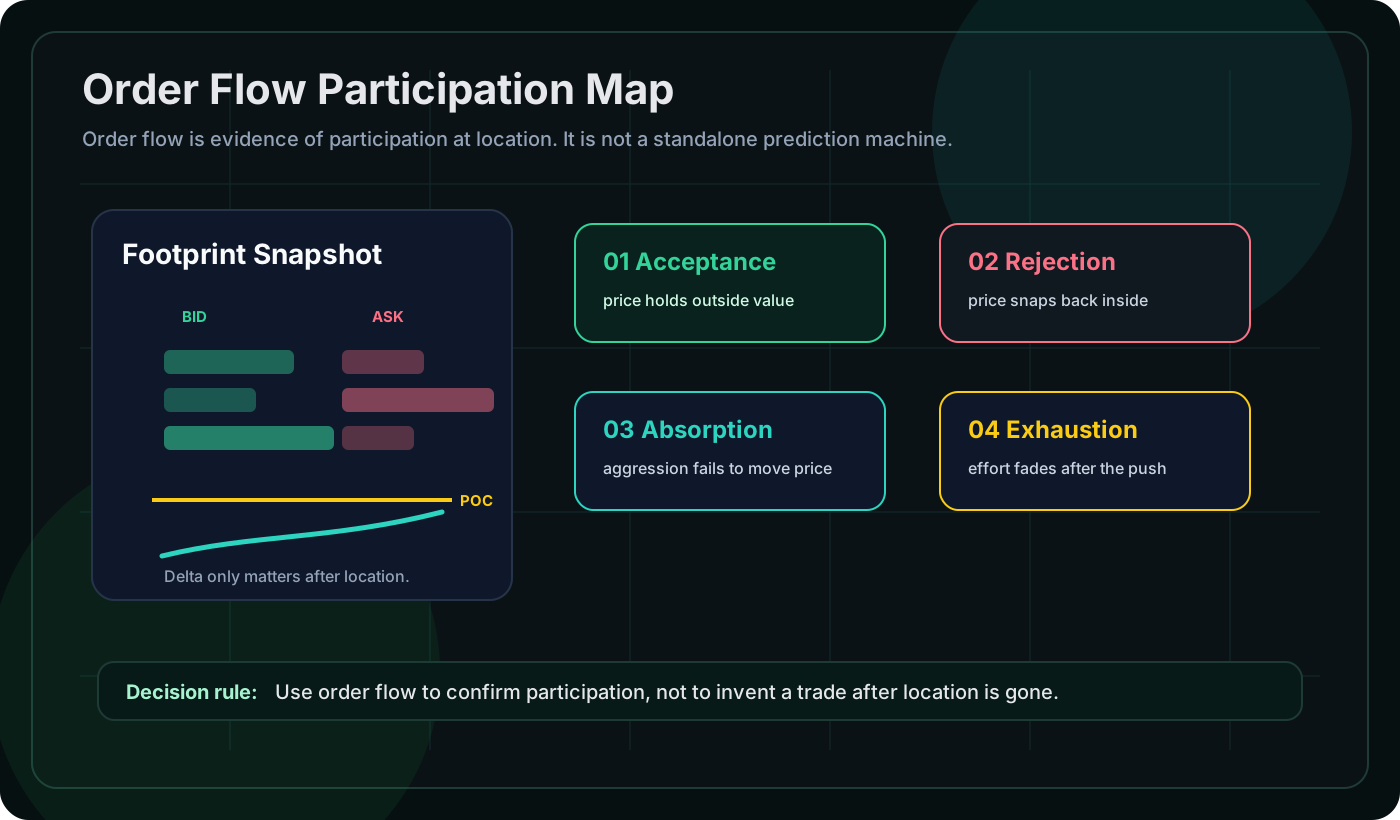
That is the right way to think about order flow. It is not a crystal ball. It is not a secret language where green numbers mean buy and red numbers mean sell. Order flow is evidence of participation. It helps answer one question: who is actually doing business here, and is price responding?

This guide covers the four reads beginners need first: delta, imbalance, absorption, and exhaustion. Learn these before trying to read every number on a footprint chart. Most traders do not need more data. They need fewer, cleaner questions.

Order Flow State Card

Read Question Trade Use
DeltaWhich side was more aggressive?pressure
ImbalanceWas aggression lopsided at a price?participation
AbsorptionDid aggression fail to move price?possible reversal
ExhaustionDid participation dry up near the end?avoid chasing

Start Here: Order Flow Is Confirmation, Not Permission

The beginner mistake is staring at the footprint and forgetting the map. A footprint without context is just a scoreboard without a field. You need to know where the auction is happening first.

Before order flow matters, answer these:

  1. Are we at a real level: POC, VAH, VAL, VWAP, prior high/low, or event level?
  2. What is the session regime: trend, balance, event risk, positive or negative GEX?
  3. What is the trade idea: bounce, rejection, breakout, reclaim, or no trade?
  4. Where is invalidation?

Only then does order flow become useful. This is why the STS stack puts Volume Profile before Flow Pro. Location first. Participation second.

Delta: Who Was More Aggressive?

Delta is the difference between aggressive buying volume and aggressive selling volume. In plain English: did more volume trade into the offer or into the bid?

Positive delta usually means buyers were more aggressive. Negative delta usually means sellers were more aggressive. Cumulative delta tracks that pressure over a session, bar, or selected period.

But delta does not prove direction by itself. This is the part beginners miss. A bar can have positive delta and still close weak if passive sellers absorb the buying. A bar can have negative delta and still hold support if passive buyers absorb the selling.

Delta Read What It Can Mean What To Check Next
Positive delta, price risingbuyers aggressive and rewardedis it at extension or structure?
Positive delta, price stalledpossible sell absorptionis this at VAH, POC, or supply?
Negative delta, price fallingsellers aggressive and rewardedis the move already extended?
Negative delta, price holdingpossible buy absorptionis this at VAL, POC, or demand?

Imbalance: Where Did One Side Overwhelm the Other?

An imbalance is a lopsided volume relationship at a price level. Footprint and numbers-bar tools often compare bid volume and ask volume at adjacent prices. If ask-side activity overwhelms bid-side activity, the chart may highlight a buy imbalance. If bid-side activity overwhelms ask-side activity, it may highlight a sell imbalance.

The exact thresholds depend on the platform and settings. Some traders use 300% diagonal imbalance. Some use fixed volume thresholds. The number matters less than consistency. If you keep changing the threshold to make the chart tell a better story, you are not analyzing order flow. You are decorating bias.

Imbalances are most useful when they appear at a meaningful level and get follow-through. A stacked buy imbalance in the middle of nowhere is interesting. A stacked buy imbalance at prior VAL after sellers fail to break lower is useful.

Absorption: When Aggression Fails

Absorption is the read that changes how beginners understand order flow. It is not about who hit the market hardest. It is about whether price rewarded that aggression.

Example: price is sitting at prior POC. Buyers lift the offer repeatedly. Delta prints positive. But price cannot move higher. Every aggressive buy is being met by passive sell liquidity. That is possible absorption.

Absorption matters most at known levels:

  • Prior POC
  • Value Area High or Low
  • VWAP
  • Opening range high/low
  • Prior day high/low

Do not call every stall absorption. Sometimes price pauses because everyone is waiting. Absorption needs aggression plus failure to continue. Both pieces matter.

Exhaustion: When the Move Runs Out of Fuel

Exhaustion is when participation fades near the edge of a move. Price may make a new high, but the buying behind it is weaker. Price may make a new low, but sellers are no longer pressing with the same force.

Beginners should use exhaustion mostly as a risk filter. If you are late to a long and the move is printing weaker delta, thinner volume, and poor follow-through near VAH, the trade may still go higher. But the easy part may already be gone.

This connects directly to the 1-3 Candle Rule. Order flow can show that a setup was valid three candles ago and spoiled now. The journal should call that a missed trade, not a fresh entry.

The GO/NO-GO Checklist

Before using order flow as confirmation, run this checklist:

Order Flow GO/NO-GO

  1. Location: Is price at a real level from Volume Profile, VWAP, prior session, or opening range?
  2. Timing: Has QPulse or your timing trigger actually fired?
  3. Participation: Does delta, imbalance, or Flow Pro support the direction?
  4. Response: Is price rewarding the aggression or absorbing it?
  5. Risk: Does the trade still pass the R-multiple and position-size check?

If the answer is no on location, stop. Order flow in the middle of nowhere is usually noise. If the answer is no on risk, stop. A beautiful footprint does not fix bad math.

How Flow Pro Fits

Flow Pro exists because most traders drown in footprint detail. The point is not to replace order flow literacy. The point is to compress the participation read into a cleaner GO/NO-GO layer after location and timing are already defined.

Use it like this:

  1. Volume Profile tells you where the trade can happen.
  2. QPulse tells you when momentum rotates.
  3. Flow Pro tells you whether participation is strong enough to care.

If Flow Pro is dead, the trade might still work. But it no longer deserves the same size or confidence. Read Flow Pro and the Account Killer for the deeper version of that rule.

The Beginner Mistakes

Reading Isolated Prints

One big number does not make a trade. Ask where it happened, what price did afterward, and whether the broader structure supports it.

Ignoring Passive Liquidity

Aggressive buying is not bullish if price cannot lift. Aggressive selling is not bearish if price cannot break. Response matters.

Trading Low-Volume Noise

Order flow tools need real activity. Thin lunch-hour markets can make tiny prints look dramatic. If participation is low, reduce the weight of the read.

Using Order Flow to Avoid Taking the Stop

This is the expensive one. Traders stare at the footprint looking for a reason to stay after invalidation. If the stop was hit, the trade is over. New evidence can justify a new trade, not a rewritten old one.

Source and tool notes

  • NinjaTrader describes Order Flow Volumetric Bars as an x-ray view into aggressive buying and selling activity and explains delta as the difference between buying and selling volume: Order Flow Volumetric Bars guide.
  • NinjaTrader's Cumulative Delta documentation describes the tool as accumulating bid/ask or up/down tick volume to compare buy/sell pressure: Order Flow Cumulative Delta guide.
  • NinjaTrader's order-flow feature page lists volumetric bars, imbalance, market delta analysis, absorption, exhaustion, and unfinished auction patterns as order-flow use cases: Order Flow Trading overview.
  • Sierra Chart's Numbers Bars documentation describes price-level bid/ask volume detail inside each bar: Numbers Bars documentation.
  • This article is educational. Order-flow tools can help read participation, but they do not guarantee fills, reversals, continuation, or profitability.

Final rule: order flow confirms a trade. It does not create one from nothing. Start with the level, wait for timing, demand participation, then size the risk. If the footprint is exciting but the trade has no location, no invalidation, or no R:R, the professional answer is no trade.

Next Step

Use Flow Pro only after location and timing align

The beginner read is simple: structure first, trigger second, participation third. Do not let order flow become a standalone excuse.

#order-flow#delta#imbalance#absorption#exhaustion#futures
Share this articleTwitterLinkedIn

Frequently asked questions

What is order flow trading?

Order flow trading studies executed buying and selling activity to understand participation, aggression, and pressure at specific prices. In futures, traders often use footprint charts, delta, cumulative delta, and volume-at-price tools.

What does delta mean in order flow?

Delta is the difference between aggressive buying volume and aggressive selling volume. Positive delta usually means more volume traded at the offer; negative delta usually means more volume traded at the bid.

What is an order flow imbalance?

An imbalance happens when buying or selling volume is meaningfully larger at a price level compared with the opposite side. It can show aggressive participation, but it still needs location and follow-through.

What is absorption in order flow?

Absorption is when aggressive buyers or sellers hit the market but price does not continue in their direction. It can suggest passive liquidity is absorbing the aggression, especially at a known level.

Can beginners trade from order flow alone?

No. Beginners should not use order flow as a standalone signal. It works best as confirmation after structure, context, timing, and risk are already defined.

S
Sage

Head of Trading Education

Head of Trading Education at Nexural. A futures and swing trader who built the Nexural cockpit to survive his own trading — institutional-grade research, an event-sourced journal, and tools whose math is public. Writes the way he trades: receipts over marketing.

Read the tape with receipts

Market Desk turns this into a daily read: thesis, evidence, and what would prove it wrong.