Skip to content
v3 redesign is live — welcome to the trading cockpit.
Market updates, stock news, and futures insights — 3x/week, freeSubscribe free
Skip to content
build.logtraders.online=2,166trades.60s=74swings.ranked=308edge.latency_ms=42ms
Back to Blog
Order Flow

Delta Divergence Explained for Futures Traders

S
Sage

Head of Trading Education

11 min read
Updated June 17, 2026
Delta Divergence Explained for Futures Traders

What is "Delta Divergence Explained for Futures Traders" about?

A practical guide to reading cumulative delta divergence in futures: bullish divergence, bearish divergence, absorption, exhaustion, false signals, and Flow Pro confirmation.

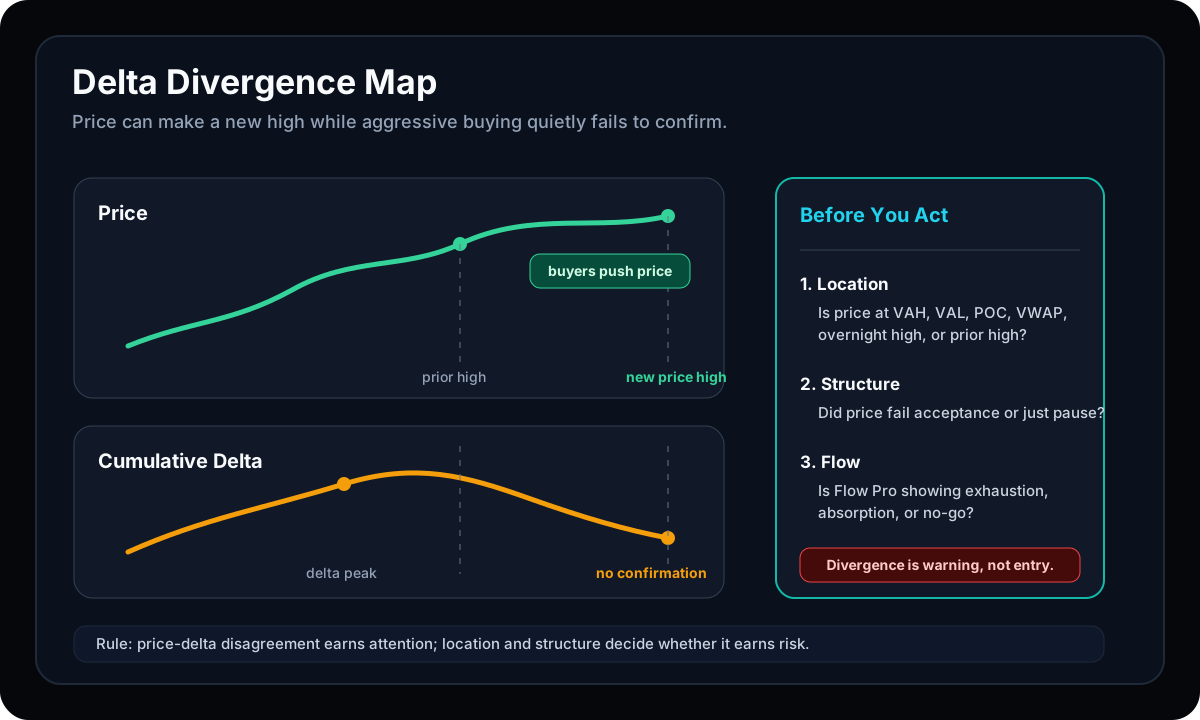
Price makes a new high. The candle looks clean. The breakout traders pile in. But cumulative delta does not make a new high. Buyers pushed price higher, yet aggressive buying did not confirm the move.

That is delta divergence. It is not magic. It is not a short signal by itself. It is the market whispering, "The chart moved, but participation did not agree."

Good order-flow traders do not trade the whisper. They use it to slow down, check location, and wait for structure.

Delta divergence futures map showing price making a new high while cumulative delta fails to confirm

What Cumulative Delta Is Actually Measuring

Delta compares aggressive buying and aggressive selling. A simple version:

Delta = volume traded at the ask minus volume traded at the bid.

If buyers keep lifting the offer, delta rises. If sellers keep hitting the bid, delta falls. Cumulative delta keeps a running total so you can compare aggressive participation against price movement.

The mistake is treating delta like a standalone signal. Delta tells you about aggression. It does not tell you whether the aggression is smart, trapped, late, hedged, or being absorbed by larger passive liquidity.

That is why the earlier Order Flow for Beginners guide starts with behavior, not prediction.

The Four Basic Price-Delta Reads

Price Delta Read Action
New highNew highBuyers are aggressive and rewardedTrend can continue
New highLower highBearish divergenceWatch for failed acceptance
New lowNew lowSellers are aggressive and rewardedTrend can continue
New lowHigher lowBullish divergenceWatch for failed breakdown

Notice the action column. It does not say "buy" or "short." It says watch. Delta divergence earns attention. It does not earn risk yet.

Bearish Delta Divergence

Bearish delta divergence happens when price pushes to a new high but cumulative delta does not confirm.

Plain English: price is higher, but aggressive buyers are less committed than they were at the previous high.

This can mean:

  • Buyers are getting tired.
  • Passive sellers are absorbing demand.
  • The move is being carried by thin liquidity instead of fresh buying.
  • Late buyers are chasing into a poor location.

The important phrase is can mean. Bearish divergence near prior VAH, overnight high, VWAP extension, or a failed breakout is useful. Bearish divergence in the middle of a strong trend day can be expensive noise.

Pair it with the Value Area High breakout framework. A divergence above VAH is not a short until price fails acceptance and returns inside value.

Bullish Delta Divergence

Bullish delta divergence happens when price makes a new low but cumulative delta makes a higher low.

Plain English: price pushed lower, but aggressive sellers did not show the same force. Selling may be weakening, or passive buyers may be absorbing contracts.

This matters most at:

  • Prior POC.
  • Value Area Low.
  • Overnight low.
  • Prior day low.
  • A high-volume node where rotation is plausible.

If you do not know those levels, go back to the Volume Profile before-the-open map before trying to trade the divergence.

The Difference Between Divergence and Absorption

Delta divergence is the comparison between price and cumulative delta. Absorption is what may be happening underneath it.

Example: price presses into a new low. Sellers keep hitting the bid, but price stops going down. The footprint shows heavy bid-side volume at the same price area. That can be passive buying absorbing aggressive selling.

The divergence says, "selling is not getting the same result." Absorption says, "someone may be taking the other side here."

That is why Flow Pro belongs after location and structure. It should confirm that order flow supports the idea, not invent the idea from a single histogram.

The Three-Part Delta Divergence Checklist

Before Acting on Divergence

  1. Location: is price at a meaningful auction level?
  2. Structure: did price fail acceptance, reclaim a level, or reject a breakout?
  3. Flow: does Flow Pro, footprint behavior, or a clean delta shift confirm exhaustion or absorption?

If one of those three is missing, reduce size or pass. If two are missing, it is not a trade.

Use the Asymmetric Scorecard pre-flight checklist to keep that decision objective.

If the divergence setup is valid but the stop is wider than expected, review reward-to-risk examples before entering. A clean order-flow warning still fails the trade plan if the math is poor.

Why Delta Divergence Fails

Delta divergence fails because markets are auctions, not math puzzles.

  • Trend days: price can keep grinding even while delta diverges.
  • News windows: order books thin out and flow can flip violently.
  • Liquidation moves: forced buying or selling can overpower a normal divergence read.
  • Bad data settings: bid/ask classification, session resets, and platform configuration can change what the delta study shows.
  • Bad location: divergence in the middle of nowhere is usually just noise.

This is why the timeframe stack matters. A 1-minute delta divergence against a 15-minute trend is usually a warning to manage, not a reason to fight the move.

A Simple Playbook

For a bearish divergence:

  1. Price pushes above prior value or a major high.
  2. Cumulative delta fails to make a matching high.
  3. Price fails acceptance and returns below the level.
  4. Flow Pro or footprint behavior shows exhaustion, absorption, or no-go.
  5. Entry happens only after structure confirms. Stop goes beyond the failed high.

For a bullish divergence:

  1. Price pushes below prior value or a major low.
  2. Cumulative delta fails to make a matching low.
  3. Price reclaims the level or forms a clean higher low.
  4. Flow confirms sellers are no longer being rewarded.
  5. Entry happens after reclaim or rotation. Stop goes beyond the failed low.

If you missed the decision point, do not chase. Log it using the missed trade journal process.

No-Trade Conditions

  • The divergence appears in the middle of value.
  • Price is trending cleanly and not failing structure.
  • A major report is minutes away.
  • You cannot define invalidation.
  • The stop distance does not fit account risk.
  • You are using divergence to justify a trade you already wanted.

When the stop is too wide, use the futures position size calculator before pretending a smaller timeframe solved the risk.

Source and risk notes

  • NinjaTrader's Order Flow Cumulative Delta documentation describes an indicator that accumulates volume filled at bid and ask prices or up/down ticks to compare buy/sell pressure: Order Flow Cumulative Delta.
  • NinjaTrader's cumulative delta education article describes cumulative delta as a tool for summarizing buying versus selling activity in order-flow analysis: What is Cumulative Delta?.
  • Sierra Chart's Cumulative Delta Bars - Volume study documentation states that the study is based on bid volume and ask volume: Cumulative Delta Bars - Volume.
  • CME's E-mini S&P 500 page defines ES as a standardized futures product with a $50 times S&P 500 Index contract unit: CME E-mini S&P 500 futures.
  • NFA investor best-practice materials warn that futures trading is risky and should use only risk capital a trader can afford to lose: NFA Investor Best Practices.
  • This article is educational. Delta divergence can organize order-flow evidence, but it does not predict reversals, prevent slippage, or remove leverage risk.

Final rule: divergence is a disagreement, not a decision. Let it pull your attention to the chart. Then make the trade prove itself through location, structure, and flow. If it cannot do that, the best order-flow read is no trade.

Next Step

Use Flow Pro as the go/no-go layer

Delta divergence warns you to pay attention. The trade still needs location, structure, and flow confirmation before it deserves risk.

#delta divergence#cumulative delta#order flow#futures trading#flow pro
Share this articleTwitterLinkedIn

Frequently asked questions

What is delta divergence in futures trading?

Delta divergence happens when price and cumulative delta disagree. For example, price makes a new high while cumulative delta fails to make a new high, suggesting the move may lack fresh aggressive buying.

Is bullish delta divergence a buy signal?

No. Bullish delta divergence is a warning that sellers may be exhausting or passive buyers may be absorbing. It still needs location, structure, and confirmation before it becomes a trade idea.

What is bearish delta divergence?

Bearish delta divergence happens when price pushes to a new high but cumulative delta does not confirm. It can warn that buyers are less aggressive into higher prices.

Why does delta divergence fail on trend days?

On strong trend days, price can keep moving even while delta temporarily diverges. Divergence can persist because positioning, liquidity, and forced buying or selling can overpower the warning.

How should beginners use cumulative delta?

Beginners should use cumulative delta as confirmation only. Start with location and setup structure, then use delta to judge whether aggressive participation supports or contradicts the idea.

S
Sage

Head of Trading Education

Head of Trading Education at Nexural. A futures and swing trader who built the Nexural cockpit to survive his own trading — institutional-grade research, an event-sourced journal, and tools whose math is public. Writes the way he trades: receipts over marketing.

See the indicators on a live chart

The Nexural Swing Desk runs these reads in real time — volume profile, flow, and regime on one board.