A beginner sees "micro" and thinks small. Then they buy five MNQ contracts because one contract feels harmless. The trade moves 40 points against them, the stop was never written down, and the loss is no longer small. The problem was not MNQ. The problem was sizing from vibes.
Micro futures are one of the best learning tools a futures trader has. MES and MNQ let you trade the same index behavior as ES and NQ with smaller contract multipliers. That is useful. It is also dangerous, because a smaller contract makes it psychologically easier to stack too many contracts.
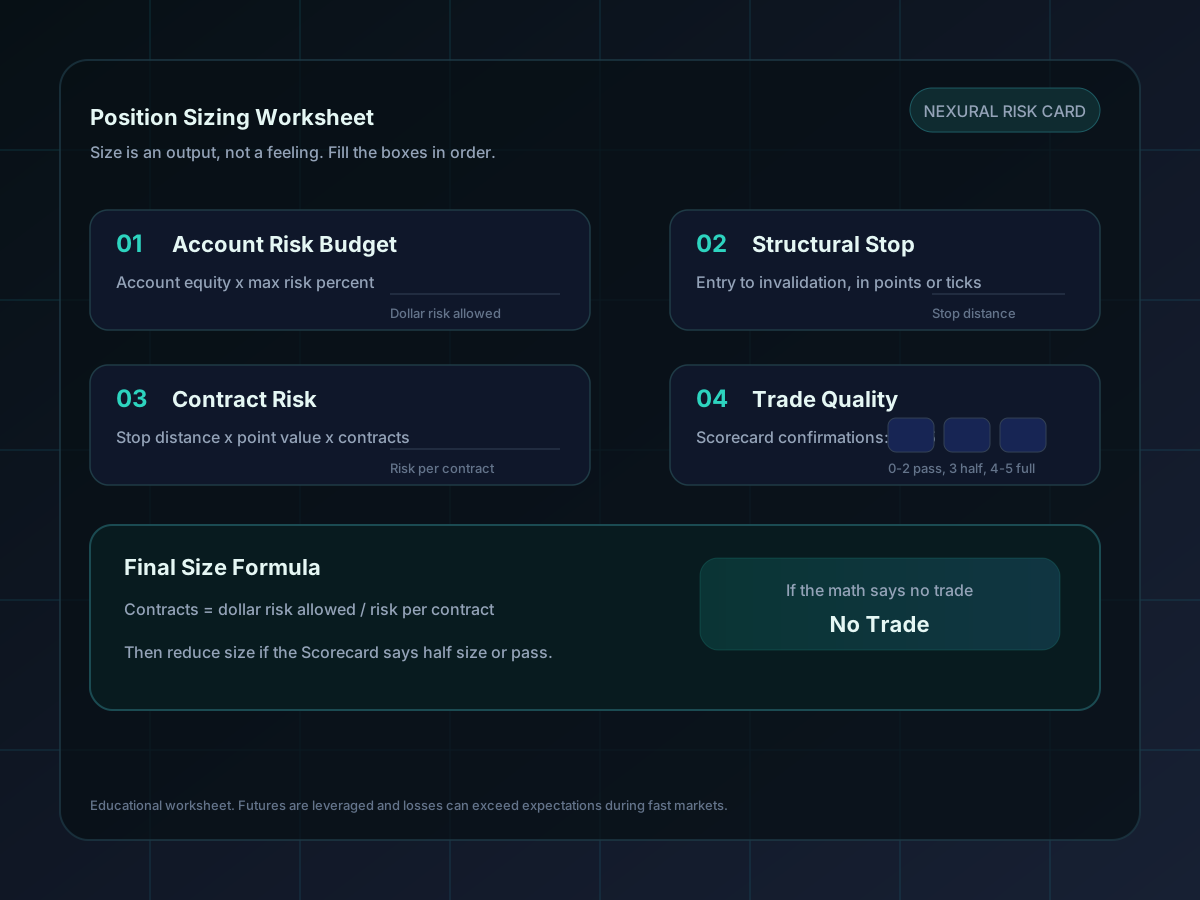
This guide gives you the risk map I wish every beginner had before opening the order ticket: account risk, stop distance, contract value, trade quality, and the final contract count. No motivational risk talk. Just the math and the workflow.
The Rule: The Stop Decides Size
Most beginners do this backward. They decide how many contracts they want to trade, then try to make the stop fit. That is how a real stop turns into a fake stop. You cannot tell the market, "I only want to risk $50, so please respect this tiny stop." The market does not care.
The professional sequence is:
- Define the setup. Where is the trade idea invalidated?
- Measure the stop. How many points from entry to invalidation?
- Convert points to dollars. What does one contract lose if the stop hits?
- Apply account risk. How many contracts fit without bending the stop?
- Adjust for quality. Full size, half size, or no trade.
If the math says 0.6 contracts, the answer is not "round up and hope." The answer is one contract only if the risk is acceptable, or no trade if it is not. This is why the futures position size calculator belongs before the order ticket, not after the loss.
MES and MNQ Point Values
The contract multiplier is the part beginners skip. It is also the part that turns chart distance into real account risk.
| Contract | Point Value | Minimum Tick | Tick Value | Beginner Trap |
|---|---|---|---|---|
| MES Micro E-mini S&P 500 |
$5 / point | 0.25 | $1.25 | Thinking slow movement means no risk. |
| MNQ Micro E-mini Nasdaq-100 |
$2 / point | 0.25 | $0.50 | Ignoring that Nasdaq can move more points. |
MES is not automatically safer than MNQ. MNQ has the lower point value, but it can travel farther. The only honest comparison is stop distance times point value.
The Three-Step Sizing Worksheet
Use this before every micro futures trade.
Step 1: Pick the Dollar Risk First
Choose the amount you can lose without changing your next decision. For a beginner, that number should feel almost boring. If a normal stop ruins your mood, the size is too large.
Example:
- Account: $5,000
- Risk budget: $50
- Maximum daily loss: $150
The $50 is not a moral achievement. It is just the number that keeps one trade from becoming an emotional event.
Step 2: Measure the Real Stop
The stop belongs where the trade idea is wrong. If you are buying a pullback into a prior value area, the stop probably belongs beyond the failed auction area, not two ticks under your entry because two ticks is what fits your account.
Example MES trade:
- Entry: 5,520.00
- Structural stop: 5,512.00
- Stop distance: 8 points
- MES value: $5 per point
- Risk per contract: 8 x $5 = $40
With a $50 risk budget, one MES contract fits. Two contracts risk $80 before slippage and commissions. That is not "a little extra." That is a different trade.
Step 3: Divide Risk Budget by Contract Risk
Now compare MES and MNQ using the same $50 risk budget:
| Trade | Stop | Point Value | Risk / Contract | $50 Budget |
|---|---|---|---|---|
| MES pullback | 8 points | $5 | $40 | 1 contract |
| MNQ pullback | 20 points | $2 | $40 | 1 contract |
| MNQ wide stop | 35 points | $2 | $70 | 0 contracts |
That last row matters. Sometimes the right size is zero. A beginner who can accept that will survive long enough to improve.
Do Not Size From Margin
Margin is the broker's requirement. Risk is what you can lose when the trade is wrong. Those are not the same number.
This is the classic beginner mistake: "The intraday margin is low, so I can trade several contracts." That logic confuses permission with prudence. The broker is telling you the minimum required to open the position. It is not telling you the maximum you should lose.
Futures are leveraged instruments. The CFTC risk disclosure language is blunt: leverage can lead to large losses as well as gains. That is exactly why the flat 2% rule is too crude for futures. Your stop, volatility, and contract multiplier matter more than a generic percentage.
The Quality Adjustment: Full Size, Half Size, Pass
Once the calculator gives you a maximum size, the Asymmetric Scorecard decides whether the trade deserves it.
Micro Futures Size Filter
- 5 confirmations: full calculated size, if the stop and daily risk limit still fit.
- 4 confirmations: half size or one micro contract.
- 3 confirmations: reduce size only if the setup is familiar and the session is clean.
- 2 or fewer: no trade. Do not use micros as an excuse to practice bad ideas.
This is where micros help. They let you reduce size without abandoning the setup completely. But they should not become a loophole for low-quality trades. A bad trade with one micro is still a bad trade. It is just a cheaper bad trade.
The Four Mistakes That Blow Up Micro Accounts
1. Copying Another Trader's Contract Count
Someone else trading three MNQ contracts tells you nothing. You do not know their account size, stop distance, average loss, daily limit, or emotional tolerance. Copy the process, not the size.
2. Widening the Stop After Entry
If you widen a stop from 20 MNQ points to 35 MNQ points after entry, your one-contract risk went from $40 to $70. You did not "give it room." You changed the trade without recalculating risk.
3. Adding Because It Is Only Micro
One MNQ contract is small. Five MNQ contracts are not the same learning trade. If you scale in without a written plan, you are not managing a position. You are negotiating with discomfort.
4. Trading News With Normal Size
Scheduled events can make a normal stop meaningless. If CPI, FOMC, NFP, or a major earnings event is about to hit index futures, the correct size may be half, one contract, or no trade. The market does not owe you clean fills.
The Beginner Workflow
Before the next MES or MNQ trade, use this exact sequence:
- Mark the setup and invalidation level.
- Measure the stop in points.
- Open the futures position size calculator.
- Enter account risk, stop points, and contract value.
- Check the setup against the Asymmetric Scorecard.
- Write the size decision in the journal before entry.
- If the size feels loud, reduce it. If the setup needs a fake stop to fit, skip it.
Source and risk notes
- CME lists Micro E-mini S&P 500 futures as $5 x the S&P 500 Index with a 0.25 minimum tick: MES contract specifications.
- CME lists Micro E-mini Nasdaq-100 futures as $2 x the Nasdaq-100 Index with a 0.25 minimum tick: MNQ contract specifications.
- CFTC public risk disclosure language warns that futures leverage can work against traders as well as for them and can lead to large losses: 17 CFR 1.55 risk disclosure.
- The sizing process here is educational, not financial advice. It is a risk-control workflow for deciding whether a trade's stop, size, and account risk fit before entry.
Final rule: micro futures do not make risk disappear. They make risk adjustable. That is their power. Use the smaller contract to trade the correct stop, not to trade more often, add more contracts, or pretend margin is risk. Start with the micro futures beginner guide, size every setup with the calculator, and let the journal tell you whether your size helped your execution or made you emotional.
Calculate the size before the order ticket opens
The article gives the risk map. The next move is to run the actual contract math and record the decision.