Skip to content
v3 redesign is live — welcome to the trading cockpit.
Market updates, stock news, and futures insights — 3x/week, freeSubscribe free
Skip to content
build.logtraders.online=2,166trades.60s=74swings.ranked=308edge.latency_ms=42ms
Back to Blog
Trading Education

Micro Futures Trading: The Complete Beginner's Guide for 2026

S
Sage

Head of Trading Education

10 min read
Micro Futures Trading: The Complete Beginner's Guide for 2026

My first futures trade was on MES. I risked $62.50 — five points at $12.50 per point. I made $37.50. It took 14 minutes. It felt like the most money I'd ever earned per hour. Then I sized up too fast, blew through my daily loss limit in 40 minutes, and spent the rest of the day staring at a P&L that made me sick. That was the most expensive $25 lesson of my life — and the most valuable one.

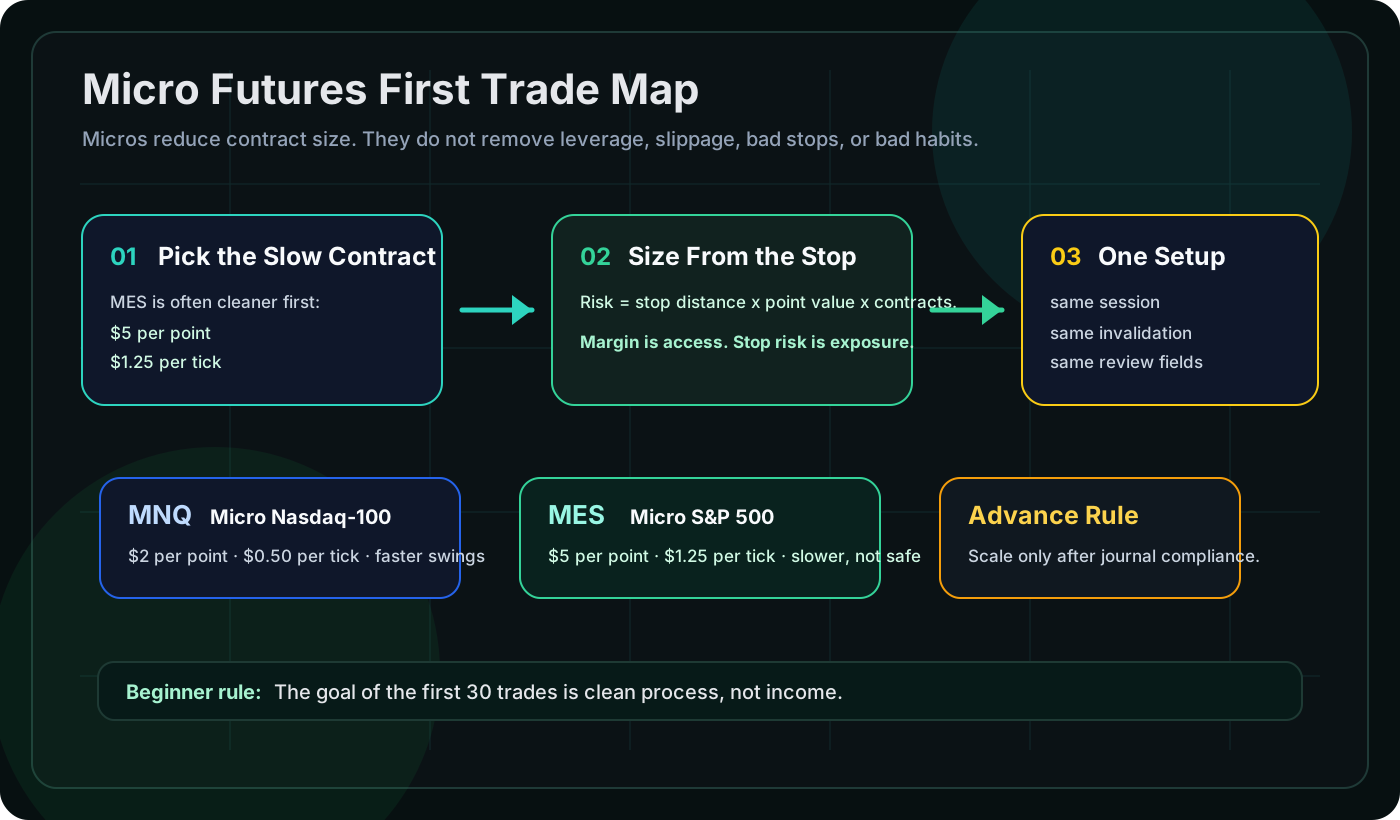
Micro futures are the single best instrument for learning to trade. Not because they're "easy" — they're not. They're real futures contracts on the world's most liquid markets. But at $5 per point on MES versus $50 on ES, you can learn the mechanics of asymmetric risk management without the mistakes costing you your rent.

The bad belief this post is killing: micros are practice wheels. No. Micros are real contracts with smaller consequences. Treat them like toys and they will teach you toy habits: overtrading, sloppy stops, revenge entries, and tiny scalps that commissions eat alive.

The Micro Futures Discipline Ladder

Stage Rule Advance Only If
1 contractMES only, RTH only30 logged trades
2 contractssame setup, partial exitspositive average R
Add MNQseparate playbook, separate stats90% journal compliance
Standard futuresonly after sizing math earns itnot because ego wants it

What Are Micro Futures?

Micro futures are 1/10th-size versions of standard CME futures contracts. They track the exact same underlying — same price, same order book depth, same 23-hour session. The only difference is the multiplier.

Dollar Risk Per Point: Micro vs Standard $5 $50 S&P 500 $2 $20 Nasdaq $5 $50 Russell $10 $100 Gold Micro (1/10th) Standard

That visual tells the whole story. A 10-point move on MES costs or makes you $50. The same move on ES costs or makes you $500. Same market. Same analysis. Ten times less consequence while you're learning.


The Complete Micro Futures Contract Sheet

Contract Symbol $/Point Tick $/Tick Day Margin* Avg Daily Range
Micro S&P 500 MES $5 0.25 $1.25 ~$50 35-60 pts
Micro Nasdaq-100 MNQ $2 0.25 $0.50 ~$50 150-250 pts
Micro Russell 2000 M2K $5 0.10 $0.50 ~$50 20-40 pts
Micro Gold MGC $10 0.10 $1.00 ~$500 $15-30
Micro Crude Oil MCL $100 0.01 $1.00 ~$500 $1.50-3.00

*Day margins vary by broker. NinjaTrader margins shown. Overnight margins are 8-10x higher.

Why I Still Trade Micros

Here's something most trading educators won't tell you: I still trade micro contracts regularly. Not because I can't afford ES — because micros give me better position sizing granularity.

Example: my asymmetric sizing framework says I should risk $380 on a particular ES setup. One ES contract with a 5-point stop risks $250. Two contracts risk $500. Neither is $380. But I can trade 3 MES contracts for $375 in risk — almost exactly right.

Micros aren't a stepping stone to "real" futures. They are real futures. They're a precision tool.


The 6 Advantages Over Stocks

1. No Pattern Day Trader Rule

The SEC requires $25,000 minimum equity for stock day trading. Futures? You can open an account with $500 and take unlimited day trades. This is the single biggest advantage for traders starting with limited capital.

2. Superior Tax Treatment

Futures profits in the US are taxed under Section 1256: 60% long-term capital gains, 40% short-term — regardless of holding period. A day trader making $50K in futures pays approximately $7,500 less in taxes than a stock day trader earning the same amount. That's a 15% edge just from the tax code.

3. True Price Transparency

Every futures trade executes on a central exchange (CME). One order book. One price. No payment for order flow, no dark pools, no internalization. When your MES order fills at 5,247.50, that's the actual market price — not a price that a market maker decided to give you.

4. 23-Hour Markets

ES and NQ trade from Sunday 6:00 PM to Friday 5:00 PM ET, with a 1-hour daily maintenance break. You can trade London open at 3 AM, the Asian session overnight, or standard US hours. Most retail stock traders are locked into 9:30-4:00 — futures traders have session flexibility.

5. Granular Risk Control

A single MES contract lets you risk $12.50 per point. That's more granular than any stock position unless you're buying fractional shares. For traders learning to manage risk with the Asymmetric Filter, this precision matters.

6. No Short-Selling Restrictions

In stocks, short selling requires a locate, has uptick rules, and can get squeezed. In futures, going short is exactly the same as going long — you click sell instead of buy. Same margin, same rules, same execution. The VAH Rejection Short is just as natural to execute as the POC Bounce Long.


Your First Week: A Session-by-Session Plan

Here's exactly what I'd do if I were starting from zero again. One contract of MES, NinjaTrader platform, paper trading mode.

Sessions 1-5: Watch and Map

Don't trade. Open a 5-minute MES chart with Volume Profile and VWAP. Watch the 9:30 AM open. Note where price reacts to yesterday's POC, VAH, and VAL. Screenshot three charts and write one sentence about each: "Price opened above VAH and rotated back to POC by 10:15 AM." That's it.

Sessions 6-10: One Setup Only

Pick the POC Bounce Long. Wait for price to test yesterday's POC during RTH (9:30 AM - 4:00 PM). Look for a rejection candle. Enter with a 5-point stop ($25 risk on 1 MES). Target: 10 points ($50). That's 2:1 R:R — the asymmetric minimum.

Sessions 11-20: Add the Review Loop

Log every trade in the Nexural trade journal. After each session, answer three questions: (1) Did I follow the plan? (2) Was the setup valid according to the scorecard? (3) What would I do differently? This 5-minute review is where the actual learning happens — not during the trade.

Sessions 21-30: Assess and Decide

After 30 sessions (30 trading days), review your stats: win rate, average R-multiple, number of trades taken vs. planned, largest winner vs. largest loser. If your average R is positive and your execution score is above 70%, you're ready to consider going live with real money at the same 1-contract size. If not, do 30 more sessions. There's no rush — the market will be here tomorrow.


The Mistakes I Made (So You Don't Have To)

Mistake What Happened The Fix
Sized up after 3 winners Went from 1 to 5 MES contracts on day 4. Lost $312 in 40 minutes. Size is fixed for the first 30 sessions. No exceptions.
Traded ETH without knowing it Entered a position at 7:45 AM. Spread was 3 ticks. Slippage ate the trade. Only trade RTH (9:30-4:00) until you understand session dynamics.
No daily loss limit After 2 losses I revenge-traded 8 more times. Down $425 on a $2,500 account. Hard daily limit: 2% of account ($50 on $2,500). Hit it and walk away.
Jumped between MES, MNQ, MCL Each instrument has different volatility, spread, and personality. I had no edge in any of them. Master one instrument for 60+ sessions before adding another.

Where to Go From Here

Micro futures are the on-ramp. The destination is consistent, risk-controlled profitability. Here's the learning path I'd follow:

  1. Read the Asymmetric Investor — free online chapters covering the complete framework from risk-reward to position sizing.
  2. Complete the automation curriculum — 195 free pages on platforms, backtesting, and strategy development. Start with the NinjaTrader module.
  3. Install the free indicator suite — 42 NinjaTrader indicators including Volume Profile, QPulse, and Flow Pro. No account required.
  4. Start the trade journal — track R-multiples, setup quality, and execution mistakes from session one.
  5. Study the STS playbooks — concrete entry/exit rules with the indicators you just installed.

The free tier includes everything listed above. Upgrade when you're ready for the AI swing desk, live flow data, and the research platform. There's no pressure — the free tools are permanent.


Understanding Micro Futures Margin: Day vs Overnight

One thing that trips up new traders: the margin you see advertised ($50 per MES contract) is the intraday margin. Overnight margin — what you need if you hold a position past the 5:00 PM ET session break — is 8-10x higher.

Contract Day Margin Overnight Margin Multiplier
MES ~$50 ~$1,500 30x
MNQ ~$50 ~$2,100 42x
MGC ~$500 ~$1,100 2.2x
MCL ~$500 ~$950 1.9x

Margins vary by broker and change with volatility. Check your broker's current rates before sizing.

If you have a $2,500 account and hold 2 MES contracts overnight, you need $3,000 in margin — more than your account balance. You'll get a margin call, and the broker will liquidate your position at whatever price the market is at. I've seen this happen at 2 AM when ES drops 30 points and the trader wakes up to a $300 loss that they didn't know they had. Rule: if you're new, close all positions before 3:30 PM ET and never hold overnight.

Which Micro Contract Should You Start With?

I get asked this constantly. The answer depends on your personality, not your account size.

  • MES (Micro S&P 500) — Best for beginners. It's the most liquid, the most orderly, and has the most educational content available. The 5 ES strategies article covers specific setups. If you can't decide, start here.
  • MNQ (Micro Nasdaq-100) — 2-3x more volatile than MES on a percentage basis. Great for momentum traders who want bigger moves. Terrible for beginners who don't have tight stops — a "small" move on MNQ can be 40 points ($80) before you blink.
  • M2K (Micro Russell 2000) — Sensitive to economic data releases. If you trade economic events (CPI, jobs data, Fed announcements), M2K reacts first and hardest. Otherwise, stick with MES.
  • MGC (Micro Gold) — Different personality than equity indices. Gold trades on geopolitics, USD strength, and inflation expectations. Good for portfolio diversification once you've mastered one equity index.
  • MCL (Micro Crude Oil) — The most volatile micro contract. $100/point means even micro crude has significant per-tick risk ($1/tick). I do not recommend this for beginners. Wait until you have 60+ sessions on MES or MNQ.

My recommendation: trade MES only for your first 60 sessions. Master one instrument completely — its session behavior, its typical daily range, how it reacts to key Volume Profile levels — before adding a second. Switching between MES, MNQ, and MCL in your first month is a guaranteed way to have no edge in any of them.

The Real Cost of Trading Micros

Micro futures have a hidden cost that nobody talks about: commission as a percentage of profit is much higher than on standard contracts.

A 10-point move on MES pays $50. Commission round-trip on NinjaTrader is about $1.30. That's 2.6% of your profit eaten by commission. The same 10-point move on ES pays $500 with the same ~$2.50 commission — only 0.5%. This means micro futures strategies need wider targets to overcome the proportionally higher friction.

My rule of thumb: minimum 8-10 point targets on MES, not the 3-4 point "scalps" that YouTube traders promote. A 3-point MES scalp pays $15. After $1.30 commission and 1 tick of slippage ($1.25 per side), your net is $11.20. Your risk for that $11.20 is probably 4-5 points ($20-25). That's barely 0.5:1 reward-to-risk — the opposite of asymmetric trading. Use wider targets. Let the math work for you, not against you.

When Micro Futures Lie to You

Micros lie when the small dollar amount tricks you into taking trades you would never take on full-size contracts. "It's only $25 risk" becomes five bad trades, then ten, then a day that looks small in dollars but catastrophic in process. Bad habits compound faster than small losses.

My rule: every micro trade must be good enough to take at standard size someday. If the only reason you are taking it is because the loss is small, pass. Micros are for learning professional execution, not for making low-grade decisions affordable.

Final rule: trade micros like an apprenticeship. One instrument, one setup, one contract, one journal. Scale only after the data says your process deserves more size.

#micro-futures#MES#MNQ#beginners#futures-101#CME
Share this articleTwitterLinkedIn

Ready to Trade Smarter?

Join thousands of traders using Nexural to find asymmetric setups and trade with edge.

Get Started Free