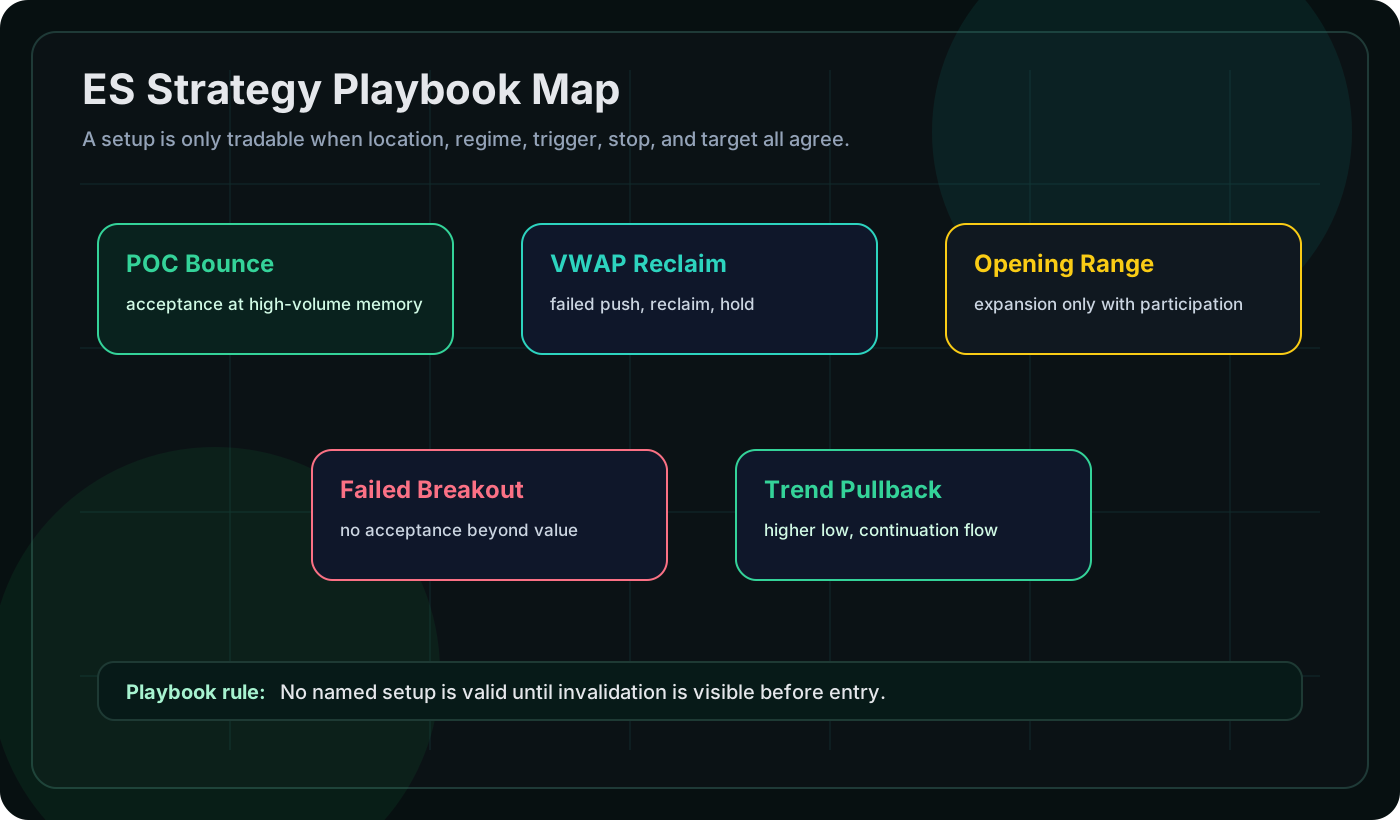
On March 14, 2025, at 10:17 AM Eastern, I watched ES bounce off the Point of Control at 5,178 for the third time in nine minutes. QPulse crossed above zero on the 3-minute chart. Flow Pro was green. Volume Profile showed a fat cluster between 5,172-5,182. I went long two contracts at 5,180 with a stop at 5,174. ES ran to 5,196 by 11:40 AM. That is a 2.7R trade on a setup I have taken 347 times in the last fourteen months.
That trade is the POC Bounce — one of five ES strategies I trade every week using the STS system. Not theoretical strategies from a textbook. Five strategies with specific entry rules, mechanical stops, defined targets, and regime filters.
But here is the part most strategy posts conveniently skip: these are not five buttons you mash because you are bored. They are five tools for five different market conditions. The strategy is not the magic. The selection is the magic. A good strategy in the wrong regime is just a well-dressed loss.
The bad belief this post is killing: more strategies equals more opportunity. No. More strategies usually equals more ways to rationalize a mediocre trade. Opportunity comes from matching one clean setup to the right regime, then having the patience to let the rest of the noise go annoy somebody else.
Match Strategy to Regime First
The single biggest improvement I made to my trading was learning to match strategy to GEX regime. Wrong regime = wrong strategy = loss.
| Strategy | GEX+ (Pinning) | GEX- (Amplifying) | Transitional |
|---|---|---|---|
| POC Bounce | Strong | Weak | Moderate |
| VAH Rejection | Strong | Moderate | Strong |
| ORB | Avoid | Strong | Half size |
| VWAP Reclaim | Moderate | Strong | Strong |
| EOD Momentum | Moderate | Strong | Moderate |
The Five-Minute ES Strategy Selector
This is the actual premarket decision, stripped of romance. Pick the regime first. Then pick the strategy. Then decide whether the trade deserves money.
ES Strategy Misuse Ledger
| Misuse | What It Feels Like | Correct Move |
|---|---|---|
| Trading ORB on a GEX+ day | "Breakout has to go" | stand down |
| Fading a trend day at VAH | "Resistance is resistance" | use momentum playbook |
| Taking every POC touch | "Level is real" | require QPulse + Flow |
| Trading Friday lunch | "One more setup" | reduce or stop |
Strategy 1: POC Bounce (Mean Reversion)
Logic: POC is where the most volume traded — institutional fair value. Price deviating and returning has high bounce probability.
Rules: (1) Price touches prior session POC within 2 points. (2) QPulse crosses zero in bounce direction on 3-min. (3) Flow Pro confirms. (4) 15-min QPulse not strongly against you. Stop: 4-6 points below/above POC. Target: Half off at 1.5R, trail remainder. Avg R: 0.41R across 347 trades, 62% win rate. Full playbook: POC Bounce Long.
Real trade: March 14 — prior POC at 5,178. Price touched at 10:14 AM. QPulse crossed zero up at 10:15. Flow Pro green. Entered 5,180, stop 5,174. Half off at 5,188 (+1.3R). Trailed remainder, exited 5,196 at 11:40 AM (+2.7R). Blended: 2.0R.
Strategy 2: VAH Rejection Short
Logic: VAH is where 70% of volume's upper boundary sits. Price pushing to VAH and rejecting = sellers defending. Full playbook: VAH Rejection Short.
Rules: (1) Price wicks above VAH and closes below on 3-min. (2) QPulse rolling over. (3) Flow Pro showing selling or transitioning. Stop: 2 points above wick high. Target: POC, then VAL. Avg R: 1.2R across 189 trades, 54% win rate.
Real trade: April 3 — prior VAH at 5,246. ES pushed to 5,249 at 10:42 AM, printed bearish engulfing closing at 5,244. QPulse rolling from +0.8 to +0.3. Flow Pro flipped red. Shorted 5,244, stop 5,251. Half at POC 5,232 (+1.7R). Remainder at 5,223 (+3.0R). Blended: 2.35R.
Strategy 3: Opening Range Breakout
Logic: First 30 minutes (9:30-10:00) establish initial balance. Breaking out signals new participants driving price beyond consensus. Strong GEX- regime dependency. Fails on FOMC/CPI days.
Rules: (1) Mark 9:30-10:00 high/low. (2) 3-min close beyond range. (3) Wait for pullback (40-60% retracement). (4) QPulse strongly directional (above +0.5 for longs). (5) Check GEX — skip on GEX+ days entirely. Stop: Below pullback low. Target: 1x opening range from breakout level. Avg R: 1.6R across 112 trades, 48% win rate. Without GEX filter, win rate drops to 38% and expectancy goes negative.
Real trade: Feb 20 — GEX deeply negative. 9:30-10:00 range: 5,312 to 5,324 (tight 12 points). At 10:08, 3-min closed at 5,326. Pullback to 5,323. QPulse at +0.7. Entered 5,324, stop 5,318. Target 5,336 hit at 10:52. Half off (+2.0R). Trailed, caught at 5,343 (+3.2R). Blended: 2.6R.
Strategy 4: VWAP Reclaim
Logic: Price below VWAP 30+ min then reclaiming on rising delta = shift from sellers to buyers. The 30-min filter eliminates quick dips (noise) from genuine regime shifts.
Rules: (1) Below VWAP 30+ consecutive minutes. (2) Cross back above on positive delta bar. (3) Pullback holds VWAP from above. (4) QPulse crossing zero up. Stop: 3 points below VWAP. Target: Prior POC, then VAH. Avg R: 1.4R across 94 trades, 57% win rate — highest win rate in my arsenal.
Real trade: April 17 — VWAP at 5,205. Below since 10:15. Low of 5,192. At 11:02, 3-min closed at 5,207 on strong delta. Pullback held at 5,204. QPulse crossed zero at 11:08. Entered 5,206, stop 5,202. Third at POC 5,218 (+3.0R). Third at 5,226 (+5.0R). Trailed last, stopped 5,222 (+4.0R). Blended: 4.0R. Best single trade of April.
Strategy 5: End-of-Day Momentum
Logic: MOC (Market-on-Close) orders from mutual funds and pension funds create directional flow in the last hour (3:00-4:00 PM). Ride the momentum with a tight trail.
Rules: (1) At 3:00 PM, check 30-min delta direction + price vs VWAP. (2) Wait for 2-4 point pullback between 3:00-3:20. (3) Enter on resumption (3-min takes out pullback high/low). (4) QPulse confirming and accelerating. (5) No trade if range-bound prior 2 hours. Stop: 2 points past pullback extreme. Target: Trail with 2-point stop, exit at 3:58. Avg R: 1.1R across 156 trades, 51% win rate. Big wins (2-4R) come on heavy MOC imbalance days, 2-3x/week.
Real trade: May 8 — ES at 5,340 at 3:00 PM. Delta strongly positive, price above VWAP. Pullback to 5,336 at 3:12. Resumption bar at 3:14, QPulse +0.6. Entered 5,341, stop 5,334. ES ran to 5,358 by 3:52. Trailing stop caught at 5,355. +2.0R.
Day-of-Week Performance
| Strategy | Mon | Tue | Wed | Thu | Fri |
|---|---|---|---|---|---|
| POC Bounce | 0.32R | 0.58R | 0.41R | 0.52R | 0.18R |
| VAH Rejection | 1.1R | 1.5R | 1.2R | 1.0R | 0.6R |
| ORB | 0.8R | 1.4R | 2.1R | 1.9R | 1.2R |
| VWAP Reclaim | 1.2R | 1.8R | 1.7R | 1.3R | 0.5R |
| EOD Momentum | 0.4R | 0.9R | 1.6R | 1.5R | 1.0R |
Mondays underperform across all strategies. Tuesdays and Wednesdays are the strongest (institutional activity peaks mid-week). Fridays are weak for mean-reversion because desks reduce risk ahead of the weekend. My rule: Mondays = reduce size, A+ setups only. Tue-Thu = full size. Fridays = favor breakout over mean-reversion, stop by 2:00 PM.
The Daily Decision Tree
Before every session, I run through this in five minutes as part of my pre-flight checklist:
- GEX regime? GEX+ = POC Bounce + VAH Rejection. GEX- = ORB + VWAP Reclaim + EOD. Transitional = all five at reduced size.
- Day of week? Monday = reduce size. Friday = favor breakout. Tue-Thu = full menu.
- Macro events? FOMC/CPI/NFP = no ORB, reduce size, wait for data release.
- 15-minute trend? Strongly trending = momentum strategies. Range-bound = mean-reversion.
When These Strategies Fail
They fail when the regime changes and you pretend it did not. They fail when the 15-minute trend is screaming one way and you try to fade it because the level "should hold." They fail when you enter late, widen the stop, and then blame volatility. ES is liquid, but it is not polite. It will punish lazy context.
My worst ES days were not caused by bad strategies. They were caused by forcing good strategies into bad conditions. That is why every setup above starts with regime, not entry.
A great strategy in the wrong regime is a losing strategy. Regime selection is the first decision every day. The full indicator suite — Volume Profile, QPulse, Flow Pro — is free at nexural.io/indicators. Start with one strategy, trade it for two weeks in simulation, track every trade in your journal. Final rule: do not collect strategies. Earn the right to trade one setup cleanly, then add the next.