I trade 8 futures instruments every day: ES, NQ, CL, GC, SI, HG, ZB, and RTY. I've been doing this long enough to know that most "beginner's guides" to futures are written by people who don't actually trade futures. They explain what a contract is, show you a chart, and send you off to blow up your account with a platform tour and a dream.
This guide is different. It covers everything you actually need to know — including the things nobody tells beginners because they're not sexy: how margin calls work in practice, why trading during ETH can destroy you, how slippage works differently in CL versus ES, and the specific numbers behind risk management that separate survivors from statistics.
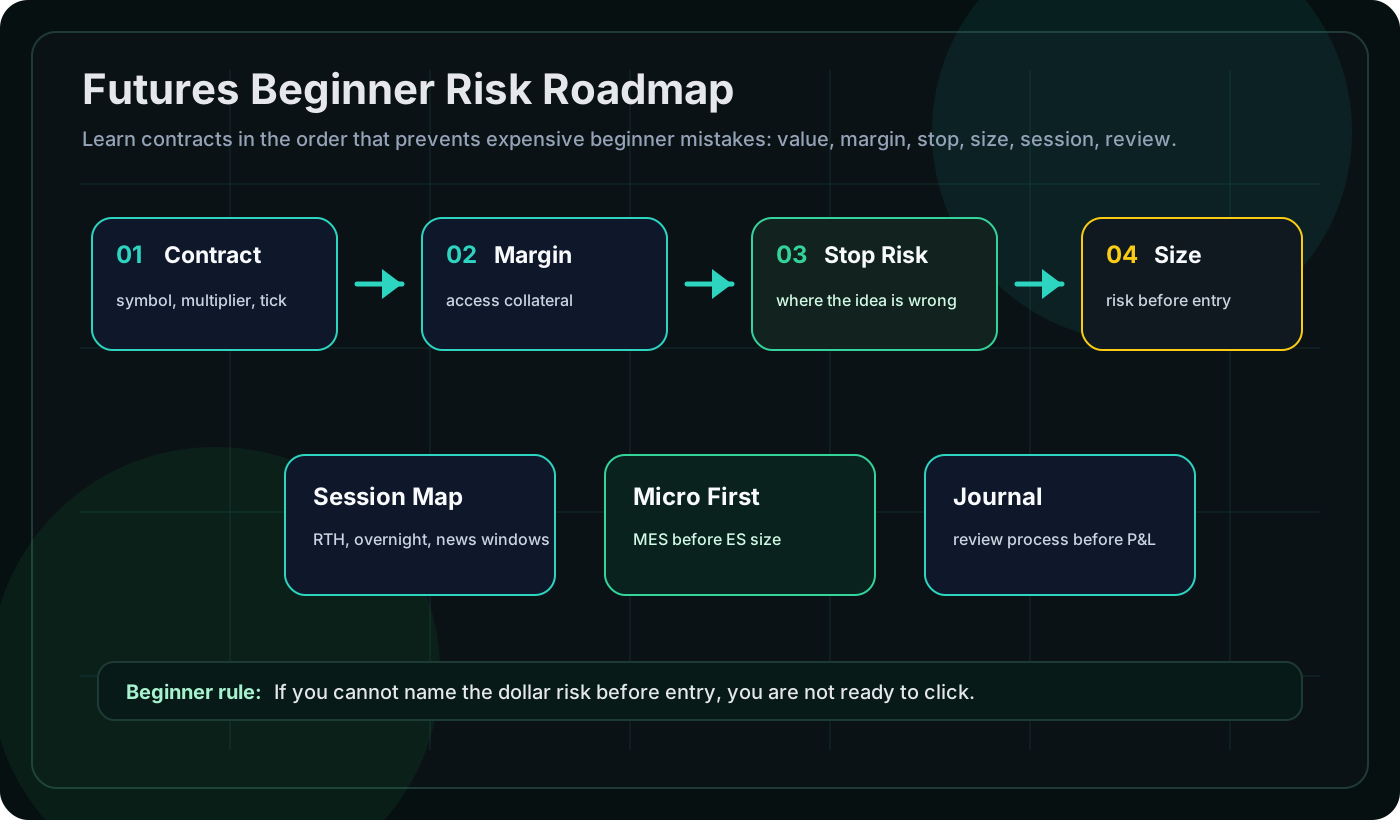
The bad belief this post is killing: futures are just stocks with more leverage. No. Futures are professional instruments with adult consequences. They are cleaner, faster, more capital-efficient, and completely unforgiving when you confuse buying power with risk capacity.
The Futures Beginner Survival Ladder
| Stage | What You Trade | Permission to Advance |
|---|---|---|
| Learn | simulator only | 20 rule-following sessions |
| Prove | 1 micro ES/MES | positive R over 30 trades |
| Expand | ES/NQ micros only | journal compliance above 90% |
| Specialize | CL, GC, SI, ZB | after you stop doing dumb stuff |
What Is a Futures Contract?
A futures contract is a standardized agreement to buy or sell a specific asset at a specific price on a specific date. Every contract trades on a central exchange (CME Group for most US futures), which eliminates counterparty risk — you're not betting against a broker, you're trading on a regulated marketplace.
The three things that make futures different from stocks:
- Leverage is structural, not borrowed. Stock margin is a loan — you pay interest. Futures margin is a performance bond — a good-faith deposit. You don't pay interest on futures margin.
- Contracts expire. Every futures contract has an expiration date. Most traders close before expiration and "roll" to the next month. You will never accidentally receive 1,000 barrels of crude oil.
- You can go short as easily as long. No borrowing, no locate fees, no uptick rules. Selling is the mirror image of buying.
The 8 Contracts I Trade (And Why)
| Symbol | Contract | $/Point | $/Tick | Personality | Best For |
|---|---|---|---|---|---|
| ES | E-mini S&P 500 | $50 | $12.50 | Smooth, deep liquidity | Learning |
| NQ | E-mini Nasdaq-100 | $20 | $5.00 | Fast, tech-driven | Momentum |
| RTY | E-mini Russell 2000 | $50 | $5.00 | Choppy, news-sensitive | Economic data plays |
| CL | Crude Oil | $1,000 | $10.00 | Volatile, spike-prone | Experienced traders |
| GC | Gold | $100 | $10.00 | Safe-haven, geopolitics | Macro traders |
| SI | Silver | $5,000 | $25.00 | Wild, high tick value | Not for beginners |
| HG | Copper | $250 | $12.50 | Economic bellwether | Macro correlation plays |
| ZB | 30-Year Treasury Bond | $1,000 | $31.25 | Fed-driven, yield-curve | Interest rate traders |
Start with ES or its micro version (MES). Read the micro futures guide for the 1/10th-size on-ramp.
Notice the "Personality" column. This is what most guides skip. ES is smooth and forgiving — it trends cleanly and mean-reverts predictably around Volume Profile levels. CL is a different animal — it spikes on inventory reports, has wider spreads during off-hours, and will punish you for hesitating. Silver ($25/tick) can move $500 per contract in minutes. Know your instrument before you trade it.
Understanding Margin (The #1 Misunderstanding)
Stock traders think of margin as a loan. Futures margin is completely different — it's a performance bond. You're not borrowing money; you're depositing a fraction of the contract value to guarantee your position.
- It's a loan from your broker
- You pay interest (6-12%/year)
- 4:1 day trading, 2:1 overnight
- PDT rule: $25K minimum
- It's a performance bond
- No interest charges
- Leverage varies by contract
- No PDT rule, no minimum
Day trading margin on MES at NinjaTrader is ~$50. The notional value of one MES contract at 5,300 is $26,500. That's 530:1 leverage. This is why position sizing isn't optional — it's the difference between a 3-year career and a 3-month one.
Trading Sessions: Why They Matter More Than You Think
The same 10-point ES move at 3:00 AM versus 10:00 AM is a completely different trade. At 3 AM, volume is 5% of peak. Spreads are wider. Moves are erratic and often reversed. At 10 AM, liquidity is deep, institutional flow is active, and moves have follow-through.
The sessions I trade and why:
- Pre-market (8:00-9:30 AM ET): Economic data drops. I watch, don't trade. Mark key levels from overnight range.
- First hour (9:30-10:30 AM): Highest volume. Opening range establishes. This is where the POC Bounce and VAH Rejection setups fire.
- Midday (10:30 AM - 2:00 PM): Volume drops. Mean reversion dominates. I reduce size or sit out.
- Power hour (3:00-4:00 PM): MOC orders create directional conviction. If the day has established a trend, this is where it accelerates.
New traders: only trade 9:30-11:30 AM for your first 30 sessions. This window has the best combination of liquidity, volume, and setup frequency. Everything else is noise until you've proven you can be profitable in the best conditions.
When You Should Not Trade Futures Yet
Do not trade futures live if you cannot define your stop before entry, cannot calculate dollar risk per contract, do not know the next economic release, or have not proven you can stop trading after hitting a daily loss limit. That is not gatekeeping. That is basic survival.
Also do not trade futures because you are undercapitalized and need leverage to "make it work." Leverage does not solve small-account pressure. It amplifies it. If you are emotionally desperate, futures will find that weakness and invoice you for it.
Your First Trade Checklist
Before you enter a single trade — paper or live — run through the Asymmetric Filter:
- Is there a defined setup? "It looks like it's going up" is not a setup. "Price is testing yesterday's POC with QPulse crossing zero from below" is a setup.
- What is the R:R? Minimum 2:1. If your stop is 5 ES points ($250), your target must be at least 10 points ($500). The asymmetric principle demands it.
- Where is the stop? Define it before entry. In ticks, not "around there." Place it immediately.
- What is the position size? Use the position size calculator. Never size by gut feel.
- Is the regime favorable? Check GEX. Positive = mean reversion setups. Negative = trend setups.
- What is the daily loss budget? Max 2% of account. If you've already lost 1.5%, this trade must be a clean A-grade setup or you sit out.
The Learning Path
Here's what I wish someone had given me on day one:
- Micro Futures Guide — Start with MES at 1/10th the risk.
- The Asymmetric Investor — Free chapters covering the complete risk-reward framework.
- Free Indicator Suite — 42 NinjaTrader indicators including Volume Profile, QPulse, and Flow Pro.
- Automation Curriculum — 195 free pages from coding fundamentals to live deployment.
- Trade Journal — Start tracking R-multiples from day one. The review process is where the real learning happens.
- Glossary — 97 trading terms with formulas and cross-references.
All free. All permanent. No credit card, no trial timer. The paid tiers (see pricing) unlock the AI swing desk, live flow data, and the research platform — but the foundation tools are designed to be useful forever at zero cost.
Common Beginner Mistakes (And What They Actually Cost)
I've made every one of these. Here's what each one cost me in real dollars so you can skip them.
| Mistake | What Happened | Cost | The Fix |
|---|---|---|---|
| Trading without a stop | Entered NQ long "just for a scalp." Walked away. Came back to -$1,400. | $1,400 | Stop placed before entry. Always. No exceptions. |
| Holding through news | Had a CL position into EIA inventory report. 80-tick spike in 3 seconds. | $800 | Flat before major data releases. Economic calendar is non-negotiable. |
| Averaging into losers | ES was "too cheap" at -8 points. Added. Added again at -14 points. | $2,100 | If the trade is losing, the thesis was wrong. Cut it. Period. |
| Trading ETH without knowing it | Entered MES at 7:45 AM. Spread was 3 ticks. Slippage ate the entire 5-point target. | $125 | Only trade RTH (9:30-4:00) until you understand session dynamics. |
| No daily loss limit | 3 losses became 11 in one session. Classic revenge trading spiral. | $3,200 | Hard daily limit: 2% of account. Hit it and walk away. |
Total cost of these mistakes: $7,625 across my first 6 months. Every single one was preventable with rules I now enforce mechanically. The Asymmetric Scorecard catches all five of these before they happen.
The Order Types You Need to Know
Futures platforms offer dozens of order types. You need four:
Market Order
Buy or sell immediately at the current price. Use when you need certainty of execution (getting out of a losing trade, entering a fast-moving setup). The cost: you accept whatever price the market offers, which during volatile moments can be 2-3 ticks worse than the last traded price.
Limit Order
Buy or sell at a specific price or better. Use when you want to enter at a predefined level (e.g., "buy at 5,280 if price pulls back to my POC level"). The risk: the market may never reach your price, and you miss the trade entirely. I use limit orders for 80% of my entries.
Stop Order (Stop-Loss)
Triggers a market order when price reaches your stop level. This is your circuit breaker — the maximum you're willing to lose on the trade. I place mine immediately after entry. Mental stops ("I'll get out if it hits 5,275") are not real stops. When cortisol hits and the position is losing, your brain will rationalize staying in. The stop order doesn't negotiate.
Bracket Order (OCO)
A simultaneous stop-loss + profit target that surrounds your entry. When one side fills, the other cancels automatically. This is the default order type for the STS system — enter with a bracket, walk away, and let the math play out.
The Tax Advantage Nobody Mentions
Under IRC Section 1256, futures profits are taxed 60/40 — 60% at the long-term capital gains rate and 40% at the short-term rate — regardless of how long you held the position. A day trade that lasted 4 minutes gets the same tax treatment as a stock held for 2 years.
For a trader in the 35% federal bracket making $100,000 in trading profits:
That's $9,000 per year in tax savings on the same $100K profit — purely from the instrument choice. Over a 10-year career, that's $90,000+ in saved taxes. Futures also have no wash sale rules, which simplifies year-end tax-loss harvesting significantly.
Final rule: start smaller than your ego wants, trade fewer products than your curiosity wants, and journal more honestly than your pride wants. Futures reward precision. They punish improvisation. Begin with micros, use the Asymmetric Scorecard, and do not size up until the data says you have earned it.