I have passed three prop firm evaluations and failed two. The failures cost me $1,150 in evaluation fees and six weeks of careful trading that ended with a single mistake each time. One was a trailing drawdown violation on day 11 of a 14-day evaluation. The other was a daily loss limit breach at 10:47 AM on a Monday because I did not understand how the limit resets. Those two failures taught me more about prop firm rules than any YouTube video ever could.
Prop firm evaluations are not trading contests. They are rule-survival games with trading attached. That distinction matters. If you treat the evaluation like a normal account, the rules will do what they were designed to do: find the moment you get sloppy and charge you for it. This is the real version, with the math, the edge cases, the traps, and the specific playbook I use to pass evaluations while still trading my normal STS system.
The bad belief this post is killing: passing a prop firm evaluation proves you are ready to trade size. It proves you survived a rules game. That is useful, but it is not the same as durable edge. The funded account is where the real test starts.
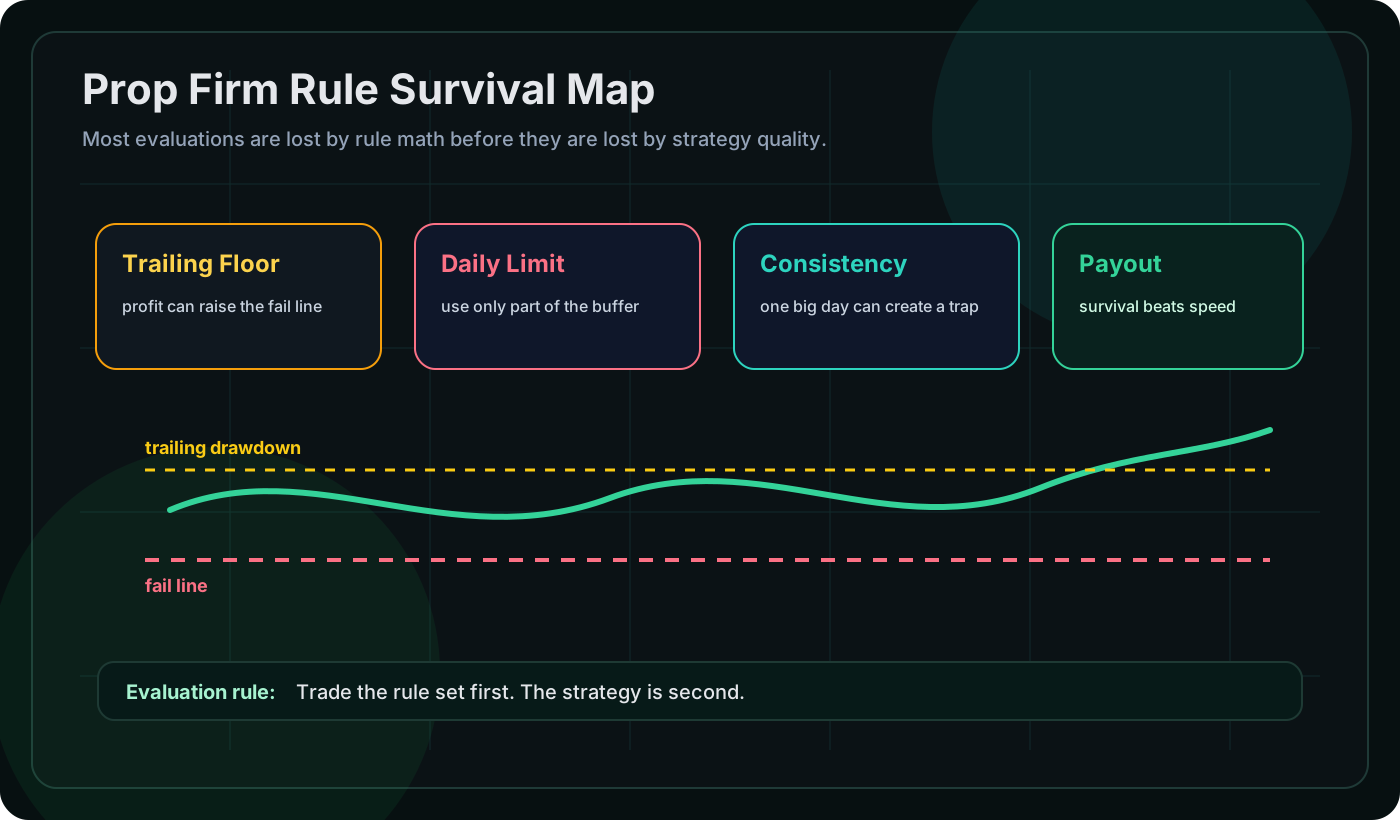
Rule 1: The Trailing Drawdown (The Silent Killer)
When you start a $50,000 evaluation with 6% trailing drawdown, your floor is $47,000. If your account reaches $52,200, the floor ratchets to $49,200. And it never comes back down. This is the trap that kills experienced traders more than beginners. Here is the day-by-day math from my second evaluation — the one I failed on day 11:
| Day | P&L | Balance | High Water | Floor | Buffer |
|---|---|---|---|---|---|
| Start | — | $50,000 | $50,000 | $47,000 | $3,000 |
| Day 3 | +$2,200 | $52,200 | $52,200 | $49,200 | $3,000 |
| Day 7 | +$1,050 | $53,250 | $53,250 | $50,250 | $3,000 |
| Day 9 | -$1,100 | $52,150 | $53,250 | $50,250 | $1,900 |
| Day 10 | -$1,200 | $50,950 | $53,250 | $50,250 | $700 |
| Day 11 | -$825 | $50,125 | $53,250 | $50,250 | VIOLATED |
On day 11, my balance was $50,125 — still above my starting balance. I was profitable. And I failed. Because my high water mark of $53,250 created a floor of $50,250, and I dropped below it. You can be profitable and still fail. The floor ratchets up with every new high but never comes down.
How the Floor Sneaks Up on You
The trap is psychological. After a strong start, traders think they are safer. Mechanically, they may be less safe because the loss floor has climbed behind them.
Rule 2: Daily Loss Limit
Typically $1,000-2,500 on a $50K account. The dangerous nuance: how "daily" is defined. Some firms reset at midnight, some at 6:00 PM ET (futures session open), some at 9:30 AM. My first failure was exactly this — I carried -$1,400 from an overnight session thinking it would reset at midnight. The firm reset at 6:00 PM. A $650 loss at 10:47 AM pushed me over the $2,000 limit. Evaluation failed because I didn't read the fine print.
Rule 3: Consistency Rules
No single day can account for more than 30-40% of total profit. This kills swing traders who grind small losses for 4 days then hit a home run on day 5. You need distributed profits across sessions.
The 50% Buffer Strategy
After failing twice, I changed the objective. The goal was no longer "trade well." The goal was "do not let the rules kill an otherwise good trading plan." Core rule: never risk more than 50% of available buffer per day, never more than 25% per trade. This is more conservative than necessary — and that is the point. The goal of an evaluation is to pass, not to maximize profit.
- Daily risk: 50% of buffer = $1,500. Even if the firm allows $2,000, I stop at $1,500. Safety margin.
- Per-trade risk: 25% of buffer = $750. On ES that is a 15-point stop. On NQ, 37.5 points. Workable for STS setups.
- No trading during CPI, FOMC, NFP. The expected value of trading these during an evaluation is negative once you factor in the risk of instant failure.
This approach is conservative. Evaluations take 15-20 days instead of 7-10. But it works: three for three since implementing this approach. Use the Drawdown Simulator to model scenarios before paying for an evaluation. The Risk Calculator computes exact position sizes for any firm's rules.
Evaluation Trap Ledger
| Trap | Why It Feels Smart | Actual Move |
|---|---|---|
| passing fast | lower subscription cost | raises blowup risk |
| trading after target hit | "just staying active" | negative EV |
| using max daily loss | firm allows it | no safety margin |
| holding into news | "big opportunity" | instant fail risk |
Comparing Drawdown Types
| Type | Ratchets? | Difficulty | Best For |
|---|---|---|---|
| Trailing Intraday | Yes (tick by tick) | Hardest | Scalpers only |
| Trailing EOD | Yes (daily) | Hard | Day traders |
| Static | No | Easiest | All styles |
| Trailing to Static | Until locked | Medium | Day + swing |
For STS system day traders: choose Trailing EOD or Trailing to Static. Avoid intraday trailing — your unrealized P&L on a winning trade can raise the floor mid-session, then trigger a violation on the pullback before you exit. It is a mechanical trap.
The 5-Step Passing Framework
- Pre-evaluation simulation (1-2 weeks): Paper trade the firm's exact rules. Use the Risk Calculator to set limits. If you pass the sim, pay for the real evaluation. If not, adjust and simulate again.
- Conservative first week: Trade at 50% normal size. Target $200-400/day. Build a small cushion without raising the high water mark excessively.
- Scale up week two: With $1,500+ cushion, increase to 75% size. Target $400-700/day.
- Target management: Within 20% of profit target, drop back to 50% size. Grind the final amount over 2-3 small trades.
- Lock and close: Hit the target, stop trading. If minimum day count remains, trade at absolute minimum size on A+ setups only. Every trade from this point is negative EV from an evaluation standpoint.
The prop firm industry pass rate is roughly 5-10% overall. Among traders who simulate first, use conservative sizing, and understand the drawdown mechanics mathematically, the rate is dramatically higher. The process above has produced 3-for-3 in my own trading.
When This Advice Fails
This approach fails if your strategy has no expectancy. Conservative sizing does not turn a bad system into a funded account. It just makes the failure slower and less dramatic. Before paying for an evaluation, prove the setup in simulation, then in your own small account, then inside the firm's exact rules. If the strategy cannot survive the backtest and walk-forward process, a prop account will not rescue it.
It also fails if you are trying to pass fast because you are undercapitalized and desperate. That mindset is gasoline. Prop firms love gasoline.
Track every evaluation session in the trade journal — R-multiples and execution quality are the metrics prop firms implicitly test for. For the position sizing math, read Position Sizing: Why the 2% Rule Is Wrong. Final rule: the drawdown rules are the game. Position sizing is how you stay alive long enough to play it.