I've built 47 strategies in the last three years. Seven survived walk-forward validation. Three made it to live trading. One became part of the Nexural automation pipeline. The other 44 looked profitable in backtest and failed within 30 sessions. That's not a bad ratio — it's actually better than most quant desks. But those 44 failures taught me more about backtesting than the winners ever did.
Here's the uncomfortable truth nobody selling backtesting software will tell you: the majority of profitable backtests are statistical noise. The equity curve goes up and to the right, the Sharpe looks great, the win rate is impressive — and none of it means anything because the process that generated those numbers is fundamentally broken.
This isn't a tutorial on which button to click in NinjaTrader's Strategy Analyzer. It's the framework I use to separate strategies with real edge from strategies that just happen to fit historical noise. The same framework behind the Nexural Research Platform's 10-check gauntlet.
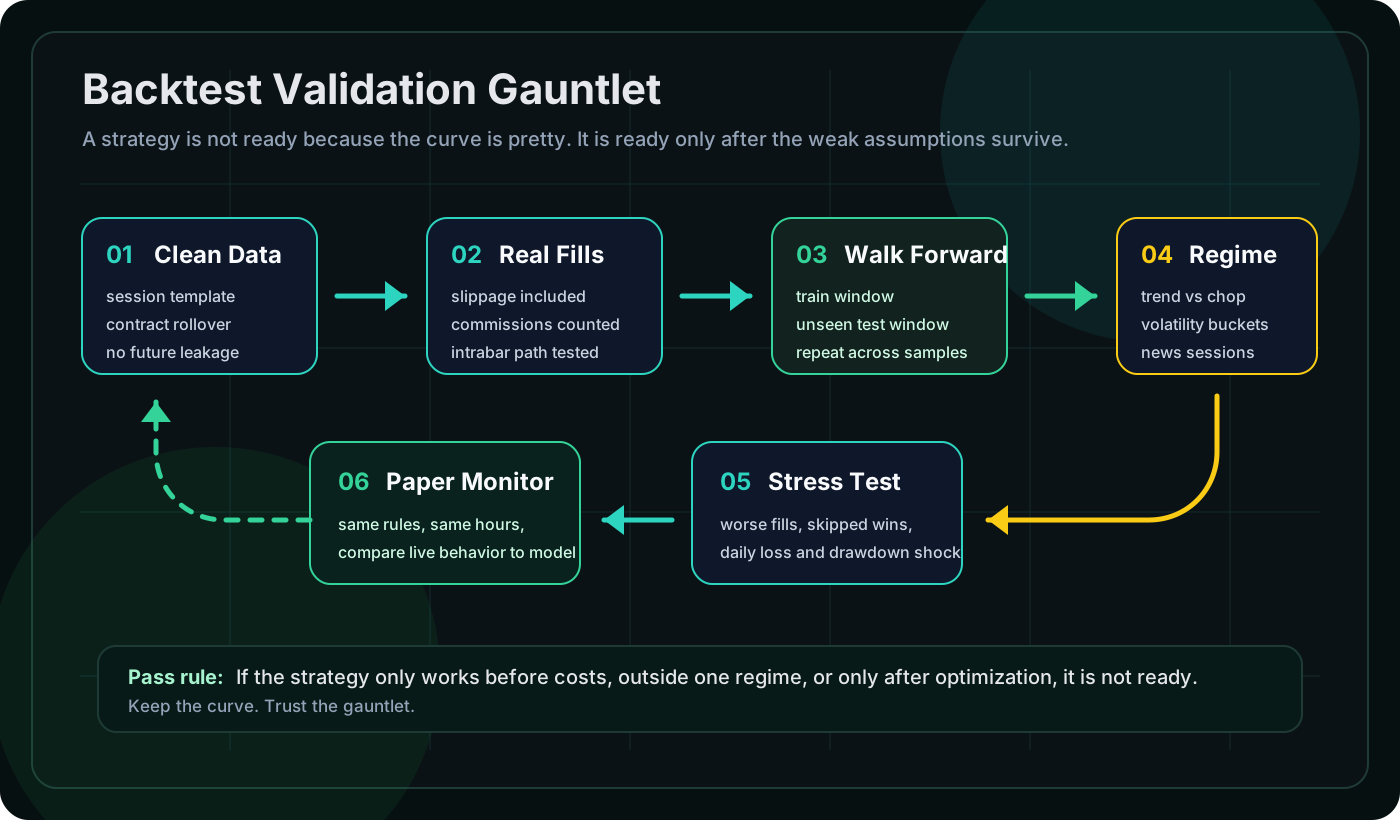
The bad belief this post is killing: if the equity curve looks good, the strategy is good. No. A pretty backtest is often just a well-dressed lie. Your job is not to admire the curve. Your job is to interrogate it until it either survives or confesses.
False Comfort in Backtests
| Looks Good | Could Actually Mean | Required Test |
|---|---|---|
| Smooth equity curve | overfit parameters | walk-forward |
| High Sharpe | too many trials | deflated Sharpe |
| Tiny drawdown | missing slippage or bad fills | execution model |
| Great recent performance | one regime doing all the work | regime split |
The 7 Ways Backtests Lie
Every backtest gives you a number. The number feels authoritative — it's computed from real data, after all. But a number without statistical rigor is just a story you're telling yourself with a calculator.
I've seen each of these destroy strategies that looked unstoppable on paper:
1. Lookahead Bias — The Silent Killer
Lookahead bias means using information that wasn't available at the time of the trade. It sounds obvious. It's not. I once built an NQ strategy that used the 15-minute bar's close price to trigger an entry — but the entry executed at the bar's open. The strategy "knew" where the bar would close before it happened. It showed a 4.2 Sharpe ratio. In live trading, it was a 0.3.
The most common lookahead traps in futures:
- Using
Close[0]for entry signals when the bar hasn't completed - Referencing settlement prices that publish after the session ends
- Using VIX term structure data that updates on a different schedule than your bar data
- Calculating indicators on a bar that includes the current tick
2. Overfitting — More Parameters, More Lies
Here's a rule of thumb from my research pipeline: if your strategy has more than 5 free parameters, you're almost certainly curve-fitting.
I tested this directly. I took a random walk data series — zero edge by construction — and optimized a strategy with 12 parameters across 2 years of data. The optimizer found a parameter set that returned +38% annually with a 1.8 Sharpe. On random data. With zero edge.
In-sample performance always improves with more parameters. Out-of-sample performance peaks around 4-6 and degrades after.
The chart tells the whole story. In-sample performance (the dashed line) always improves with more parameters — because you're giving the optimizer more knobs to turn. But out-of-sample performance (what matters) peaks around 4-6 parameters and collapses beyond that.
3. Survivorship Bias
Futures contracts expire. If you're testing a strategy on continuous contracts, make sure the rollover methodology matches how you'd actually roll in live trading. I've seen strategies show +22% on standard roll data that show +8% on Panama Canal-adjusted data — same strategy, same market, different roll handling.
4. Data Snooping — The Researcher's Trap
If you test 100 parameter combinations and pick the best one, you haven't found edge — you've found the luckiest random draw. This is the math of asymmetry working against you: with enough trials, impressive results appear by chance.
The correction: the deflated Sharpe ratio. It adjusts your reported Sharpe for the number of trials you ran. Formula:
If you tested 50 combinations and your best Sharpe is 1.8, the deflated Sharpe might be 0.7. That's not edge — that's noise. The Nexural research pipeline calculates this automatically for every strategy candidate.
5. Insufficient Sample Size
Thirty trades is not a strategy validation — it's an anecdote. The minimum for statistical significance: 200+ trades across at least two distinct market regimes (one trending, one ranging). For ES at one trade per day, that's roughly 10 months of data. For swing strategies with one trade per week, that's 4+ years.
6. Ignoring Execution Reality
| Cost Component | ES (per side) | NQ (per side) | CL (per side) |
|---|---|---|---|
| Commission | $1.29 | $1.29 | $1.29 |
| Exchange fees | $1.18 | $1.48 | $1.42 |
| Slippage (1 tick assumed) | $12.50 | $5.00 | $10.00 |
| Round-trip total | $29.94 | $15.54 | $25.42 |
| Annual cost @ 1 trade/day | $7,485 | $3,885 | $6,355 |
NinjaTrader commission rate. Slippage is the hidden cost that destroys marginal strategies.
Look at that slippage line. One tick of slippage per side on ES costs $25 per round-trip — more than 5x the commission. A strategy that makes $30/trade before costs is a loser after costs. I include 1 tick of slippage per side as a minimum in every backtest. For volatile instruments like CL, I use 2 ticks.
7. Regime Blindness
Testing a mean-reversion strategy on 2021 (trending bull market) and declaring it validated is like testing a raincoat in the Sahara and declaring it waterproof. Your data must include:
- At least one sustained uptrend (2021, 2024)
- At least one sharp correction (Q4 2018, March 2020, 2022)
- At least one grinding chop period (2015, mid-2023)
- At least one volatility regime shift (Feb 2018 VIX spike, COVID crash)
The GEX regime framework helps here — positive GEX means mean reversion, negative GEX means trend following. If your strategy only works in one regime, you need a regime filter, not a different strategy.
The Walk-Forward Framework That Actually Works
Walk-forward analysis is how I validate every strategy before it touches the Nexural automation pipeline. It's also how every institutional quant desk operates — the only difference is they have PhDs running the analysis and I have a Python pipeline.
The concept is simple: instead of optimizing on your full data set and testing on that same data (which is guaranteed to look good), you split the data into rolling windows:
Each window optimizes parameters on the in-sample data (purple), then tests those fixed parameters on unseen out-of-sample data (green). The OOS results stitched together give you the realistic equity curve.
Walk-Forward Efficiency (WFE)
The key metric. WFE measures how much of your in-sample performance carries forward:
Of the 47 strategies I've tested, the three that survived to live trading all had WFE above 55%. The 44 that failed? Average WFE of 18%. The correlation is stark.
The Nexural 10-Check Gauntlet
This is the exact checklist I run before any strategy graduates from research to paper trading. It's also what powers the automated grading in the Nexural Research Platform:
| # | Check | Pass Threshold | Why It Matters |
|---|---|---|---|
| 1 | Walk-forward efficiency | ≥ 50% | IS-to-OOS performance transfer |
| 2 | Deflated Sharpe ratio | ≥ 1.0 | Adjusts for trial count |
| 3 | OOS trade count | ≥ 200 | Statistical significance |
| 4 | Max drawdown (Monte Carlo 5th %ile) | < 25% | Survivable worst case |
| 5 | Profit factor | ≥ 1.3 | Gross profit / gross loss |
| 6 | Avg R-multiple | ≥ 0.3R | Asymmetric edge |
| 7 | Free parameters | ≤ 6 | Overfitting guard |
| 8 | Multi-regime survival | 3+ regimes | Bull, bear, chop coverage |
| 9 | Execution cost drag | < 40% of gross | Strategy survives real costs |
| 10 | PBO (Probability of Backtest Overfitting) | < 40% | Combinatorial cross-validation |
A strategy that passes all 10 checks earns an A grade and gets promoted to paper trading. A strategy that fails 3+ checks gets an F and goes to the archive. There's no subjective judgment — the gauntlet is mechanical.
A Real Example: The POC Bounce Strategy
Let me walk through a real strategy validation. The POC Bounce Long is one of the STS system playbooks — it enters long when price bounces off yesterday's Point of Control with QPulse confirmation.
Here's what the gauntlet looked like for this strategy on ES 5-minute bars, 2020-2025:
This strategy passed all 10 checks. It has 4 free parameters (MA length, POC tolerance, QPulse threshold, ATR stop multiplier). It survived 2020's COVID crash, 2022's bear market, and 2023's chop. The 0.41R average means for every dollar risked, it returns $0.41 on average — which with a 43% win rate produces consistent asymmetric returns.
From Backtest to Live: The Bridge That Breaks
Even a perfectly validated backtest can fail live. The three failure modes I've seen:
- Slippage is worse than modeled. I assumed 1 tick; real slippage during volatile opens is 2-3 ticks. The trade journal tracks expected vs. actual fill prices — if the gap widens, the strategy gets paused.
- The regime shifted. A strategy validated during positive GEX periods will struggle when GEX flips negative and dealers amplify instead of dampening. This is why every strategy in the Nexural pipeline has a regime tag.
- You modified the rules. The most common failure mode. The strategy says "enter at POC with QPulse confirmation." You skip the QPulse check because the price action "looks obvious." One unconfirmed entry becomes five. Your edge disappears because you stopped executing the system that created it.
This is why the Asymmetric Scorecard exists — it's the execution-side counterpart to backtesting. The backtest proves the system works. The scorecard proves you're actually running the system.
Start Here
If you're building strategies, the Backtest Overfitting Checklist walks through each of the 10 checks interactively. The backtesting module of the free curriculum covers the implementation details in NinjaTrader and Python.
For the full pipeline — walk-forward, Monte Carlo, deflated Sharpe, strategy grading — explore the Nexural Research Platform. The free tier includes the journal, indicators, and academy. The research tools are part of the Creator tier.
Final rule: never trust a backtest that has not been forced to trade unseen data, pay realistic costs, survive multiple regimes, and explain every parameter it uses. The market does not pay for beautiful spreadsheets. It pays for edges that keep working after the optimizer stops helping.