Skip to content
v3 redesign is live — welcome to the trading cockpit.
Market updates, stock news, and futures insights — 3x/week, freeSubscribe free
Skip to content
build.logtraders.online=2,166trades.60s=74swings.ranked=308edge.latency_ms=42ms
Back to Blog
Trading Education

Micro NQ vs Micro ES: Which Contract Should Beginners Trade?

S
Sage

Head of Trading Education

10 min read
Updated June 17, 2026
Micro NQ vs Micro ES: Which Contract Should Beginners Trade?

What is "Micro NQ vs Micro ES: Which Contract Should Beginners Trade?" about?

A practical MNQ vs MES comparison for beginner futures traders: tick value, contract multiplier, volatility, account size examples, stop distance, and position-sizing workflow.

Two beginners have the same $5,000 account. One trades MES with a 10-point stop. The other trades MNQ with a 40-point stop because Nasdaq is whipping around. The MNQ trader says, "But MNQ is only fifty cents a tick." That sentence is how small accounts get surprised.

The best beginner contract is not the one with the smaller tick. It is the one whose normal volatility fits your risk budget.

MES and MNQ are both micro equity index futures. Both are useful. Both can be dangerous. The difference is not just contract specs. The difference is how each contract behaves when the market is moving fast and your stop needs enough room to survive normal noise.

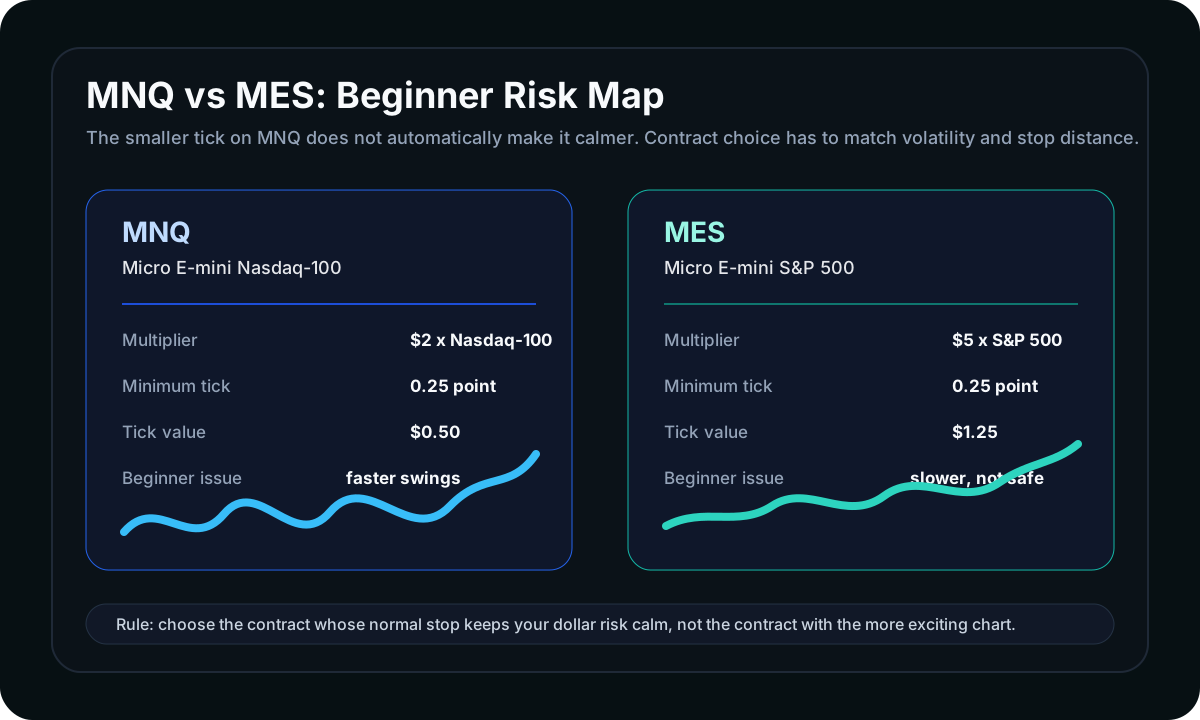
MNQ vs MES risk comparison showing multiplier, tick value, pace, and beginner fit

The Quick Answer

For most beginners, MES is usually the cleaner learning contract. It tends to move slower, represents the broader S&P 500, and gives new traders more time to practice reading structure, waiting for confirmation, and taking stops.

MNQ is not bad. It is just faster. It can be excellent for traders who understand volatility, use smaller size, and do not chase every Nasdaq candle. But if a beginner is still learning how to take a stop, MNQ can expose every bad habit quickly.

Contract Specs: MES vs MNQ

Contract Tracks Multiplier Minimum Tick Tick Value
MESS&P 500$5 x index0.25 point$1.25
MNQNasdaq-100$2 x index0.25 point$0.50

The math is straightforward. MES pays $5 per full index point. MNQ pays $2 per full index point. Since both tick in 0.25-point increments, MES ticks are $1.25 and MNQ ticks are $0.50.

The trap is thinking the lower tick value makes MNQ automatically safer. It does not. A 10-point MES stop is $50 per contract. A 40-point MNQ stop is $80 per contract. The smaller tick lost the risk contest because the market required a wider stop.

The Real Comparison Is Stop Distance

Risk is not contract name. Risk is:

Stop distance x dollar value per point x number of contracts.

That is why the futures position size calculator matters more than preference. You choose the stop first. Then the calculator tells you whether the contract and size fit the account.

Example: $5,000 Account

Assume the trader wants to risk about $50 on the trade.

Scenario Stop Risk per Contract Fit
MES10 points$501 contract fits
MNQ25 points$501 contract fits

Both can fit. The question is which stop is realistic for the setup. If the MNQ setup routinely needs 40 to 60 points of breathing room, the same $5,000 account may not be ready to trade that style with calm execution.

Example: $25,000 Account

With a larger account, the trader has more flexibility, but the decision process does not change.

  • Risk budget: $250 per trade.
  • MES 10-point stop: $50 per contract, up to 5 contracts if the plan allows it.
  • MNQ 40-point stop: $80 per contract, up to 3 contracts if the plan allows it.

The larger account does not make MNQ safer. It just gives the trader more room to size correctly. Bad sizing is still bad sizing with a larger balance.

When MES Is the Better Beginner Contract

MES is usually the better training ground when:

  • You are still learning how futures tick values work.
  • You are building your first repeatable journal process.
  • You tend to chase fast candles.
  • You need more time to read Volume Profile, VWAP, and order flow.
  • Your account cannot tolerate wider Nasdaq-style stops.

MES does not remove risk. It just often gives beginners a slower environment for learning process.

When MNQ Makes Sense

MNQ can make sense when:

  • Your strategy is designed for Nasdaq movement.
  • You already know the normal stop distance for the setup.
  • You can reduce size without feeling like you failed.
  • You are comfortable passing when volatility expands.
  • You use a journal to track whether speed is hurting execution.

MNQ is not the beginner villain. The problem is trading MNQ with MES expectations. Nasdaq can move beautifully and violently in the same morning.

The Decision Matrix

Choose MES if...

  • You want a cleaner learning environment.
  • You are still practicing stop execution.
  • Your setups need slower auction reading.
  • You are building consistency before speed.

Choose MNQ if...

  • Your strategy specifically depends on Nasdaq volatility.
  • Your stop distance and account risk still fit.
  • You can sit out when volatility gets too fast.
  • You have journal evidence that MNQ improves, rather than damages, your execution.

The Calculator Workflow

Before choosing between MNQ and MES, run this process:

  1. Define the setup and invalidation point.
  2. Measure the stop in points.
  3. Convert the stop into dollars for MES and MNQ.
  4. Compare both against your max risk per trade.
  5. Choose the contract that allows calm execution, not the one that looks more exciting.

If you are new to the whole product family, read the micro futures beginner guide and the complete futures trading beginner guide first. If you are already trading, compare your last 20 trades in the journal. The right contract should show up in the quality of your execution, not just your opinion.

Source and risk notes

  • CME Group lists Micro E-mini S&P 500 futures as $5 x the S&P 500 Index with a 0.25 index-point minimum tick: MES contract specs.
  • CME Group lists Micro E-mini Nasdaq-100 futures as $2 x the Nasdaq-100 Index with a 0.25 index-point minimum tick: MNQ contract specs.
  • CME's Micro E-mini education material explains that a one-tick move in MES equals $1.25 and a one-point move equals $5: Micro E-mini products overview.
  • FINRA warns that frequent intraday trading can involve significant risk and may be inappropriate for traders with limited resources, experience, or risk tolerance: Frequent Intraday Trading.
  • This article is educational. Futures are leveraged products and can produce losses larger than expected if volatility, slippage, or stop execution differs from the plan.

Final rule: do not ask whether MNQ or MES is better in isolation. Ask which one lets you trade the setup with correct size, clean stops, and a calm enough mind to follow the plan.

Next Step

Run both contracts through the calculator

Choose MES or MNQ after the stop distance and dollar risk are visible. Preference comes after position sizing.

#MNQ vs MES#micro futures#micro NQ#micro ES#futures position sizing
Share this articleTwitterLinkedIn

Frequently asked questions

Is MNQ or MES better for beginners?

MES is often calmer for beginners because it tracks the broader S&P 500 and usually moves less violently than MNQ. MNQ can work, but only if the trader sizes around its faster movement and wider practical stop.

What is the tick value of MNQ?

CME lists Micro E-mini Nasdaq-100 futures as $2 times the Nasdaq-100 Index with a minimum tick of 0.25 index points, making one tick worth $0.50.

What is the tick value of MES?

CME lists Micro E-mini S&P 500 futures as $5 times the S&P 500 Index with a minimum tick of 0.25 index points, making one tick worth $1.25.

Why can MNQ feel riskier even though its tick value is smaller?

MNQ has a smaller dollar tick, but Nasdaq-100 futures can move more points in a short period. Dollar risk comes from tick value multiplied by stop distance, not tick value alone.

How should I choose between MNQ and MES?

Choose the contract where your normal stop distance keeps risk inside your account limit. Run both contracts through a futures position size calculator before choosing.

S
Sage

Head of Trading Education

Head of Trading Education at Nexural. A futures and swing trader who built the Nexural cockpit to survive his own trading — institutional-grade research, an event-sourced journal, and tools whose math is public. Writes the way he trades: receipts over marketing.

Run the system, not the screenshots

The Nexural Swing Desk ranks setups against the same composite-z gauntlet — no signals, no auto-execute.