I kept a Google Sheets trading journal for eight months. From my second week of live trading through my first 437 trades, every entry, every exit, every note went into that spreadsheet. It was the most important habit I built as a trader, and it was also the habit that nearly killed my development because I did it wrong for the first five months.
Here is the story of how I started with a spreadsheet, why it worked until it did not, what happened when I switched to purpose-built software, and what I learned about the five journal metrics that actually move the needle on trading performance.
The unpopular take: most traders do not have a strategy problem. They have a memory problem. They remember the clean winner, forget the ugly re-entry, and call the week "basically fine" because the P&L was green. A journal is not a diary. It is a courtroom. The trade either has evidence or it does not.
The bad belief this post is killing: if you write trades down, you are journaling. No. Recording is not reviewing. A spreadsheet full of stale P&L rows is not development. It is a museum of trades you are too busy to learn from.
The Spreadsheet Era: How Compliance Decays
When I started journaling, I created columns for date, symbol, direction, entry price, exit price, P&L, and a notes field. It looked professional. For the first three weeks, I was religious about it. Here is what my compliance looked like over 8 months:
| Month | Trades | Journaled | Compliance | Notes Quality | Weekly Review? |
|---|---|---|---|---|---|
| Month 1 | 52 | 52 | 100% | Detailed | 4/4 |
| Month 2 | 61 | 58 | 95% | Detailed | 4/4 |
| Month 3 | 68 | 54 | 79% | Mixed | 2/4 |
| Month 5 | 65 | 38 | 58% | P&L only | 0/5 |
| Month 8 | 44 | 12 | 27% | Almost none | 0/5 |
By month eight, I was journaling one in four trades, writing no notes, doing zero reviews. The spreadsheet gave me the illusion of journaling while providing none of the benefits.
The worst part was not the missing rows. It was the rows I did fill in. "Good setup." "Bad exit." "Should have held." Absolute nonsense. That is not review. That is a trader leaving a sticky note for a future version of himself who is already annoyed.
The Journal Truth Curve
Manual journals usually fail slowly. First the screenshots disappear. Then the notes get vague. Then only the winners get detail. By the time compliance collapses, the data is already contaminated.
The 5 Metrics That Actually Improve Trading
1. R-Multiple Per Trade
R-multiple normalizes every trade as a ratio of initial risk. $500 risk, $1,500 profit = +3R. This lets you compare across instruments, sizes, and volatility regimes. It also reveals your expectancy: (win rate x avg R-winner) minus (loss rate x avg R-loser). Positive = your system makes money. Negative = no amount of discipline saves you. Read: Why Most Traders Lose.
2. Setup Tags
Every trade tagged with a specific playbook setup name. Not "long ES" but "VP POC bounce with QPulse zero-line cross." After 200 tagged trades, I discovered my "GEX wall fade" had 62% win rate / +1.8R average, while my "breakout continuation" had 38% / -0.3R. Without tags, aggregate stats masked the setup-level performance.
3. Execution Score (1-5)
Self-assessment of plan adherence, independent of outcome. A +3R trade that broke rules = score 2 (process loss). A -1R trade that followed rules = score 5 (process win). Over time, high execution scores correlate with positive expectancy more than any single trade result.
4. Weekly Review (30 min)
Five sections: total R, best trade, worst trade, execution score average, one adjustment for next week. Non-negotiable. Without this, you accumulate data but never convert it to knowledge.
5. Mistake Categorization
Checkboxes, not free text: No Mistake, Early Exit, Late Entry, Oversized, Moved Stop, Revenge, No Setup. After 3 months, this revealed Early Exit was costing me 0.8R per week — $23,040/year in lost profit from cutting winners at +1.1R when targets were +2.4R. Without categorized tracking, I would never have found it.
Head-to-Head: Spreadsheet vs Software
| Feature | Spreadsheet | Nexural Journal |
|---|---|---|
| Trade import | Manual (3-5 min/trade) | Auto from NT8 (2 sec) |
| R-multiple | Manual formula | Automatic |
| Setup tagging | Free text (inconsistent) | Dropdown menus |
| Execution scoring | Manual (if remembered) | Built-in slider |
| Mistake categories | None or free text | Checkboxes |
| Analytics by setup | Pivot table (45 min) | One click |
| Weekly review | Manual (easily skipped) | Auto-generated Friday |
| Monte Carlo | Not possible | Built-in |
| Playbook integration | Separate document | Linked to each trade |
| Cost | Free | Subscription |
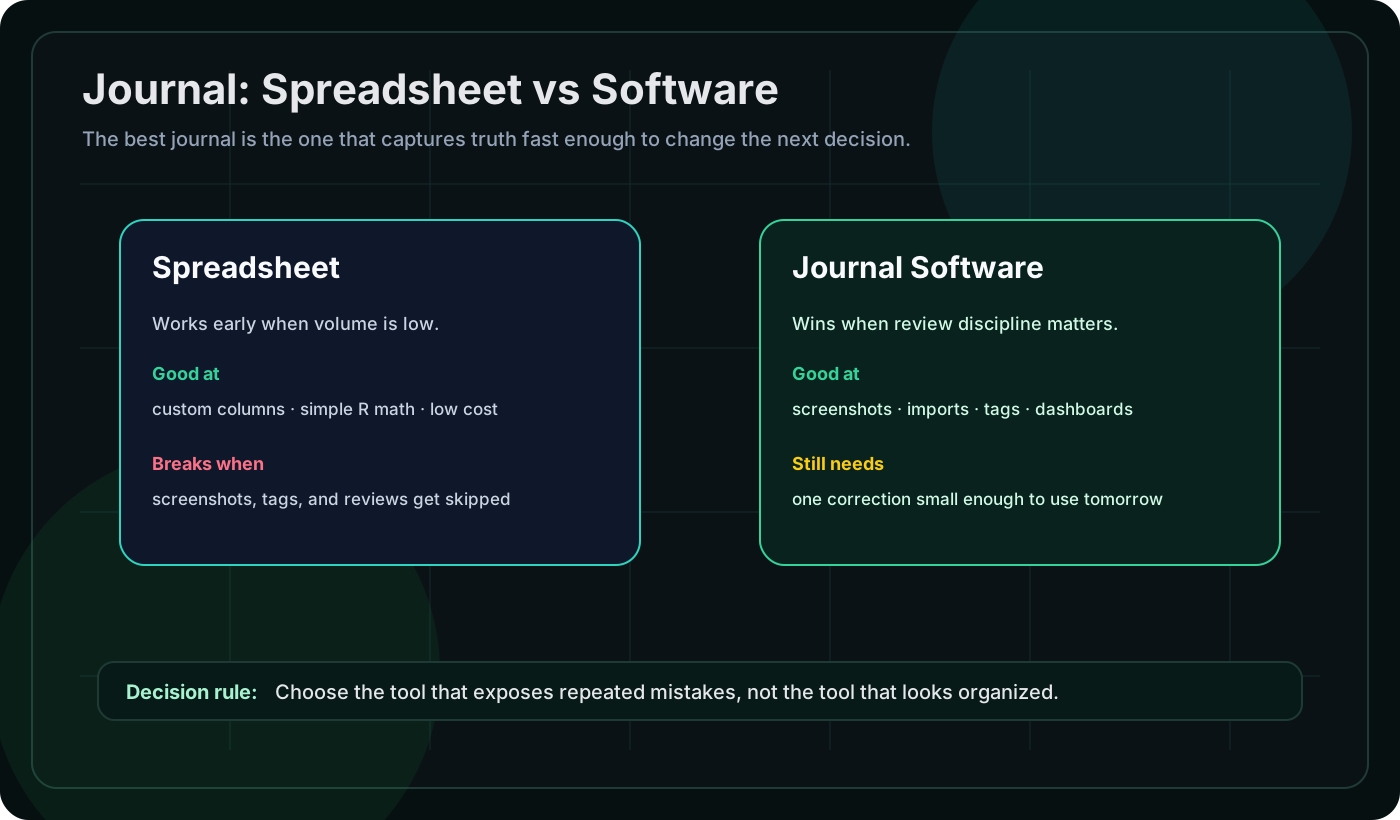
The one genuine spreadsheet advantage: it is free. If you are in your first month and not yet sure trading is for you, a spreadsheet is fine. But once you are past that stage and actively trying to improve, the friction becomes a bottleneck. My weekly review compliance went from 0% (months 4-8 in spreadsheet) to 100% in the first three months with software because the reviews were auto-generated.
When a Spreadsheet Is Still the Right Tool
I am not religious about software. If you are taking five simulated trades a week, a spreadsheet is enough. If you are testing whether trading fits your temperament, do not buy tools to cosplay seriousness. Use a sheet, track R, tag setups, write the mistake honestly, and see if you can keep the habit for 30 sessions.
But once real money is involved, friction becomes expensive. The moment you skip a losing trade because you do not feel like typing it in, the spreadsheet stopped being a journal and became a highlight reel. Highlight reels are for social media. They are poison for development.
When Your Journal Lies to You
A journal lies when only winners get screenshots, only losers get emotional notes, or every mistake gets filed under "bad luck." It also lies when your tags are too vague. "Long ES" is not a setup. "POC bounce, QPulse first candle, Flow Pro green, positive GEX" is a setup. One can be reviewed. The other is fog.
Journal Lie Detector
| Journal Entry Says | What It Hides | Fix |
|---|---|---|
| "Bad exit" | no rule for exiting | tag the exit error |
| "Good setup" | setup not defined | use playbook names |
| "Should have held" | target rules missing | score target adherence |
| "Choppy day" | ignored no-trade filter | track Flow Pro state |
The Nexural Journal auto-imports from NinjaTrader, calculates R-multiples, provides structured tagging and scoring, categorizes mistakes with checkboxes, and generates weekly reviews. It is the tool I wish I had from day one. See pricing or start free.
The final rule: if your journal cannot tell you which setup makes money, which mistake costs the most R, and which time of day turns you into an idiot, it is not a journal. It is a receipt drawer. Read The Psychology of Taking the Stop for the uncomfortable part: logging the loss is easy. Accepting what it says about you is the work.