Handbook / Trading asymmetrically
Position size in plain numbers
How much to put into one trade, worked out with simple math.
In one sentence
Decide how much money you are willing to lose first, and let that decide how big the trade is.
Why it matters
Most people pick a trade size by feel. Then one bad trade hurts too much.
If you risk only a small part of your account on each trade, a losing streak is a bump, not a disaster.
Our sizing rule: Default 1% of the account per trade, never more than 2%. Keep total open risk at 6% or less. After a 10% drawdown, risk no more than 1% per trade; at 15%, no more than 0.5%; at 20%, stop trading real money and review.
A drawdown is how far your account has fallen from its highest point. Sage's personal position sizes are his own and often larger than the rule we teach. This is not advice.
Do this
- Pick your risk per trade. For example, 1% of your account. On $10,000, 1% is $100. That is the most you plan to lose on this trade.
- Find your stop distance. Entry price minus stop price. If you buy at $50 and your stop is $48, the stop distance is $2 per share.
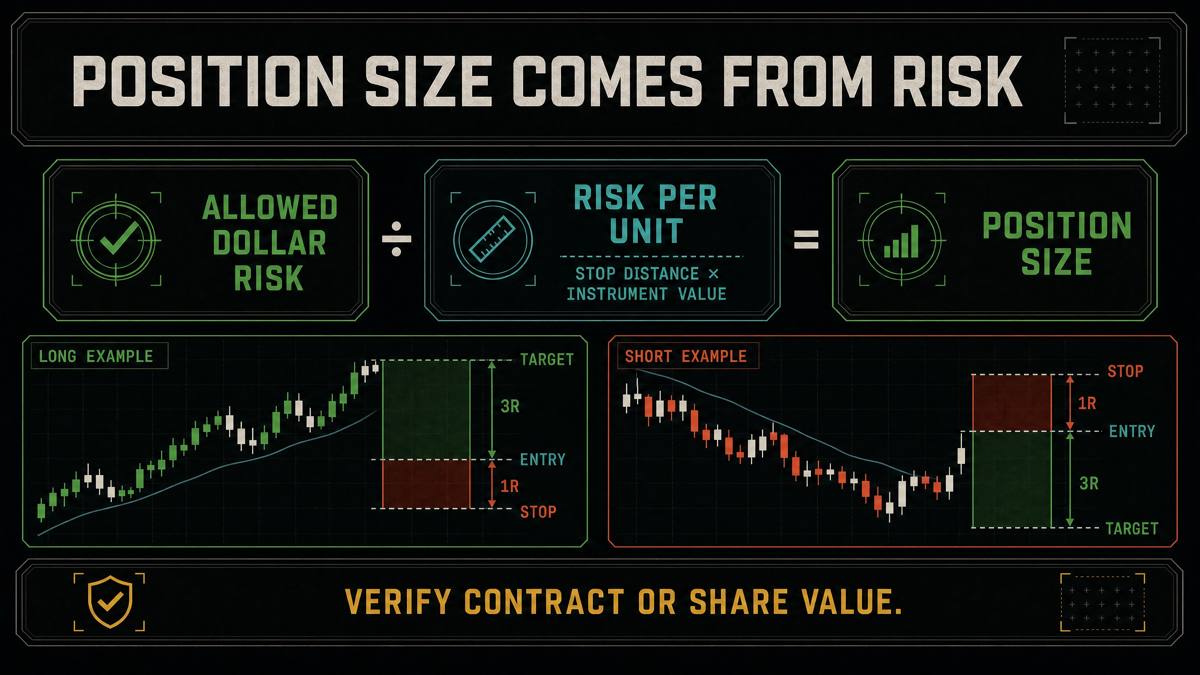
- Divide. Risk divided by stop distance equals the number of shares. $100 ÷ $2 = 50 shares.
- Check the total. 50 shares at $50 is $2,500 of stock. But if the stop works, you only lose about $100.
- Wider stop means fewer shares. If the stop were $5 away, you would buy only 20 shares.
- Remember gaps. Price can jump past your stop overnight or on news. Then you can lose more than planned. Leveraged funds and futures can move even faster.
Real example
This teaching diagram shows the same math: allowed dollar risk divided by risk per share equals position size. It is not a real trade.
From the book, chapter 13: with 1% risk, ten losses in a row still leaves about 90% of the account. With 10% risk, ten losses leaves about 35%. Read chapter 13 of the book for the full version.
Common mistakes
- Sizing by how sure you feel. Feeling sure does not make a trade safer. The book says the 2% limit matters most when you feel most confident.
- Moving the stop to fit a bigger size. The stop goes where the idea is wrong. Size comes after.
- Forgetting that small numbers add up. Five open trades at 2% each is 10% at risk at once. That is over the 6% limit.
- Counting related trades as separate bets. Three trades that tend to move together, like three chip stocks, are really one bet. If one falls, the others often fall too. Add their risk together.