Handbook / Trading asymmetrically
Small losses, bigger wins
Why you can lose more often than you win and still come out ahead.
In one sentence
Trading "asymmetrically" means your losses are small and your wins are bigger, so you can be wrong a lot and still make money.
Why it matters
Most people think a good trader wins most of the time. That is not what counts.
What counts is two numbers together: how often you win, and how big your wins are next to your losses. A trader who wins only 4 times in 10 can do well. A trader who wins 7 times in 10 can still lose money, if the losses are huge.
Do this
Here is how to check any set of trades. You only need four numbers.
- Count how often you win. Winning trades divided by all trades. This is your win rate.
- Find your average win. Add up the winning trades. Divide by how many there were.
- Find your average loss. Do the same for the losing trades.
- Do the math. Take (win rate × average win) and subtract (loss rate × average loss). If the answer is above zero, your wins more than pay for your losses, on average.
- Keep losses small on purpose. Use a stop on every trade, and only take trades where the target is far bigger than the stop.
A quick word we use: R means the amount you risked on a trade. If you risk $100 and make $250, that is +2.5R. If you lose the $100, that is −1R.
Real example
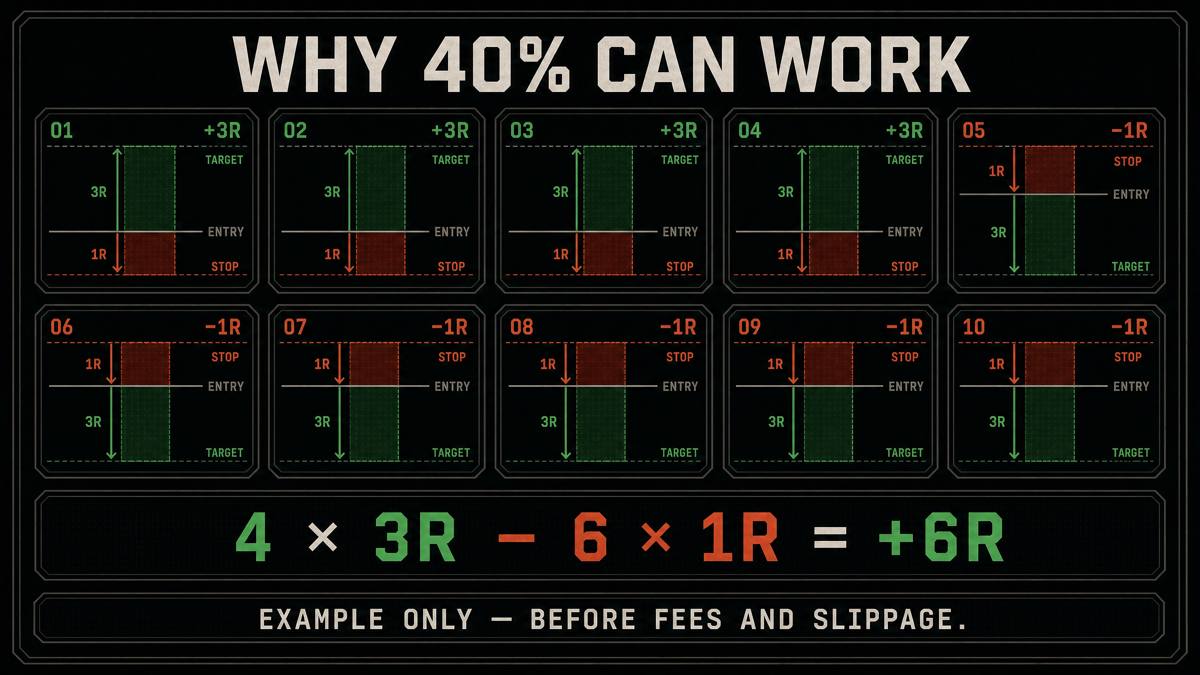
Example 1 — made-up round numbers. Say you win 4 trades in 10. Each win is +3R and each loss is −1R.
The math: 0.4 × 3 = 1.2. Then 0.6 × 1 = 0.6. So 1.2 − 0.6 = +0.6R per trade, before fees. You lost more often than you won, and still came out ahead.
Our system's trade ideas are scored the same way on the proof page. Those are hypothetical, not real trades. Check the live numbers there.
Example 2 — Sage's real account. This is a different record: his own real trades. His win rate is 65%. His average win is $6,189.89. His average loss is −$1,595.97. So his average win is about 3.9 times his average loss.
Here is one small loss and one big win from the same week:
- Shares
- 7,500
- Average cost
- $3.2181
- Sold at
- $3.17
- Shares
- 6,500
- Average cost
- $6.774
- Sold at
- $10.65
Common mistakes
- Chasing a high win rate. Taking small wins and big losses feels good, but loses money.
- Letting a loss grow. One big loss can erase many small wins. Honor the stop.
- Cutting winners too early. If you always sell at the first sign of profit, your wins stay small.
- Mixing up the two records. The /proof numbers are hypothetical ideas. The trade log is Sage's real account. See Trade log vs proof.