Handbook / STS — the Sage Trading System
Step 4: Is the trade worth it?
Set the stop, find the target, and only trade when the target is three times as far as the stop.
In one sentence
Before you enter, the target must be at least three times as far away as your stop, or you pass.
Why it matters
This is the math that makes STS work. If you win three dollars for every one dollar you risk, you can be wrong most of the time and still come out ahead.
With a 3 to 1 trade, one win covers three losses. That is why the rule is strict.
Do this
- Set the stop. Put it just past the level you are trading from. Or put it past the last swing low (for a buy) or swing high (for a sell) on the 3-minute chart. Pick the one that makes more sense.
- Set the target. Use the next level from Step 1 in the direction of the trade.
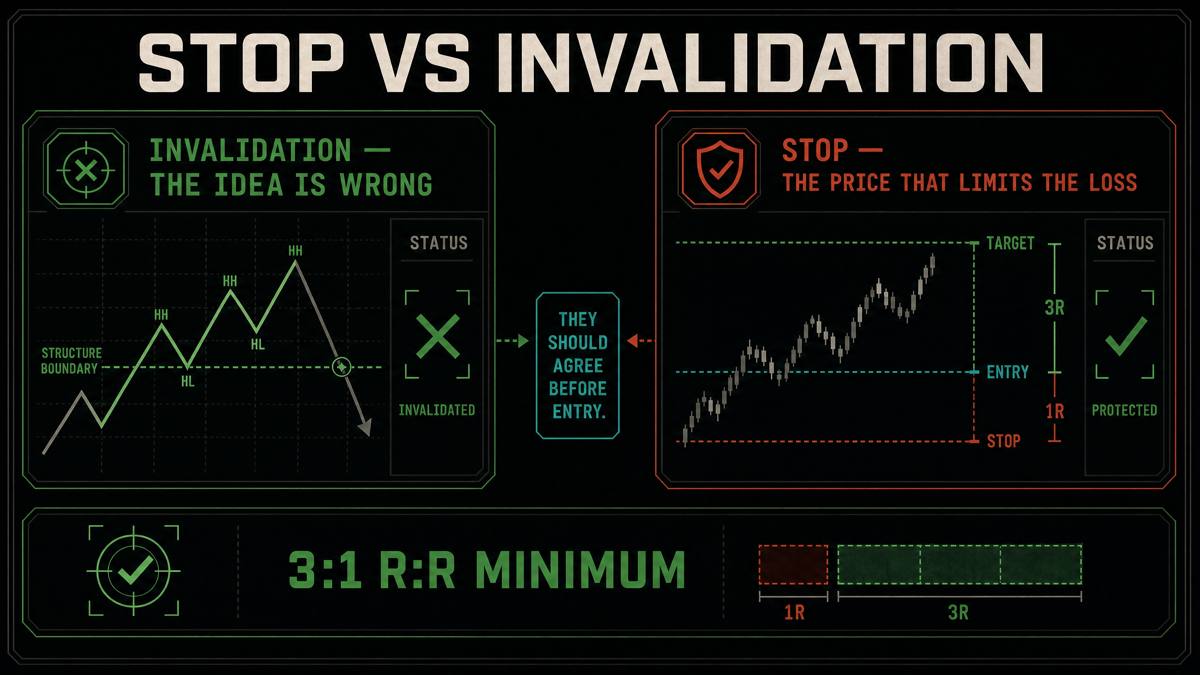
- Measure. Is the distance to the target at least three times the distance to the stop? If not, pass.
- Size it. Risk 1% of your account on a trade by default, and never more than 2%. In futures, STS uses 1 to 5 micro contracts. See Position size in plain numbers.
- Take some profit at each level. Sell part at the first target and part at the next. Let the last part run.
- Move the stop to your entry price once the first target is hit. Now the rest of the trade cannot turn into a loss, unless price jumps past your stop.
- Never move the stop further away. Only closer.
Real example
This teaching diagram shows a 3 to 1 trade: one part risk, three parts reward. It is not a real trade.

Common mistakes
- Adding to a winning trade. It raises your average price and shrinks your reward. Sage's rule: start with your position, sell in parts, never add.
- Setting the target first and the stop to fit. The stop goes where the idea is wrong, not where the math looks nice.
- Taking a 2 to 1 trade "just this once". The rule only works if you keep it.