Handbook / Indicators / Nexural Transform
Nexural Transform
A push reading with pattern labels that describe what may be happening at your level.
In one sentence
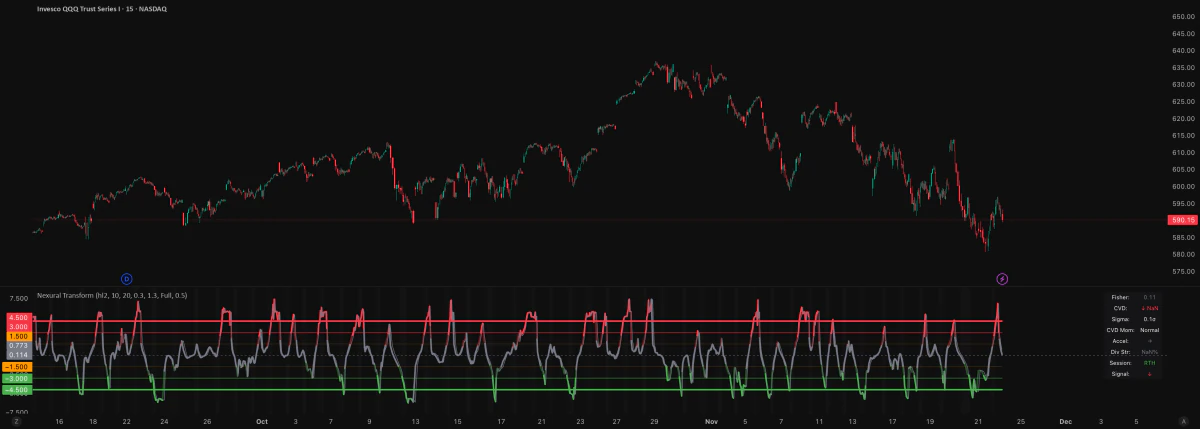
Nexural Transform mixes a push reading with CVD and pattern labels. It helps you describe what may be happening at a level you planned.
Why it matters
The main line shows push and stretch. CVD, the running total of buying minus selling volume, adds a buying or selling layer when smaller-bar data is there. Labels mark patterns. Absorption is heavy volume with little price move. A sweep is a quick run through a price area. A failed auction is a push that could not hold. Exhaustion means a move is running out of fuel. It also labels icebergs (possible hidden orders) and stacked imbalances.
Seven checks use price, volume, delta, and session-aware limits. A confidence score adds them up, but several checks may share the same inputs. Each label is a guess from chart data. Pair it with a set level and a type-of-market tool, like Regime Matrix.
Do this
- Set your level and the exact pattern question before you read labels.
- Compare the label with CVD, what price did, and the session.
- Wait for the pattern to last or be backed up. Do not react to the first print.
- Drop the pattern when price does the opposite of what it should.
Real example
This is a teaching example, not a real trade.
An absorption label prints at a floor. Selling volume grows, but price stops falling. The effort is not pushing price lower, which supports the absorption idea. Wait for buyers to show a clear response. If the floor breaks, the label did not make a real reversal.
Common mistakes
- Calling every label proof of big players.
- Ignoring what your data feed can and cannot see.
- Trading before price backs up the pattern.
What it can't do
Labels like iceberg, sweep, absorption, or smart money are guesses from chart data. They do not prove hidden orders or who is trading. They do not promise a reversal.