Handbook / Indicators / Nexural Delta Trend
Nexural Delta Trend
Shows the trend and asks if estimated buying or selling backs each turn.
In one sentence
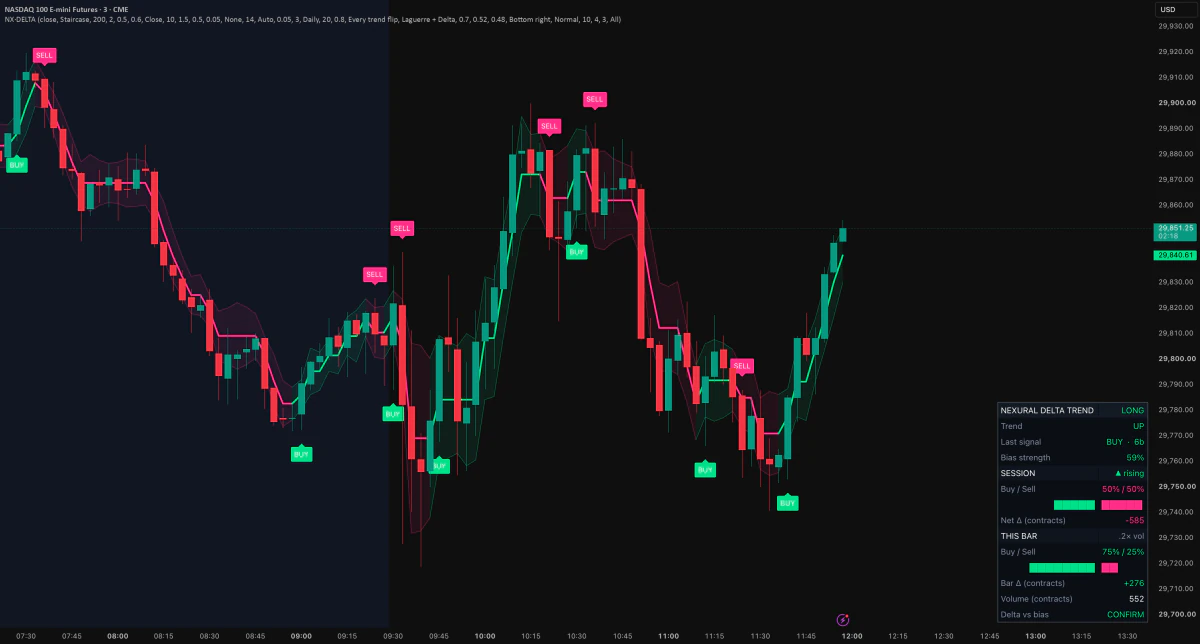
Delta Trend puts the trend and the buying or selling behind it on one chart. It asks if estimated volume backs each turn.
Why it matters
Delta is buying volume minus selling volume. Here it is an estimate. The tool sorts smaller bars inside each candle as up or down and adds their volume.
You can pick one of two trend modes. The Staircase mode only steps after price moves a set distance based on ATR (average true range, the normal size of a bar). The other mode reacts faster. Bands widen when price is noisy and tighten when it moves cleanly, to cut down on false flips.
Signals come in tiers. A plain flip is one tier. A flip with stronger volume support ranks higher. A panel shows the direction, the delta, whether they agree, and how busy trading is. Use it after you know the structure and your level, such as from Volume Profile.
Do this
- Choose one trend mode and one group of settings for one market, timeframe, and session.
- Wait for a flip on a closed bar, at a level you planned before the signal.
- Compare the signal with the delta panel. If they disagree, treat it as a warning, not a reason to flip sides.
- Set your stop, target, exit point, and size outside the tool. Then decide if the trade makes sense.
Real example
This is a teaching example, not a real trade.
Delta Trend flips bullish at a buy zone you marked earlier. But the panel shows bearish delta and weak trading on the closing bar. The direction changed, but the volume did not back it. That does not make it bearish. It just means the proof is not complete. Wait for price to hold and volume to improve, or pass. Do not trade bigger to make up for weak support.
Common mistakes
- Calling the delta estimate real trade-by-trade data.
- Taking every trend flip with no level in mind.
- Thinking a delta that disagrees means a sure reversal.
What it can't do
The delta is an estimate from smaller bars, not true buy and sell data. The trend engine can still lag or flip back and forth. A flip is not a full trade plan.