Handbook / Indicators / DI Pressure Pro
DI Pressure Pro
A quick read of which side is pushing, from the DI lines, candle shape, and estimated flow.
In one sentence
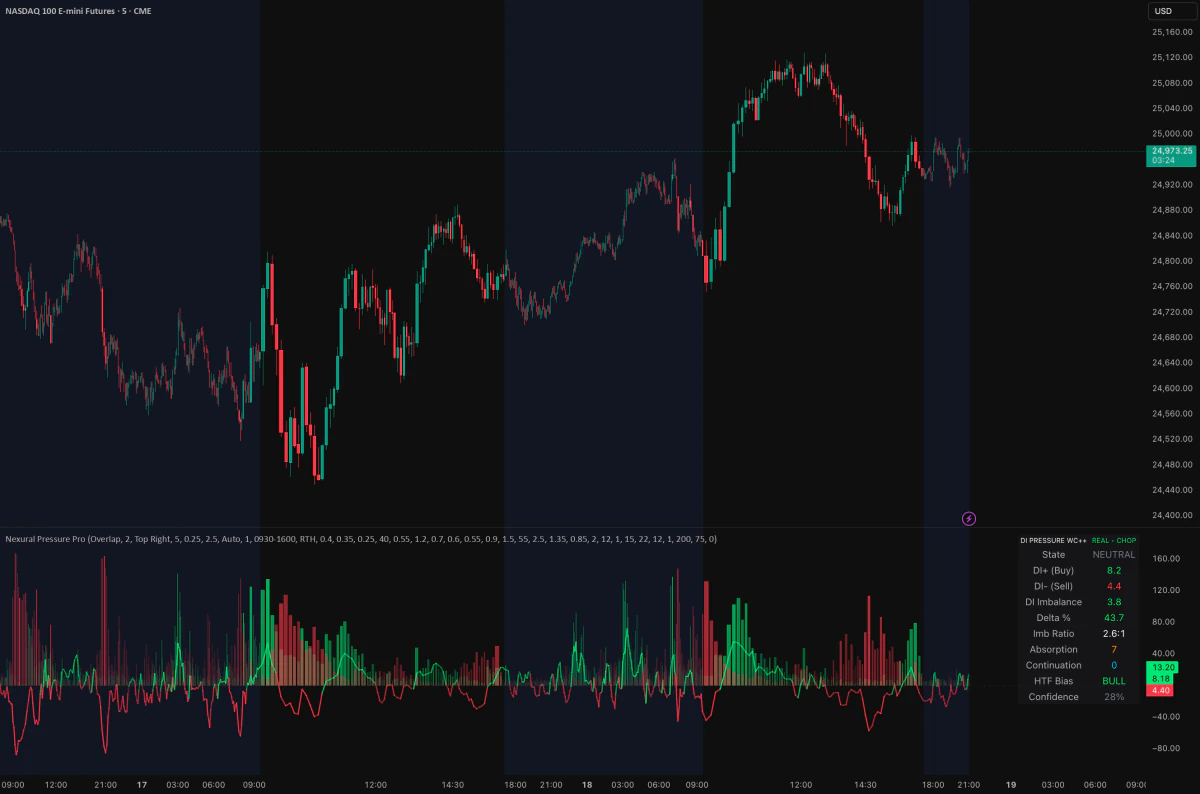
DI Pressure Pro gives you a quick read of which side is pushing. It mixes DI, candle shape, and a guess at order flow.
Why it matters
DI is the directional index, a reading of buying push against selling push. It makes up half of the score. Candle body and wick balance make up 30%. A guess at cumulative delta (the running total of buying minus selling volume) makes up the last 20%.
Every part comes from the same bars. So the score is one blend, not three separate checks. Use it as a quick check that the push is steady. Pair it with a real level and timing, from tools like Volume Profile and QPulse.
Do this
- Set the bigger chart's direction and your planned level.
- Compare DI push with how cleanly candles close and how their wicks look.
- Check if the running pressure lasts across several bars.
- Use the score as support. You still need your own timing, risk, and exit point.
Real example
This is a teaching example, not a real trade.
DI turns bullish. But candles close with long upper wicks, and the running pressure does not build. The parts disagree. DI got better, but the candles and the follow-through stay weak. Do not turn the bullish state into a trade. Wait for clean closes and steady pressure at a real level.
Common mistakes
- Calling the flow guess true trade-by-trade data.
- Reacting to one change in the score.
- Ignoring when the parts disagree.
- Acting on pressure with no exit point.
What it can't do
The flow here is a guess from candles and volume. It cannot replace real trade data. It is support for a trade, not a way to predict price. On TradingView it's called "Nexural Imbalance Pro." The link on this page goes there.