Handbook / Indicators / Nexural ORB
Nexural ORB
Maps the opening range and grades breaks and reclaims after the range is done.
In one sentence
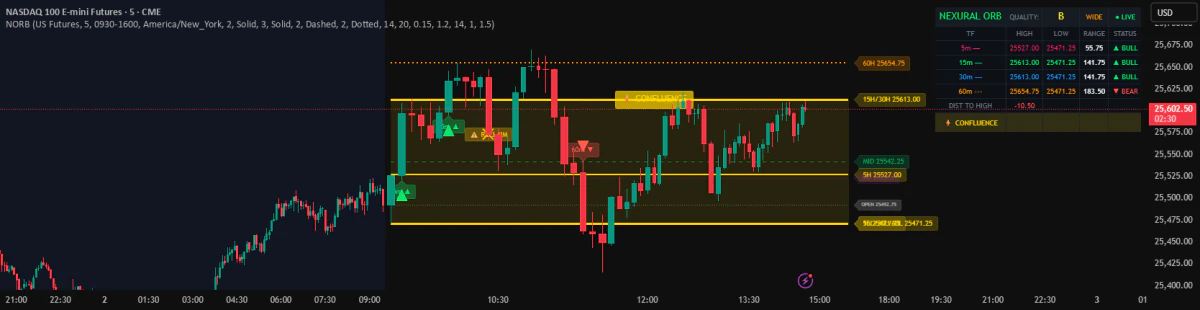
ORB maps the opening range breakout (ORB) area. It shows where the early range formed, how clean it is, and if a later break or reclaim is worth watching.
Why it matters
The opening range is the high and low of the first minutes of the session. ORB can show the 5, 15, 30, and 60 minute ranges together. Grades rate the range by how tight it is, its volume, the day of the week, and the overnight action.
It also marks breaks, reclaims (price coming back inside the range), overnight highs and lows, and targets at one and 1.5 times the range. It checks when range edges, overnight levels, and the session open line up. Volume and time filters cut weak break labels. They cannot stop false breaks.
Pair it with Regime Matrix or QVS Pro for the type of market. Add a trigger or pressure tool after the range forms.
Do this
- Pick your range window before the session opens.
- Wait until that range is done before you treat its edges as fixed.
- Compare a break or reclaim with volume, the type of market, and the overnight action.
- Place your exit point inside or beyond the range, based on the playbook you tested.
Real example
This is a teaching example, not a real trade.
A tight 15 minute range forms near the overnight high. Then price breaks above it on rising volume. The range quality supports a breakout idea, but the close and the hold above the edge still matter. Use your planned trigger and stop. If price drops right back inside the range, call it a failed break. Do not defend the story.
Common mistakes
- Trading before the range is done.
- Thinking an A grade means a sure trend day.
- Ignoring a fast drop back inside the range.
What it can't do
The range does not exist until its time window closes. A good grade or lined-up levels do not tell you direction or safe risk. How ranges behave changes a lot by market, session, and news.